
荷兰各市镇社区层面围产期发病率和死亡率的差异:一项基于人群的队列研究。
Differences in perinatal morbidity and mortality on the neighbourhood level in Dutch municipalities: a population based cohort study.
作者信息
Vos Amber A, Denktaş Semiha, Borsboom Gerard J J M, Bonsel Gouke J, Steegers Eric A P
机构信息
Department of Obstetrics and Gynecology, Division of Obstetrics & Prenatal Medicine, Erasmus MC, PO Box 2040, 3000 CA, Rotterdam, The Netherlands.
Department of Social Sciences, Erasmus University College, Erasmus University Rotterdam, PO Box 1738, 3000, DR, Rotterdam, The Netherlands.
出版信息
BMC Pregnancy Childbirth. 2015 Sep 2;15:201. doi: 10.1186/s12884-015-0628-7.
BACKGROUND
In a national perinatal health programme, we observed striking heterogeneity in the explanation of the most prominent risks across municipalities. Therefore we explored the separate contribution of several socio-demographic risks on perinatal health inequalities between municipalities and neighbourhoods. The study aims to identify perinatal health inequalities on the neighbourhood level across the selected municipalities, and to objectify the contribution of socio-demographic risk factors on pregnancy outcomes in each municipality by the application of the population attributable risk concept.
METHODS
Population based cohort study (2000-2008). Perinatal outcomes of 352,407 single pregnancies from 15 municipalities were analysed. Odds ratios and population attributable risks were calculated. Main outcomes were combined perinatal morbidity (small-for-gestational age, preterm birth, congenital anomalies, and low Apgar score), and perinatal mortality.
RESULTS
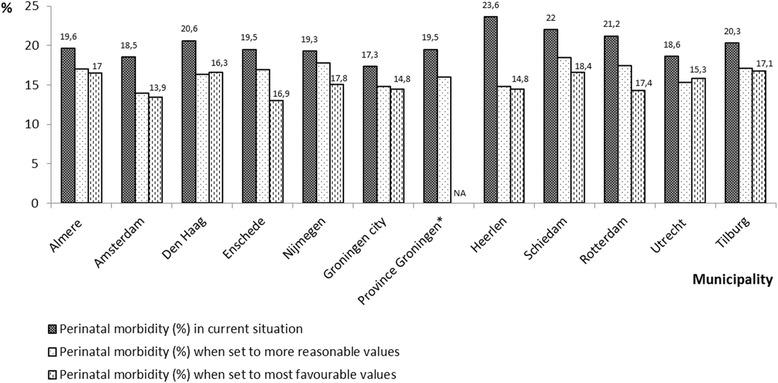
Perinatal health inequalities existed on both the municipal and the neighbourhood level. In municipalities, combined perinatal morbidity ranged from 17.3 to 23.6%, and perinatal mortality ranges from 10.1 to 15.4‰. Considerable differences in low socio-economic status between municipalities were apparent, with prevalences ranging from 14.4 to 82.5%. In seven municipalities, significant differences between neighbourhoods existed for perinatal morbidity (adjusted OR ranging from 1.33 to 2.38) and for perinatal mortality (adjusted OR ranging from 2.06 to 5.59). For some municipalities, socio-demographic risk factors were s a strong predictor for the observed inequalities, but in other municipalities these factors were very weak predictors. If all socio-demographic determinants were set to the most favourable value in a predictive model, combined perinatal morbidity would decrease with 15 to 39% in these municipalities.
CONCLUSIONS
Substantial differences in perinatal morbidity and mortality between municipalities and neighbourhoods exist. Different patterns of inequality suggest differences in etiology. Policy makers and healthcare professionals need to be informed about their local perinatal health profiles in order to introduce antenatal healthcare tailored to the individual and neighbourhood environment.
背景
在一项全国围产期健康计划中,我们观察到各市政当局对最主要风险的解释存在显著差异。因此,我们探讨了几种社会人口风险因素对市政当局和社区之间围产期健康不平等的单独影响。本研究旨在确定所选市政当局中社区层面的围产期健康不平等情况,并通过应用人群归因风险概念,客观评估社会人口风险因素对每个市政当局妊娠结局的影响。
方法
基于人群的队列研究(2000 - 2008年)。分析了来自15个市政当局的352,407例单胎妊娠的围产期结局。计算了比值比和人群归因风险。主要结局为合并围产期发病率(小于胎龄儿、早产、先天性异常和低阿氏评分)以及围产期死亡率。
结果
市政当局和社区层面均存在围产期健康不平等。在市政当局中,合并围产期发病率在17.3%至23.6%之间,围产期死亡率在10.1‰至15.4‰之间。市政当局之间社会经济地位低下的差异明显,患病率在14.4%至82.5%之间。在七个市政当局中,社区之间在围产期发病率(调整后的比值比在1.33至2.38之间)和围产期死亡率(调整后的比值比在2.06至5.59之间)方面存在显著差异。对于一些市政当局,社会人口风险因素是观察到的不平等的强预测因素,但在其他市政当局中,这些因素是非常弱的预测因素。如果在预测模型中将所有社会人口决定因素设定为最有利的值,这些市政当局的合并围产期发病率将降低15%至39%。
结论
市政当局和社区之间在围产期发病率和死亡率方面存在显著差异。不同的不平等模式表明病因存在差异。政策制定者和医疗保健专业人员需要了解当地的围产期健康状况,以便引入针对个人和社区环境的产前保健。
 Zotero 插件