
力竭性亚极量耐力和抗阻运动通过身体和氧化应激诱导暂时性免疫抑制。
Exhaustive submaximal endurance and resistance exercises induce temporary immunosuppression via physical and oxidative stress.
作者信息
Jin Chan-Ho, Paik Il-Young, Kwak Yi-Sub, Jee Yong-Seok, Kim Joo-Young
机构信息
Department of Leisure and Gaming, Hanseo University, Seosan, Korea.
Department of Physical Education, Yonsei University, Seoul, Korea.
出版信息
J Exerc Rehabil. 2015 Aug 30;11(4):198-203. doi: 10.12965/jer.150221. eCollection 2015 Aug.
UNLABELLED
Regular running and strength training are the best ways to improve aerobic capacity and develop the size of skeletal muscles. However, uncontrolled physical activities can often lead to an undertraining or over-training syndrome. In particular, overtraining causes persistent fatigue and reduces physical performance due to changes in the various physiological and immunological factors. In this study, we gave an exhaustive submaximal endurance or resistance exercise to participants and investigated the relationship between physical stress (cortisol level in blood), oxidative stress (intracellular ROS accumulation), and adaptive immune response (CD4:CD8 ratio).
MATERIALS AND METHODS
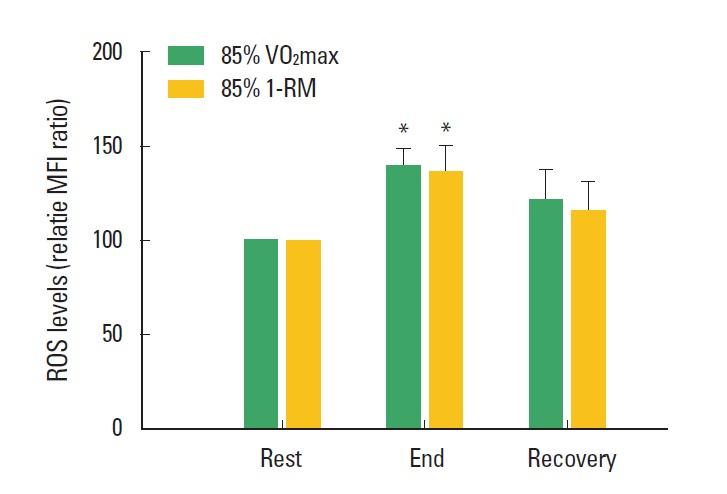
Ten male volunteers were recruited, and performed a submaximal endurance or resistance exercise with 85% of VO2max or 1-repetition maximum until exhaustion. Blood samples were collected at rest, and at 0 and 30 min after the exercise. Cortisol levels, oxidative stress, and immune cell phenotypes in peripheral blood were evaluated. Cortisol levels in the sera increased after the exhaustive endurance and resistance exercises and such increments were maintained through the recovery. Intra-cellular ROS levels also increased after the exhaustive endurance and resistance exercises. The ratio of CD4+ T cells to CD8+ T cells after each type of submaximal exercise decreased compared with that at the resting stage, and returned to the resting level at 30 min after the exercise. In this study, an exhaustive endurance or a resistance exercise with submaximal intensity caused excessive physical stress, intra-cellular oxidative stress, and post-exercise immunosuppression. This result suggests that excessive physical stress induced temporary immune dysfunction via physical and oxidative stress.
未标注
规律的跑步和力量训练是提高有氧能力和增加骨骼肌大小的最佳方法。然而,无节制的体育活动常常会导致训练不足或过度训练综合征。特别是,过度训练会导致持续疲劳,并由于各种生理和免疫因素的变化而降低身体表现。在本研究中,我们让参与者进行了力竭性次最大耐力或阻力运动,并研究了身体应激(血液中皮质醇水平)、氧化应激(细胞内活性氧积累)和适应性免疫反应(CD4:CD8比值)之间的关系。
材料与方法
招募了10名男性志愿者,让他们以最大摄氧量的85%或1次重复最大值进行次最大耐力或阻力运动,直至力竭。在休息时以及运动后0分钟和30分钟采集血样。评估外周血中的皮质醇水平、氧化应激和免疫细胞表型。力竭性耐力和阻力运动后血清中的皮质醇水平升高,且这种升高在恢复过程中持续存在。力竭性耐力和阻力运动后细胞内活性氧水平也升高。每种次最大运动后CD4+T细胞与CD8+T细胞的比值与静息阶段相比下降,并在运动后30分钟恢复到静息水平。在本研究中,次最大强度的力竭性耐力或阻力运动导致了过度的身体应激、细胞内氧化应激和运动后免疫抑制。这一结果表明,过度的身体应激通过身体和氧化应激诱导了暂时的免疫功能障碍。


 Zotero 插件