
侵袭性乳腺癌细胞产生的白细胞介素-1β是通过趋化因子产生来决定其与间充质干细胞相互作用的因素之一。
IL-1β produced by aggressive breast cancer cells is one of the factors that dictate their interactions with mesenchymal stem cells through chemokine production.
作者信息
Escobar Pauline, Bouclier Céline, Serret Julien, Bièche Ivan, Brigitte Madly, Caicedo Andres, Sanchez Elodie, Vacher Sophie, Vignais Marie-Luce, Bourin Philippe, Geneviève David, Molina Franck, Jorgensen Christian, Lazennec Gwendal
机构信息
INSERM, U844, U1183, Montpellier, F-34091, France.
CNRS, SYS2DIAG, Cap Delta, Montpellier, F-34184, France.
出版信息
Oncotarget. 2015 Oct 6;6(30):29034-47. doi: 10.18632/oncotarget.4732.
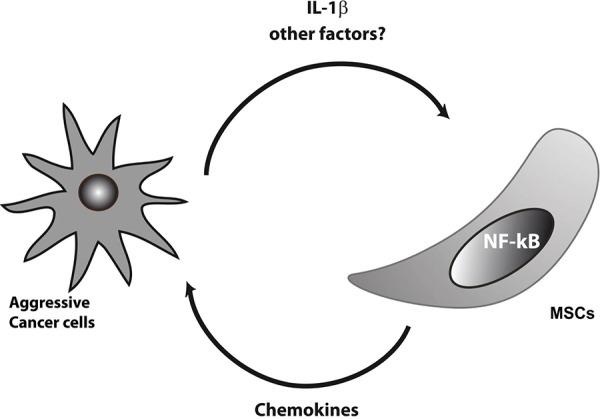
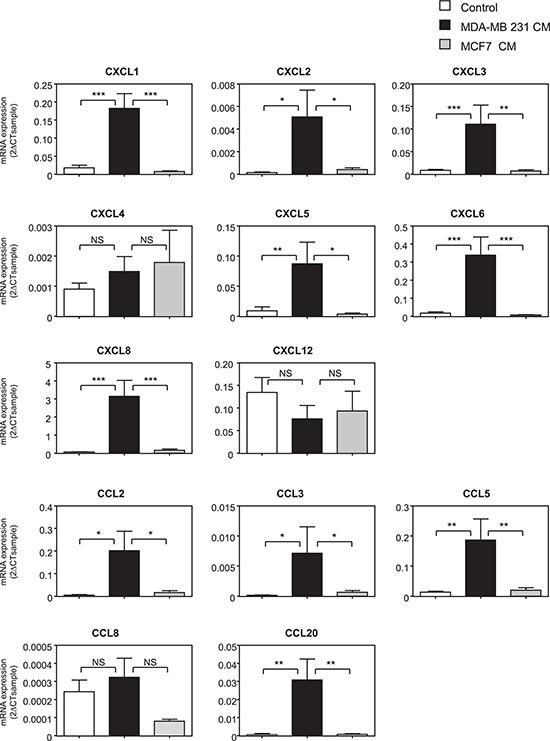
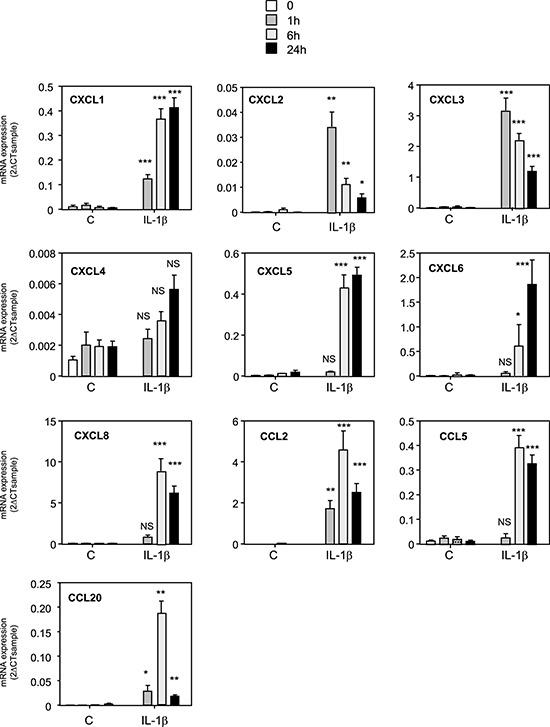
The aim of this work was to understand whether the nature of breast cancer cells could modify the nature of the dialog of mesenchymal stem cells (MSCs) with cancer cells. By treating MSCs with the conditioned medium of metastatic Estrogen-receptor (ER)-negative MDA-MB-231, or non-metastatic ER-positive MCF-7 breast cancer cells, we observed that a number of chemokines were produced at higher levels by MSCs treated with MDA-MB-231 conditioned medium (CM). MDA-MB-231 cells were able to induce NF-κB signaling in MSC cells. This was shown by the use of a NF-kB chemical inhibitor or an IκB dominant negative mutant, nuclear translocation of p65 and induction of NF-κB signature. Our results suggest that MDA-MB-231 cells exert their effects on MSCs through the secretion of IL-1β, that activates MSCs and induces the same chemokines as the MDA-MB-231CM. In addition, inhibition of IL-1β secretion in the MDA-MB-231 cells reduces the induced production of a panel of chemokines by MSCs, as well the motility of MDA-MB-231 cells. Our data suggest that aggressive breast cancer cells secrete IL-1β, which increases the production of chemokines by MSCs.
这项工作的目的是了解乳腺癌细胞的性质是否会改变间充质干细胞(MSC)与癌细胞对话的性质。通过用转移性雌激素受体(ER)阴性的MDA-MB-231或非转移性ER阳性的MCF-7乳腺癌细胞的条件培养基处理MSC,我们观察到,用MDA-MB-231条件培养基(CM)处理的MSC产生的一些趋化因子水平更高。MDA-MB-231细胞能够在MSC细胞中诱导NF-κB信号传导。这通过使用NF-κB化学抑制剂或IκB显性负突变体、p65的核转位以及NF-κB特征的诱导得以证明。我们的结果表明,MDA-MB-231细胞通过分泌IL-1β对MSC发挥作用,IL-1β可激活MSC并诱导与MDA-MB-231CM相同的趋化因子。此外,抑制MDA-MB-231细胞中IL-1β的分泌会降低MSC诱导产生的一组趋化因子的水平,以及MDA-MB-231细胞的运动能力。我们的数据表明,侵袭性乳腺癌细胞分泌IL-1β,这会增加MSC产生趋化因子的量。



 Zotero 插件