
免疫受体Tim-3在健康和恶性人类髓系细胞中的差异表达及生化活性
Differential expression and biochemical activity of the immune receptor Tim-3 in healthy and malignant human myeloid cells.
作者信息
Gonçalves Silva Isabel, Gibbs Bernhard F, Bardelli Marco, Varani Luca, Sumbayev Vadim V
机构信息
School of Pharmacy, University of Kent, Kent, ME4 4TB, United Kingdom.
Institute for Research in Biomedicine, Universita' della Svizzera Italiana (USI) 6500 Bellinzona, Switzerland.
出版信息
Oncotarget. 2015 Oct 20;6(32):33823-33. doi: 10.18632/oncotarget.5257.
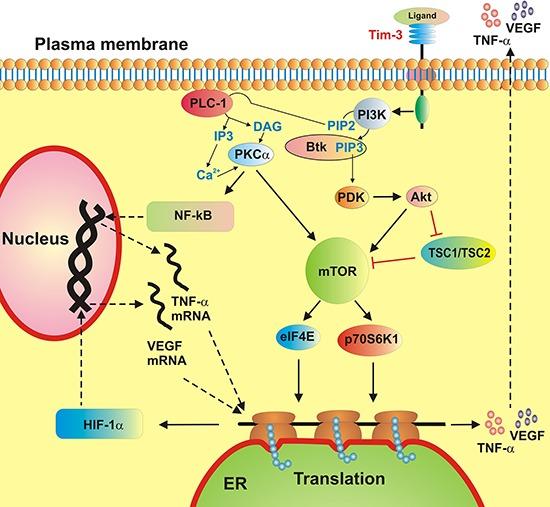
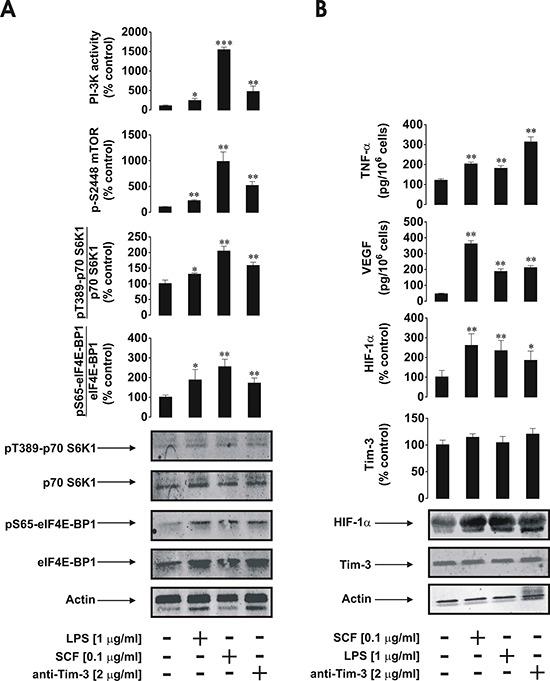
The T cell immunoglobulin and mucin domain 3 (Tim-3) is a plasma membrane-associated receptor which is involved in a variety of biological responses in human immune cells. It is highly expressed in most acute myeloid leukaemia (AML) cells and therefore may serve as a possible target for AML therapy. However, its biochemical activities in primary human AML cells remain unclear. We therefore analysed the total expression and surface presence of the Tim-3 receptor in primary human AML blasts and healthy primary human leukocytes isolated from human blood. We found that Tim-3 expression was significantly higher in primary AML cells compared to primary healthy leukocytes. Tim-3 receptor molecules were distributed largely on the surface of primary AML cells, whereas in healthy leukocytes Tim-3 protein was mainly expressed intracellularly. In primary human AML blasts, both Tim-3 agonistic antibody and galectin-9 (a Tim-3 natural ligand) significantly upregulated mTOR pathway activity. This was in line with increased accumulation of hypoxia-inducible factor 1 alpha (HIF-1α) and secretion of VEGF and TNF-α. Similar results were obtained in primary human healthy leukocytes. Importantly, in both types of primary cells, Tim-3-mediated effects were compared with those induced by lipopolysaccharide (LPS) and stem cell factor (SCF). Tim-3 induced comparatively moderate responses in both AML cells and healthy leukocytes. However, Tim-3, like LPS, mediated the release of both TNF-α and VEGF, while SCF induced mostly VEGF secretion and did not upregulate TNF-α release.
T细胞免疫球蛋白和粘蛋白结构域3(Tim-3)是一种与质膜相关的受体,参与人类免疫细胞的多种生物学反应。它在大多数急性髓系白血病(AML)细胞中高度表达,因此可能成为AML治疗的一个潜在靶点。然而,其在原代人类AML细胞中的生化活性仍不清楚。因此,我们分析了从人血液中分离的原代人类AML原始细胞和健康原代人类白细胞中Tim-3受体的总表达和表面存在情况。我们发现,与原代健康白细胞相比,原代AML细胞中Tim-3的表达明显更高。Tim-3受体分子主要分布在原代AML细胞表面,而在健康白细胞中,Tim-3蛋白主要在细胞内表达。在原代人类AML原始细胞中,Tim-3激动性抗体和半乳糖凝集素-9(Tim-3的天然配体)均显著上调mTOR通路活性。这与缺氧诱导因子1α(HIF-1α)积累增加以及VEGF和TNF-α分泌增加一致。在原代人类健康白细胞中也获得了类似结果。重要的是,在这两种原代细胞中,将Tim-3介导的效应与脂多糖(LPS)和干细胞因子(SCF)诱导的效应进行了比较。Tim-3在AML细胞和健康白细胞中均诱导相对适度的反应。然而,Tim-3与LPS一样,介导了TNF-α和VEGF的释放,而SCF主要诱导VEGF分泌,并未上调TNF-α的释放。



 Zotero 插件