
水杨酸会引起芒果果实的变化,从而影响桔小实蝇的产卵行为和发育。
Salicylic Acid Induces Changes in Mango Fruit that Affect Oviposition Behavior and Development of the Oriental Fruit Fly, Bactrocera dorsalis.
作者信息
Pagadala Damodaram Kamala Jayanthi, Aurade Ravindra Mahadappa, Kempraj Vivek, Roy Tapas Kumar, Shivashankara Kodthalu Seetharamaiah, Verghese Abraham
机构信息
National Fellow Lab, Division of Entomology and Nematology, Indian Institute of Horticultural Research, Hessaraghatta Lake PO, Bangalore, Karnataka, India.
Division of Plant Physiology and Biochemistry, Indian Institute of Horticultural Research, Hessaraghatta Lake PO, Bangalore, Karnataka, India.
出版信息
PLoS One. 2015 Sep 30;10(9):e0139124. doi: 10.1371/journal.pone.0139124. eCollection 2015.
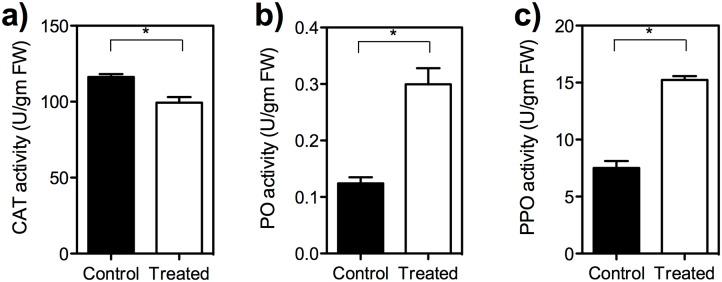
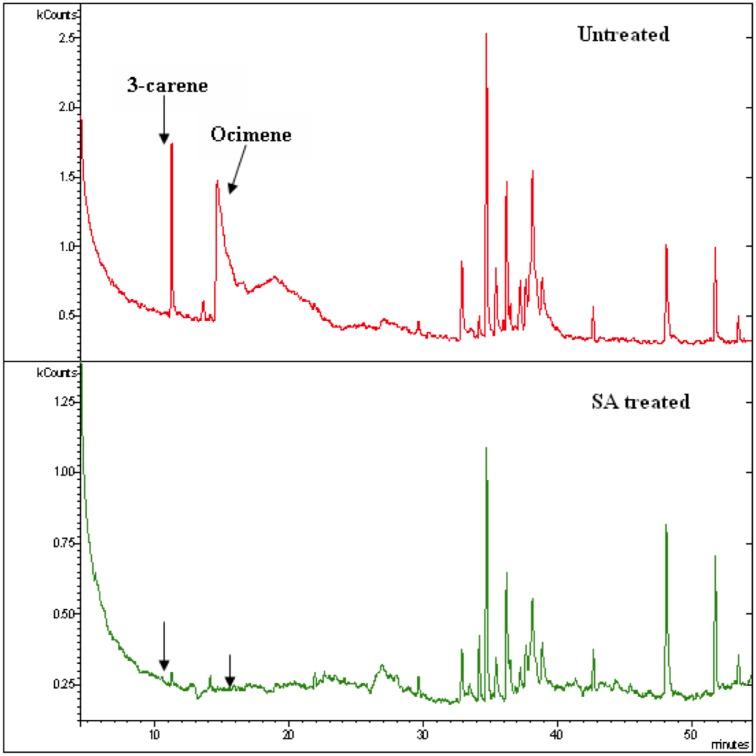
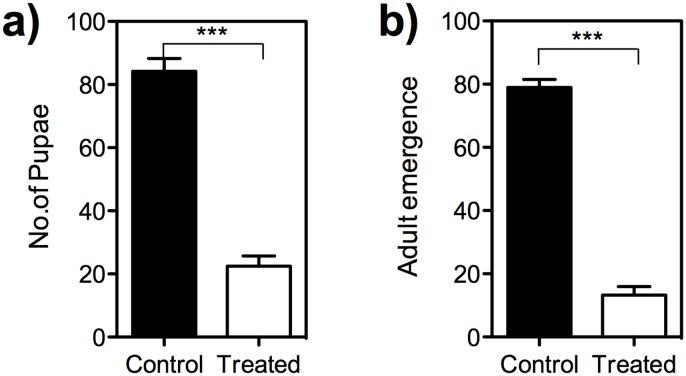
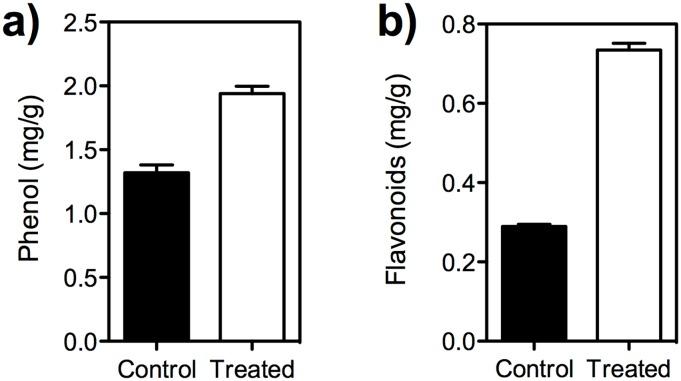
The Oriental fruit fly, Bactrocera dorsalis (Hendel) is an important quarantine pest around the globe. Although measures for its control are implemented worldwide through IPM and male annihilation, there is little effect on their population. Hence, there is a need for new strategies to control this minacious pest. A strategy that has received negligible attention is the induction of 'natural plant defenses' by phytohormones. In this study, we investigated the effect of salicylic acid (SA) treatment of mango fruit (cv. Totapuri) on oviposition and larval development of B. dorsalis. In oviposition choice assays, gravid females laid significantly less eggs in SA treated compared to untreated fruit. Headspace volatiles collected from SA treated fruit were less attractive to gravid females compared to volatiles from untreated fruit. GC-MS analysis of the headspace volatiles from SA treated and untreated fruit showed noticeable changes in their chemical compositions. Cis-ocimene and 3-carene (attractants to B. dorsalis) were reduced in the headspace volatiles of treated fruit. Further, reduced pupae formation and adult emergence was observed in treated fruit compared to control. Increased phenol and flavonoid content was recorded in treated fruit. We also observed differential expression of anti-oxidative enzymes namely catalase (CAT), polyphenoloxidase (PPO) and peroxidase (POD). In summary, the results indicate that SA treatment reduced oviposition, larval development and adult emergence of B. dorsalis and suggest a role of SA in enhancing mango tolerance to B. dorsalis.
桔小实蝇,即橘小实蝇(亨德尔),是全球重要的检疫性害虫。尽管通过综合防治和雄性诱杀在全球范围内实施了防治措施,但其种群数量几乎没有受到影响。因此,需要新的策略来控制这种有害害虫。一种受到极少关注的策略是通过植物激素诱导“天然植物防御”。在本研究中,我们研究了水杨酸(SA)处理芒果果实(品种:Totapuri)对桔小实蝇产卵和幼虫发育的影响。在产卵选择试验中,与未处理的果实相比,在经SA处理的果实上产卵的怀孕雌蝇显著减少。与未处理果实的挥发物相比,从经SA处理的果实中收集的顶空挥发物对怀孕雌蝇的吸引力较小。对经SA处理和未处理果实的顶空挥发物进行气相色谱-质谱分析表明,它们的化学成分有明显变化。顺式罗勒烯和3-蒈烯(桔小实蝇的引诱剂)在处理果实的顶空挥发物中减少。此外,与对照相比,在处理的果实中观察到蛹形成和成虫羽化减少。处理果实中的酚类和黄酮类含量增加。我们还观察到抗氧化酶即过氧化氢酶(CAT)、多酚氧化酶(PPO)和过氧化物酶(POD)的差异表达。总之,结果表明SA处理减少了桔小实蝇的产卵、幼虫发育和成虫羽化,并表明SA在增强芒果对桔小实蝇的耐受性方面发挥了作用。


 Zotero 插件