
三维基质纤维排列通过在空间和时间上引导突起调节细胞迁移和MT1-MMP的作用。
Three-dimensional matrix fiber alignment modulates cell migration and MT1-MMP utility by spatially and temporally directing protrusions.
作者信息
Fraley Stephanie I, Wu Pei-Hsun, He Lijuan, Feng Yunfeng, Krisnamurthy Ranjini, Longmore Gregory D, Wirtz Denis
机构信息
Department of Bioengineering, University of California San Diego, La Jolla, California 92093, USA.
Department of Chemical and Biomolecular Engineering, The Johns Hopkins University, Baltimore, Maryland 21218, USA.
出版信息
Sci Rep. 2015 Oct 1;5:14580. doi: 10.1038/srep14580.
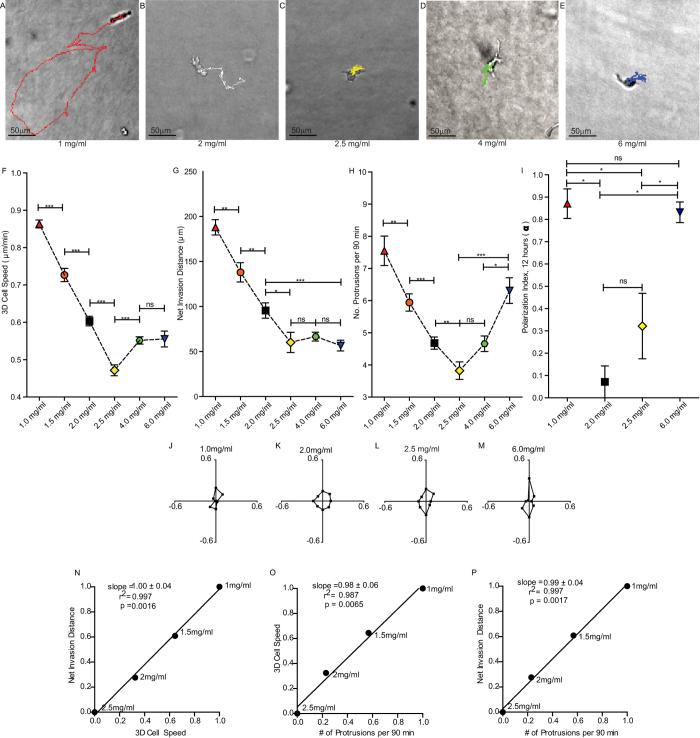
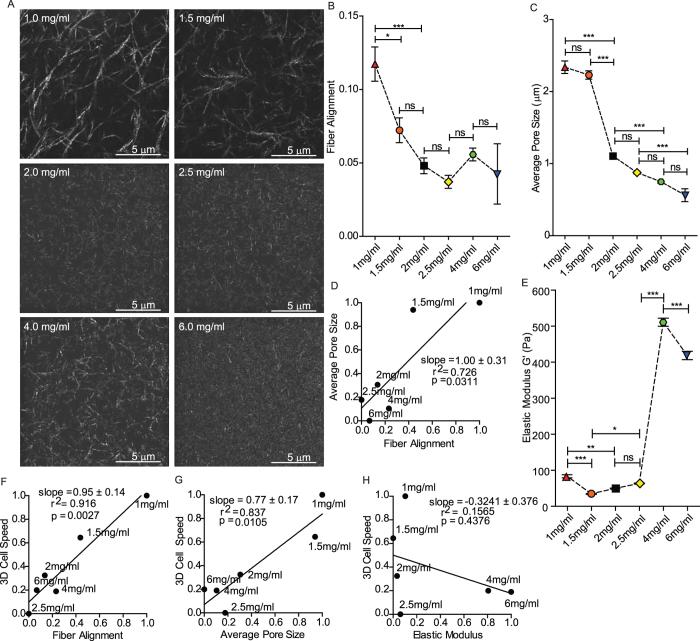
Multiple attributes of the three-dimensional (3D) extracellular matrix (ECM) have been independently implicated as regulators of cell motility, including pore size, crosslink density, structural organization, and stiffness. However, these parameters cannot be independently varied within a complex 3D ECM protein network. We present an integrated, quantitative study of these parameters across a broad range of complex matrix configurations using self-assembling 3D collagen and show how each parameter relates to the others and to cell motility. Increasing collagen density resulted in a decrease and then an increase in both pore size and fiber alignment, which both correlated significantly with cell motility but not bulk matrix stiffness within the range tested. However, using the crosslinking enzyme Transglutaminase II to alter microstructure independently of density revealed that motility is most significantly predicted by fiber alignment. Cellular protrusion rate, protrusion orientation, speed of migration, and invasion distance showed coupled biphasic responses to increasing collagen density not predicted by 2D models or by stiffness, but instead by fiber alignment. The requirement of matrix metalloproteinase (MMP) activity was also observed to depend on microstructure, and a threshold of MMP utility was identified. Our results suggest that fiber topography guides protrusions and thereby MMP activity and motility.
三维(3D)细胞外基质(ECM)的多种属性已被独立地认为是细胞运动的调节因子,包括孔径、交联密度、结构组织和硬度。然而,在复杂的3D ECM蛋白网络中,这些参数无法独立变化。我们使用自组装3D胶原蛋白,对广泛的复杂基质构型中的这些参数进行了综合定量研究,并展示了每个参数如何相互关联以及与细胞运动的关系。胶原蛋白密度增加导致孔径和纤维排列先减小后增加,在测试范围内,这两者均与细胞运动显著相关,但与整体基质硬度无关。然而,使用交联酶转谷氨酰胺酶II独立于密度改变微观结构表明,运动性最显著地由纤维排列预测。细胞突起速率、突起方向、迁移速度和侵袭距离对胶原蛋白密度增加表现出耦合的双相反应,这不是二维模型或硬度所预测的,而是由纤维排列预测的。还观察到基质金属蛋白酶(MMP)活性的需求取决于微观结构,并确定了MMP效用的阈值。我们的结果表明,纤维拓扑结构引导突起,从而影响MMP活性和运动性。


 Zotero 插件