
通过肿瘤区域增强与分割提高脑肿瘤分类性能
Enhanced Performance of Brain Tumor Classification via Tumor Region Augmentation and Partition.
作者信息
Cheng Jun, Huang Wei, Cao Shuangliang, Yang Ru, Yang Wei, Yun Zhaoqiang, Wang Zhijian, Feng Qianjin
机构信息
School of Biomedical Engineering, Southern Medical University, Guangzhou, China.
Department of Obstetrics and Gynecology, Nanfang Hospital of Southern Medical University, Guangzhou, China.
出版信息
PLoS One. 2015 Oct 8;10(10):e0140381. doi: 10.1371/journal.pone.0140381. eCollection 2015.
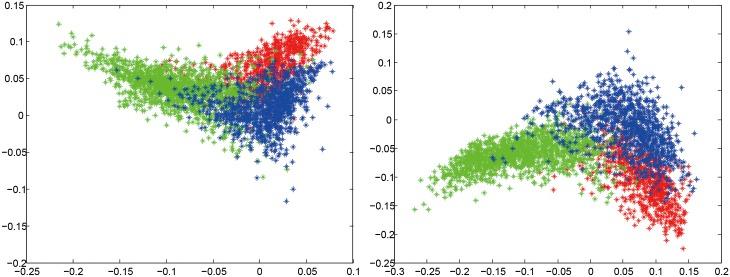
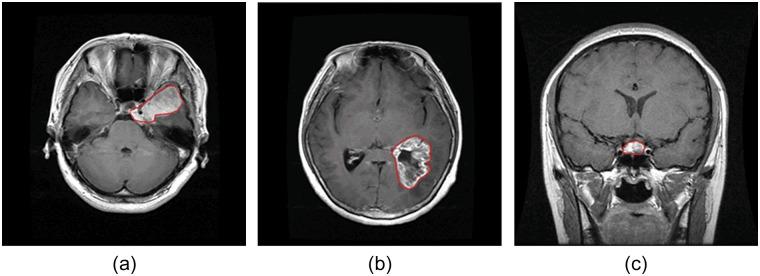
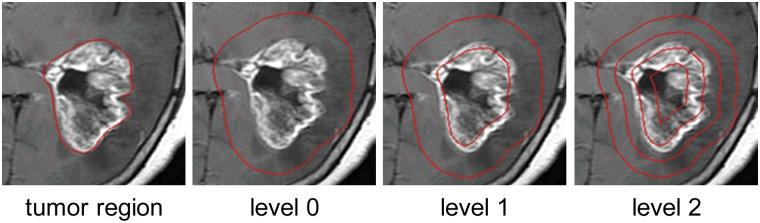
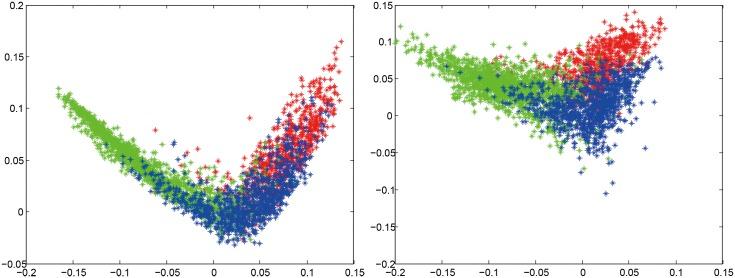
Automatic classification of tissue types of region of interest (ROI) plays an important role in computer-aided diagnosis. In the current study, we focus on the classification of three types of brain tumors (i.e., meningioma, glioma, and pituitary tumor) in T1-weighted contrast-enhanced MRI (CE-MRI) images. Spatial pyramid matching (SPM), which splits the image into increasingly fine rectangular subregions and computes histograms of local features from each subregion, exhibits excellent results for natural scene classification. However, this approach is not applicable for brain tumors, because of the great variations in tumor shape and size. In this paper, we propose a method to enhance the classification performance. First, the augmented tumor region via image dilation is used as the ROI instead of the original tumor region because tumor surrounding tissues can also offer important clues for tumor types. Second, the augmented tumor region is split into increasingly fine ring-form subregions. We evaluate the efficacy of the proposed method on a large dataset with three feature extraction methods, namely, intensity histogram, gray level co-occurrence matrix (GLCM), and bag-of-words (BoW) model. Compared with using tumor region as ROI, using augmented tumor region as ROI improves the accuracies to 82.31% from 71.39%, 84.75% from 78.18%, and 88.19% from 83.54% for intensity histogram, GLCM, and BoW model, respectively. In addition to region augmentation, ring-form partition can further improve the accuracies up to 87.54%, 89.72%, and 91.28%. These experimental results demonstrate that the proposed method is feasible and effective for the classification of brain tumors in T1-weighted CE-MRI.
感兴趣区域(ROI)的组织类型自动分类在计算机辅助诊断中起着重要作用。在当前研究中,我们专注于在T1加权对比增强磁共振成像(CE-MRI)图像中对三种脑肿瘤(即脑膜瘤、胶质瘤和垂体瘤)进行分类。空间金字塔匹配(SPM)将图像分割成越来越精细的矩形子区域,并计算每个子区域的局部特征直方图,在自然场景分类中表现出优异的结果。然而,由于肿瘤形状和大小的巨大差异,这种方法不适用于脑肿瘤。在本文中,我们提出了一种提高分类性能的方法。首先,通过图像膨胀得到的增强肿瘤区域被用作ROI,而不是原始肿瘤区域,因为肿瘤周围组织也可以为肿瘤类型提供重要线索。其次,将增强肿瘤区域分割成越来越精细的环形子区域。我们使用三种特征提取方法,即强度直方图、灰度共生矩阵(GLCM)和词袋(BoW)模型,在一个大型数据集上评估了所提方法的有效性。与使用肿瘤区域作为ROI相比,使用增强肿瘤区域作为ROI时,强度直方图、GLCM和BoW模型的准确率分别从71.39%提高到82.31%、从78.18%提高到84.75%、从83.54%提高到88.19%。除了区域增强之外,环形分割可以进一步将准确率提高到87.54%、89.72%和91.28%。这些实验结果表明,所提方法对于T1加权CE-MRI中的脑肿瘤分类是可行且有效的。

 Zotero 插件