
评估通过平板电脑提供的居家锻炼计划对预防社区居住的老年人跌倒超过2年的有效性:“昂首挺立”随机对照试验的研究方案。
Evaluating the effectiveness of a home-based exercise programme delivered through a tablet computer for preventing falls in older community-dwelling people over 2 years: study protocol for the Standing Tall randomised controlled trial.
作者信息
Delbaere K, Valenzuela T, Woodbury A, Davies T, Yeong J, Steffens D, Miles L, Pickett L, Zijlstra G A R, Clemson L, Close J C T, Howard K, Lord S R
机构信息
Neuroscience Research Australia, University of New South Wales, Sydney, New South Wales, Australia.
Department of Health Services Research-Focusing on Chronic Care and Ageing, CAPHRI School for Public Health and Primary Care, Maastricht University, Maastricht, The Netherlands.
出版信息
BMJ Open. 2015 Oct 22;5(10):e009173. doi: 10.1136/bmjopen-2015-009173.
INTRODUCTION
In order to prevent falls, older people should exercise for at least 2 h per week for 6 months, with a strong focus on balance exercises. This article describes the design of a randomised controlled trial to evaluate the effectiveness of a home-based exercise programme delivered through a tablet computer to prevent falls in older people.
METHODS AND ANALYSIS
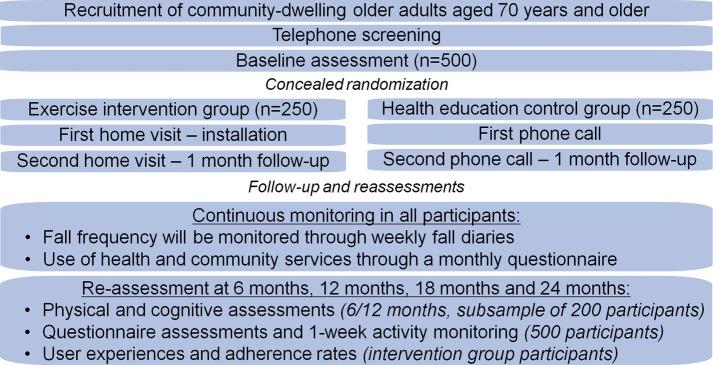
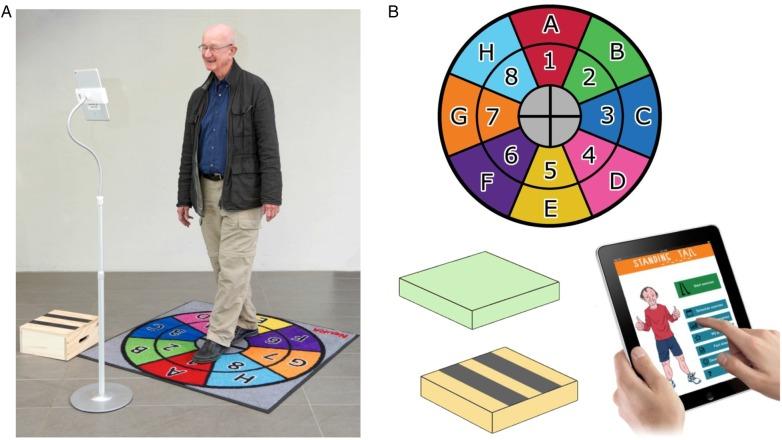
Participants aged 70 years or older, living in the community in Sydney will be recruited and randomly allocated to an intervention or control group. The intervention consists of a tailored, home-based balance training delivered through a tablet computer. Intervention participants will be asked to complete 2 h of exercises per week for 2 years. Both groups will receive an education programme focused on health-related information relevant to older adults, delivered through the tablet computer via weekly fact sheets. Primary outcome measures include number of fallers and falls rate recorded in weekly fall diaries at 12 months. A sample size of 500 will be necessary to see an effect on falls rate. Secondary outcome measures include concern about falling, depressive symptoms, health-related quality of life and physical activity levels (in all 500 participants); and physiological fall risk, balance, functional mobility, gait, stepping and cognitive performance (in a subsample of 200 participants). Adherence, acceptability, usability and enjoyment will be recorded in intervention group participants over 2 years. Data will be analysed using the intention-to-treat principle. Secondary analyses are planned in people with greater adherence. Economic analyses will be assessed from a health and community care provider perspective.
ETHICS AND DISSEMINATION
Ethical approval was obtained from UNSW Ethics Committee in December 2014 (ref number HC#14/266). Outcomes will be disseminated through publication in peer-reviewed journals and presentations at international conferences.
TRIAL REGISTRATION NUMBER
Australian New Zealand Clinical Trials Registry (ACTRN)12615000138583.
引言
为预防跌倒,老年人应每周锻炼至少2小时,持续6个月,且要重点进行平衡训练。本文描述了一项随机对照试验的设计,以评估通过平板电脑提供的居家锻炼计划对预防老年人跌倒的有效性。
方法与分析
将招募居住在悉尼社区、年龄在70岁及以上的参与者,并随机分配至干预组或对照组。干预措施包括通过平板电脑提供的量身定制的居家平衡训练。干预组参与者将被要求在2年内每周完成2小时的锻炼。两组都将通过平板电脑每周提供的情况说明书接受一个侧重于与老年人相关的健康信息的教育计划。主要结局指标包括12个月时每周跌倒日记中记录的跌倒者数量和跌倒率。为观察到对跌倒率的影响,需要500名样本量。次要结局指标包括对跌倒的担忧、抑郁症状、健康相关生活质量和身体活动水平(所有500名参与者);以及生理跌倒风险、平衡能力、功能性移动性、步态、步幅和认知表现(200名参与者的子样本)。将在2年时间内记录干预组参与者的依从性、可接受性、可用性和满意度。数据将采用意向性分析原则进行分析。计划对依从性较高的人群进行二次分析。将从健康和社区护理提供者的角度进行经济分析。
伦理与传播
2014年12月获得新南威尔士大学伦理委员会的伦理批准(参考编号HC#14/266)。研究结果将通过在同行评审期刊上发表以及在国际会议上进行报告的方式进行传播。
试验注册号
澳大利亚新西兰临床试验注册中心(ACTRN)12615000138583
 Zotero 插件