
与其他美国种族群体相比,南亚人的身体成分和脂肪因子情况较差:来自MASALA和MESA研究的结果。
Less favorable body composition and adipokines in South Asians compared with other US ethnic groups: results from the MASALA and MESA studies.
作者信息
Shah A D, Kandula N R, Lin F, Allison M A, Carr J, Herrington D, Liu K, Kanaya A M
机构信息
Department of Medicine, University of California, San Francisco, CA, USA.
Department of Medicine, Northwestern University, Evanston, IL, USA.
出版信息
Int J Obes (Lond). 2016 Apr;40(4):639-45. doi: 10.1038/ijo.2015.219. Epub 2015 Dec 8.
BACKGROUND
Small studies have shown that South Asians (SAs) have more total body, subcutaneous, visceral and hepatic fat and abnormal adipokine levels compared with Whites. However, comprehensive studies of body composition and adipokines in SAs compared with other ethnic groups are lacking.
METHODS
Using harmonized data, we performed a cross-sectional analysis of two community-based cohorts: Mediators of Atherosclerosis of South Asians Living in America (MASALA, n=906) and Multi-Ethnic Study of Atherosclerosis (MESA which included 2622 Whites, 803 Chinese Americans, 1893 African Americans and 1496 Latinos). General linear models were developed to assess the ethnic differences in ectopic fat (visceral, intermuscular and pericardial fat; and hepatic attenuation), lean muscle mass and adipokines (adiponectin and resistin). Models were adjusted for age, sex, site, alcohol use, smoking, exercise, education, household income and body mass index. Ectopic fat models were additionally adjusted for hypertension, diabetes, high-density lipoprotein and triglycerides. Adipokine models were adjusted for subcutaneous, visceral, intermuscular and pericardial fat; and hepatic attenuation.
RESULTS
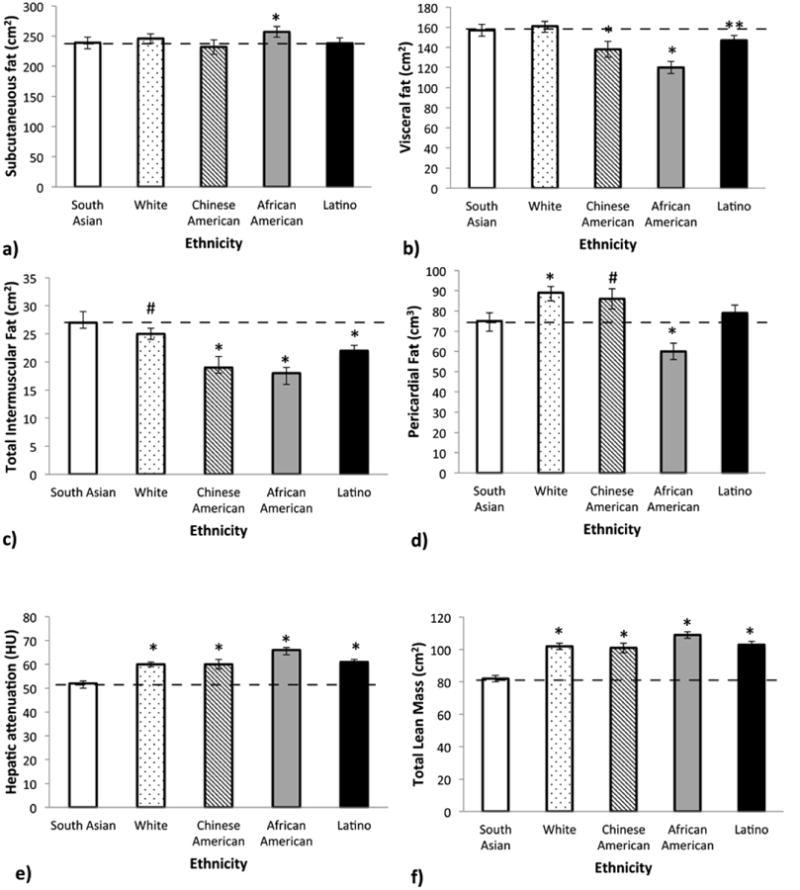
Compared with all ethnic groups in MESA (Whites, Chinese Americans, African Americans and Latinos), SAs had greater intermuscular fat (pairwise comparisons with each MESA group, P<0.01), lower hepatic attenuation (P<0.001) and less lean mass (P<0.001). SAs had greater visceral fat compared with Chinese Americans, African Americans and Latinos (P<0.05) and greater pericardial fat compared with African Americans (P<0.001). SAs had lower adiponectin levels compared with other ethnic groups (P<0.01; except Chinese Americans) and higher resistin levels than all groups (P<0.001), even after adjusting for differences in body composition.
CONCLUSION
There are significant ethnic differences in ectopic fat, lean mass and adipokines. A less favorable body composition and adipokine profile in SAs may partially explain the increased predisposition to cardiometabolic disease. The mechanisms that underlie these differences warrant further investigation.
背景
小型研究表明,与白人相比,南亚人全身、皮下、内脏及肝脏脂肪更多,脂肪因子水平异常。然而,与其他种族群体相比,针对南亚人体成分和脂肪因子的全面研究尚缺。
方法
利用统一数据,我们对两个基于社区的队列进行了横断面分析:生活在美国的南亚人动脉粥样硬化的介质(MASALA,n = 906)和多民族动脉粥样硬化研究(MESA,其中包括2622名白人、803名华裔美国人、1893名非裔美国人和1496名拉丁裔)。建立一般线性模型以评估异位脂肪(内脏、肌间和心包脂肪;以及肝脏衰减)、瘦肌肉量和脂肪因子(脂联素和抵抗素)的种族差异。模型针对年龄、性别、地点、饮酒、吸烟、运动、教育、家庭收入和体重指数进行了调整。异位脂肪模型还针对高血压、糖尿病、高密度脂蛋白和甘油三酯进行了调整。脂肪因子模型针对皮下、内脏、肌间和心包脂肪;以及肝脏衰减进行了调整。
结果
与MESA中的所有种族群体(白人、华裔美国人、非裔美国人和拉丁裔)相比,南亚人肌间脂肪更多(与每个MESA组的两两比较,P < 0.01),肝脏衰减更低(P < 0.001),瘦肌肉量更少(P < 0.001)。与华裔美国人、非裔美国人和拉丁裔相比,南亚人内脏脂肪更多(P < 0.05),与非裔美国人相比,心包脂肪更多(P < 0.001)。即使在调整了身体成分差异后,与其他种族群体相比,南亚人的脂联素水平更低(P < 0.01;华裔美国人除外),抵抗素水平高于所有群体(P < 0.001)。
结论
异位脂肪、瘦肌肉量和脂肪因子存在显著的种族差异。南亚人不太有利的身体成分和脂肪因子谱可能部分解释了其患心脏代谢疾病倾向增加的原因。这些差异背后的机制值得进一步研究。

 Zotero 插件