
微生物群特异性CD4CD8αα调节性T细胞:在肠道免疫稳态中的作用及对炎症性肠病的影响
Microbiota-Specific CD4CD8αα Tregs: Role in Intestinal Immune Homeostasis and Implications for IBD.
作者信息
Sarrabayrouse Guillaume, Alameddine Joudy, Altare Frédéric, Jotereau Francine
机构信息
Digestive System Research Unit, University Hospital Vall d'Hebron , Barcelona , Spain.
U892, INSERM , Nantes , France ; Université de Nantes , Nantes , France ; UMR 6299, CNRS , Nantes , France.
出版信息
Front Immunol. 2015 Oct 8;6:522. doi: 10.3389/fimmu.2015.00522. eCollection 2015.
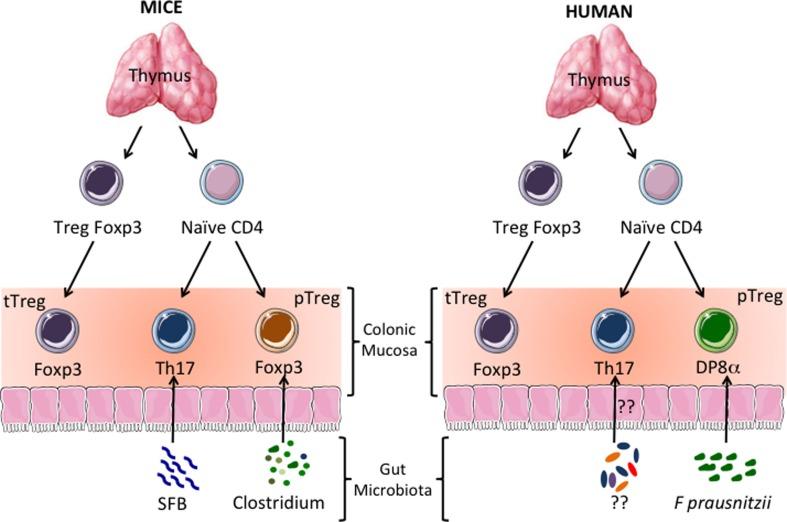
In studies in murine models, active suppression by IL-10-secreting Foxp3 regulatory T cells (Tregs) has emerged as an essential mechanism in colon homeostasis. However, the role of the equivalent subset in humans remains unclear, leading to suggestions that other subsets and/or mechanisms may substitute for Foxp3 Tregs in the maintenance of colon homeostasis. We recently described a new subset of CD4CD8αα T cells reactive to the gut bacterium Faecalibacterium prausnitzii and endowed with regulatory/suppressive functions. This subset is abundant in the healthy colonic mucosa, but less common in that of patients with inflammatory bowel disease (IBD). We discuss here the physiological significance and potential role of these Tregs in preventing inflammation of the gut mucosa and the potential applications of these discoveries for IBD management.
在小鼠模型研究中,分泌白细胞介素-10的叉头框蛋白3调节性T细胞(Tregs)的主动抑制作用已成为结肠内环境稳定的关键机制。然而,人类中同等亚群的作用仍不明确,这引发了一种观点,即其他亚群和/或机制可能在维持结肠内环境稳定方面替代叉头框蛋白3调节性T细胞。我们最近描述了一种新的CD4CD8αα T细胞亚群,它对肠道细菌普拉梭菌有反应,并具有调节/抑制功能。该亚群在健康结肠黏膜中丰富,但在炎症性肠病(IBD)患者的结肠黏膜中较少见。我们在此讨论这些调节性T细胞在预防肠道黏膜炎症方面的生理意义和潜在作用,以及这些发现对炎症性肠病管理的潜在应用。

 Zotero 插件