
社交倾听:对推特上电子烟讨论的内容分析
Social Listening: A Content Analysis of E-Cigarette Discussions on Twitter.
作者信息
Cole-Lewis Heather, Pugatch Jillian, Sanders Amy, Varghese Arun, Posada Susana, Yun Christopher, Schwarz Mary, Augustson Erik
机构信息
ICF International, Rockville, MD, United States.
出版信息
J Med Internet Res. 2015 Oct 27;17(10):e243. doi: 10.2196/jmir.4969.
BACKGROUND
Electronic cigarette (e-cigarette) use has increased in the United States, leading to active debate in the public health sphere regarding e-cigarette use and regulation. To better understand trends in e-cigarette attitudes and behaviors, public health and communication professionals can turn to the dialogue taking place on popular social media platforms such as Twitter.
OBJECTIVE
The objective of this study was to conduct a content analysis to identify key conversation trends and patterns over time using historical Twitter data.
METHODS
A 5-category content analysis was conducted on a random sample of tweets chosen from all publicly available tweets sent between May 1, 2013, and April 30, 2014, that matched strategic keywords related to e-cigarettes. Relevant tweets were isolated from the random sample of approximately 10,000 tweets and classified according to sentiment, user description, genre, and theme. Descriptive analyses including univariate and bivariate associations, as well as correlation analyses were performed on all categories in order to identify patterns and trends.
RESULTS
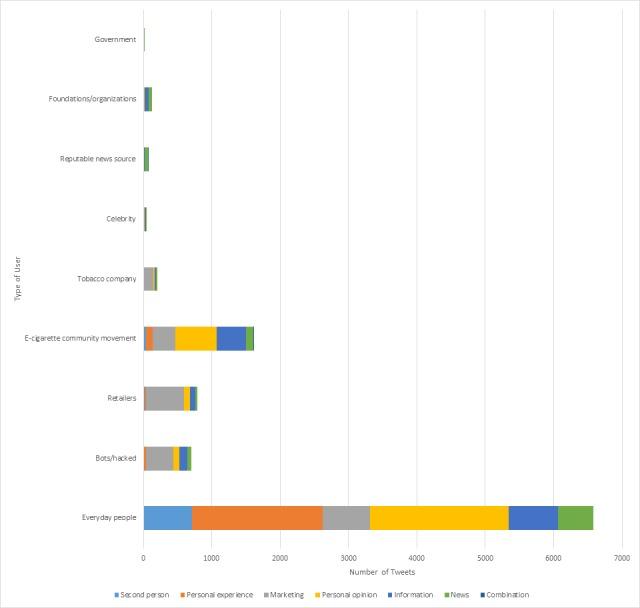
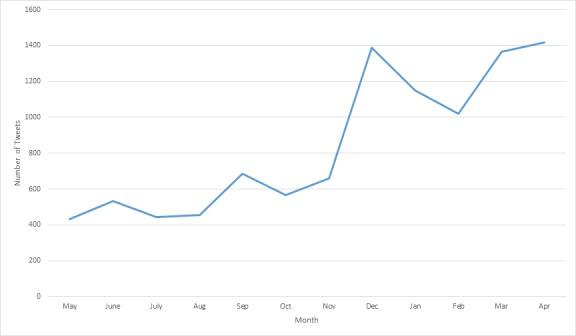
The analysis revealed an increase in e-cigarette-related tweets from May 2013 through April 2014, with tweets generally being positive; 71% of the sample tweets were classified as having a positive sentiment. The top two user categories were everyday people (65%) and individuals who are part of the e-cigarette community movement (16%). These two user groups were responsible for a majority of informational (79%) and news tweets (75%), compared to reputable news sources and foundations or organizations, which combined provided 5% of informational tweets and 12% of news tweets. Personal opinion (28%), marketing (21%), and first person e-cigarette use or intent (20%) were the three most common genres of tweets, which tended to have a positive sentiment. Marketing was the most common theme (26%), and policy and government was the second most common theme (20%), with 86% of these tweets coming from everyday people and the e-cigarette community movement combined, compared to 5% of policy and government tweets coming from government, reputable news sources, and foundations or organizations combined.
CONCLUSIONS
Everyday people and the e-cigarette community are dominant forces across several genres and themes, warranting continued monitoring to understand trends and their implications regarding public opinion, e-cigarette use, and smoking cessation. Analyzing social media trends is a meaningful way to inform public health practitioners of current sentiments regarding e-cigarettes, and this study contributes a replicable methodology.
背景
电子烟在美国的使用呈上升趋势,这引发了公共卫生领域关于电子烟使用及监管的激烈讨论。为了更好地了解电子烟态度和行为的趋势,公共卫生和传播专业人员可以关注诸如推特等热门社交媒体平台上正在进行的对话。
目的
本研究的目的是进行内容分析,利用推特历史数据确定随着时间推移的关键对话趋势和模式。
方法
对2013年5月1日至2014年4月30日期间发送的所有公开可用推文中随机抽取的、与电子烟相关战略关键词匹配的推文样本进行了五类内容分析。相关推文从大约10000条推文的随机样本中分离出来,并根据情感倾向、用户描述、类型和主题进行分类。对所有类别进行了包括单变量和双变量关联的描述性分析以及相关性分析,以确定模式和趋势。
结果
分析显示,从2013年5月到2014年4月,与电子烟相关的推文数量有所增加,推文总体呈积极态度;71%的样本推文被归类为具有积极情感倾向。前两大用户类别是普通民众(65%)和电子烟社区运动参与者(16%)。与声誉良好的新闻来源以及基金会或组织相比,这两类用户群体发布了大部分信息类推文(79%)和新闻类推文(75%),而后两者加起来仅提供了5%的信息类推文和12%的新闻类推文。个人观点(28%)、营销(21%)以及个人使用电子烟或有使用意图(20%)是三类最常见的推文类型,这些推文往往具有积极情感倾向。营销是最常见的主题(26%),政策和政府是第二常见的主题(20%),其中86%的此类推文来自普通民众和电子烟社区运动参与者,相比之下,来自政府、声誉良好的新闻来源以及基金会或组织的政策和政府类推文仅占5%。
结论
普通民众和电子烟社区在多个类型和主题中占主导地位,有必要持续监测以了解趋势及其对公众舆论、电子烟使用和戒烟的影响。分析社交媒体趋势是让公共卫生从业者了解当前对电子烟看法的一种有意义的方式,本研究提供了一种可复制的方法。


 Zotero 插件