
淀粉样前体蛋白的 A673T 突变减少了细胞中β-淀粉样蛋白从其β-羧基末端片段的产生。
The A673T mutation in the amyloid precursor protein reduces the production of β-amyloid protein from its β-carboxyl terminal fragment in cells.
机构信息
Department of Neuropathology, Graduate School of Life and Medical Sciences, Doshisha University, Kyotanabe, Kyoto, 610-0394, Japan.
Department of Neuropathology, Graduate School of Brain Sciences, Doshisha University, Kizugawa, Kyoto, 619-0225, Japan.
出版信息
Acta Neuropathol Commun. 2015 Nov 4;3:66. doi: 10.1186/s40478-015-0247-6.
INTRODUCTION
The A673T mutation in the amyloid precursor protein (APP) protects against Alzheimer's disease by reducing β-amyloid protein (Aβ) production. This mutation reduced the release of the soluble APP fragment (sAPPβ), which is processed by β-secretase, suggesting a concomitant decrease in the β-carboxyl fragment of APP (C99), which is a direct substrate of γ-secretase for Aβ production. However, it remains controversial whether the level of C99 is significantly reduced in cells expressing APP that carry A673T as the cause of reduced Aβ production. Here, we investigated the effect of the A673T mutation in C99 on γ-cleavage in cells.
RESULTS
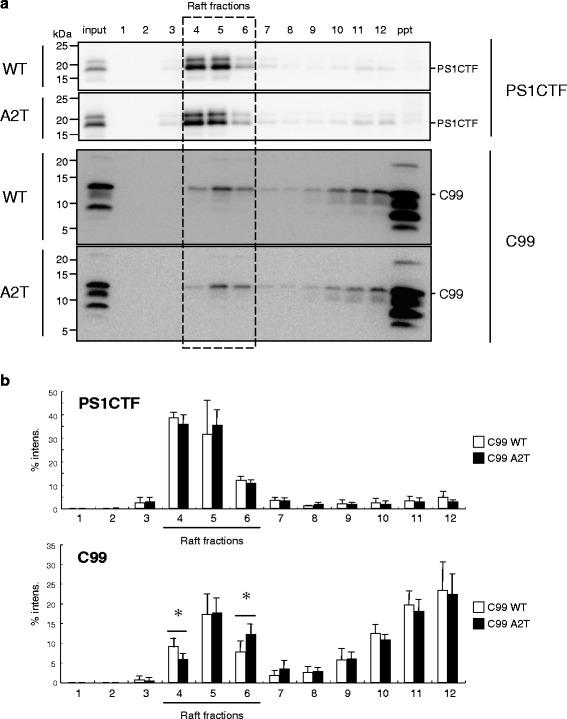
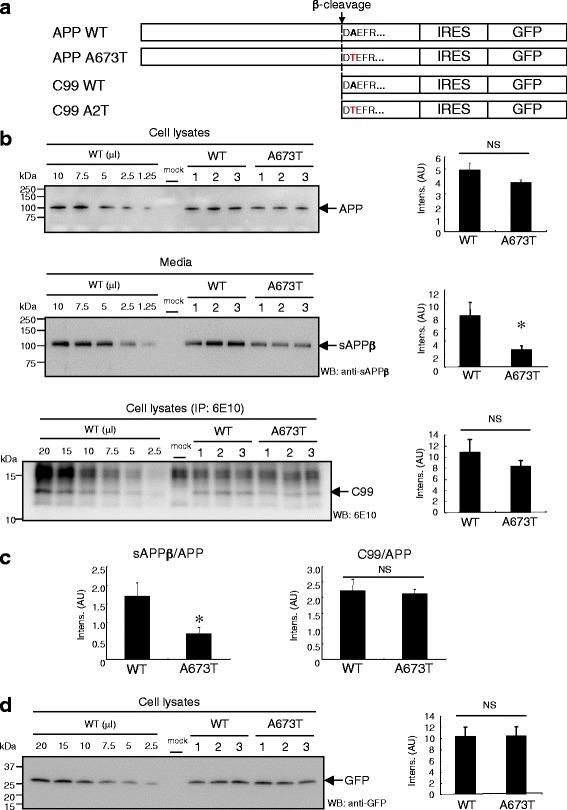
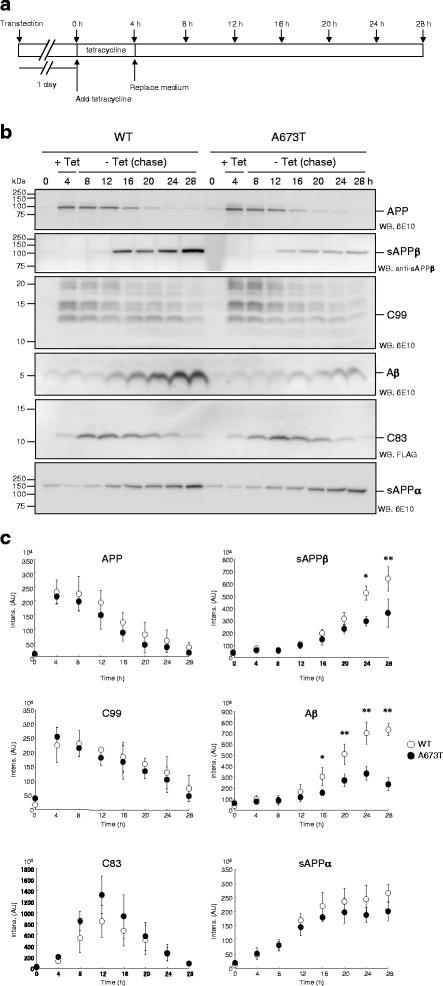
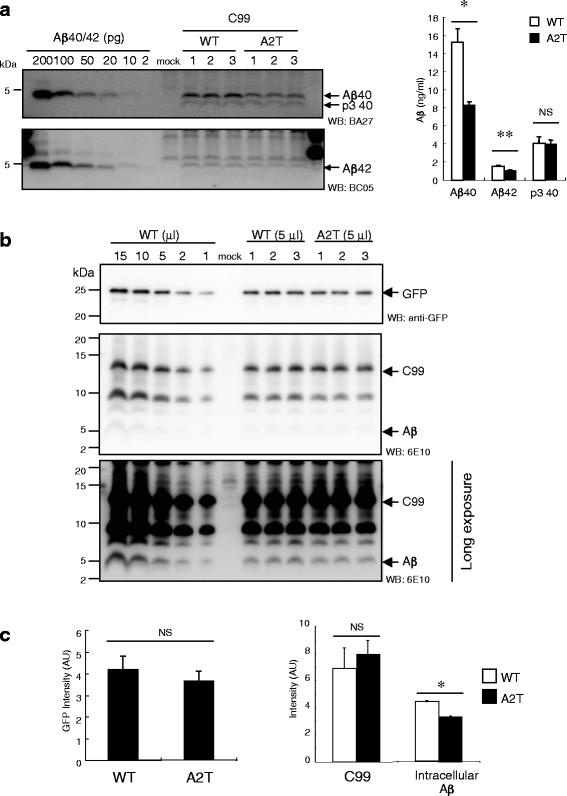
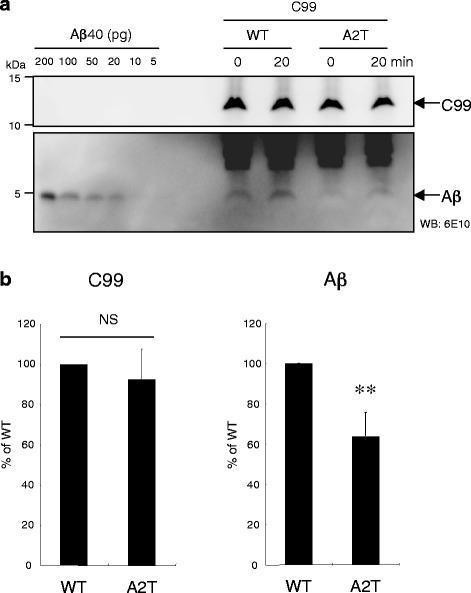
We found that the level of C99 in cells expressing APP A673T was indistinctive of that observed in cells expressing wild-type APP, although the release of sAPPβ was significantly reduced in the APP A673T cells. In addition, our reconstituted β-secretase assay demonstrated no significant difference in β-cleavage on an APP fragment carrying the A673T mutation compared with the wild-type fragment. Importantly, cells expressing C99 containing the A673T mutation (C99 A2T; in accordance with the Aβ numbering) produced roughly half the level of Aβ compared with the wild-type C99, suggesting that the C99 A2T is an insufficient substrate of γ-secretase in cells. A cell-free γ-secretase assay revealed that Aβ production from the microsomal fraction of cells expressing C99 A2T was diminished. A sucrose gradient centrifugation analysis indicated that the levels of the C99 A2T that was codistributed with γ-secretase components in the raft fractions were reduced significantly.
CONCLUSIONS
Our data indicate that the A673T mutation in APP alters the release of sAPPβ, but not the C99 level, and that the C99 A2T is an inefficient substrate for γ-secretase in cell-based assay.
简介
淀粉样前体蛋白(APP)中的 A673T 突变通过减少 β-淀粉样蛋白(Aβ)的产生来保护机体免受阿尔茨海默病的影响。该突变降低了可溶性 APP 片段(sAPPβ)的释放,sAPPβ 是由β-分泌酶加工的,这表明 APP 的β-羧基片段(C99)也同时减少,C99 是 γ-分泌酶产生 Aβ 的直接底物。然而,在表达 APP 的细胞中,C99 的水平是否因 A673T 突变导致 Aβ 产生减少而显著降低仍存在争议。在这里,我们研究了 A673T 突变对 C99 在细胞中 γ 切割的影响。
结果
我们发现,表达 APP A673T 的细胞中的 C99 水平与表达野生型 APP 的细胞中的 C99 水平没有明显差异,尽管 APP A673T 细胞中的 sAPPβ 释放显著减少。此外,我们的重新构建的β-分泌酶测定表明,与野生型片段相比,携带 A673T 突变的 APP 片段的β-切割没有明显差异。重要的是,表达含有 A673T 突变的 C99(与 Aβ 编号一致为 C99 A2T)的细胞产生的 Aβ 水平大约是野生型 C99 的一半,这表明 C99 A2T 是细胞中 γ-分泌酶的不足底物。细胞游离γ-分泌酶测定显示,表达 C99 A2T 的细胞的微粒体部分的 Aβ 产生减少。蔗糖梯度离心分析表明,与 C99 A2T 共分布在筏状部分的 γ-分泌酶成分的 C99 A2T 水平显著降低。
结论
我们的数据表明,APP 中的 A673T 突变改变了 sAPPβ 的释放,但不改变 C99 水平,并且 C99 A2T 是细胞内测定中 γ-分泌酶的低效底物。


 Zotero 插件