
基于正念疗法对降低癌症患者焦虑和抑郁的有效性:一项荟萃分析。
Effectiveness of Mindfulness-based Therapy for Reducing Anxiety and Depression in Patients With Cancer: A Meta-analysis.
作者信息
Zhang Mei-Fen, Wen Yong-Shan, Liu Wei-Yan, Peng Li-Fen, Wu Xiao-Dan, Liu Qian-Wen
机构信息
From the School of Nursing, Sun Yat-sen University (M-FZ); Department of Nursing, Cancer Center of Sun Yat-sen University (Y-SW, X-DW, Q-WL); Department of Nursing, Sun Yat-sen Memorial Hospital of Sun Yat-sen University (W-YL); and Department of Nursing, the First Affiliated Hospital of Sun Yat-sen University, Guangzhou, China (L-FP).
出版信息
Medicine (Baltimore). 2015 Nov;94(45):e0897-0. doi: 10.1097/MD.0000000000000897.
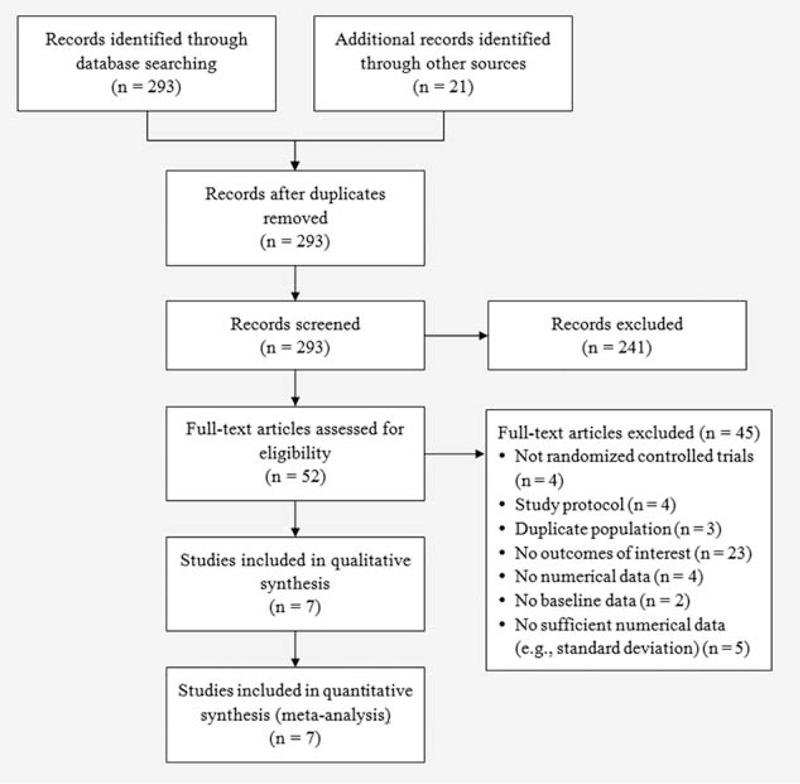
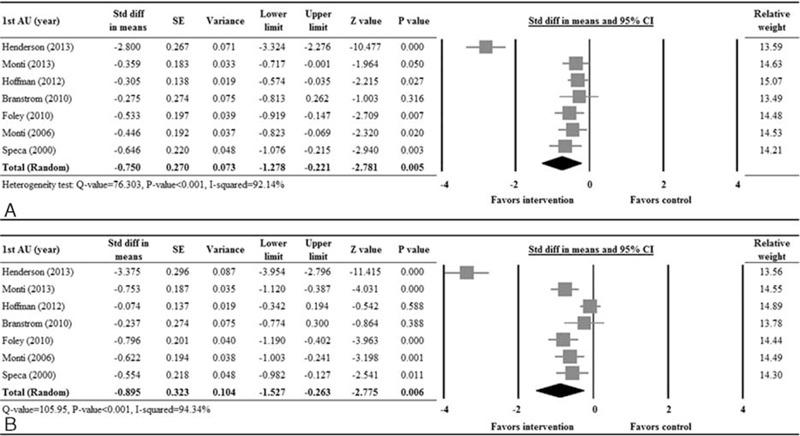
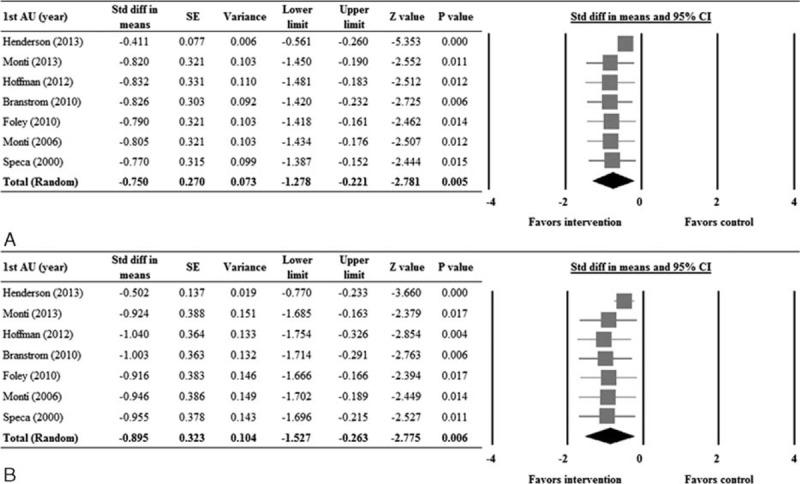
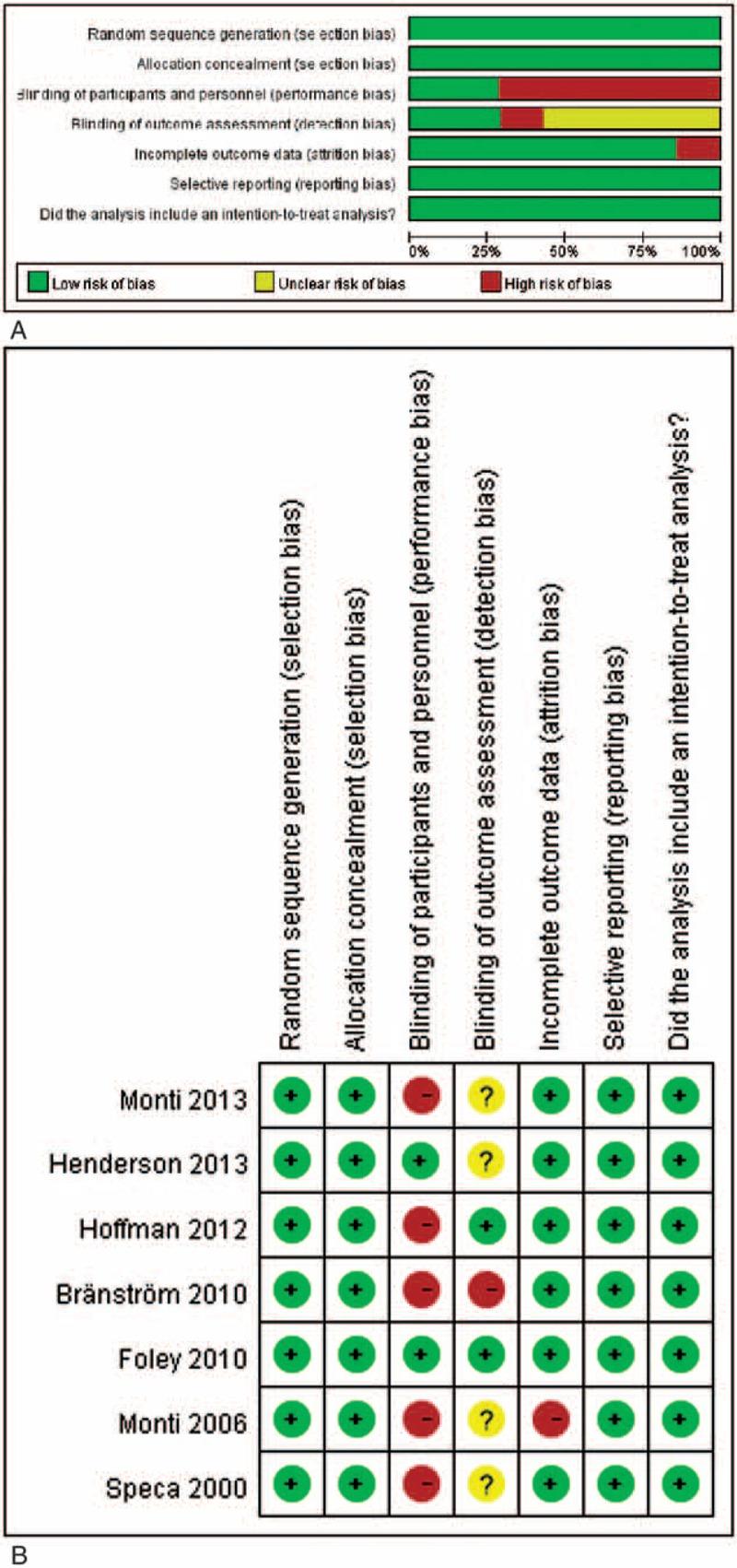
Anxiety and depression are common among patients with cancer, and are often treated with psychological interventions including mindfulness-based therapy.The aim of the study was to perform a meta-analysis of the effectiveness of mindfulness-based interventions for improving anxiety and depression in patients with cancer.Medline, the Cochrane Library, EMBASE, and Google Scholar were searched. The randomized controlled trials designed for patients diagnosed with cancer were included. Mindfulness-based interventions were provided.The outcomes assessed were the changes in anxiety and depression scores from before to after the intervention. The treatment response was determined by calculating the standardized mean difference (SMD) for individual studies and for pooled study results. Subgroup analyses by cancer type, type of therapy, and length of follow-up were performed.Seven studies, involving 469 participants who received mindfulness-based interventions and 419 participants in a control group, were included in the meta-analysis. Mindfulness-based stress reduction and art therapy were the most common interventions (5/7 studies). All studies reported anxiety and depression scores. The pooled SMD of the change in anxiety significantly favored mindfulness-based therapy over control treatment (-0.75, 95% confidence interval -1.28, -0.22, P = 0.005). Likewise, the pooled SMD of the change in depression also significantly favored mindfulness-based therapy over control (-0.90, 95% confidence interval -1.53, -0.26, P = 0.006). During the length of follow-ups less than 12 weeks, mindfulness-based therapy significantly improved anxiety for follow-up ≤12 weeks after the start of therapy, but not >12 weeks after the start of therapy.There was a lack of consistency between the studies in the type of mindfulness-based/control intervention implemented. Patients had different forms of cancer. Subgroup analyses included a relatively small number of studies and did not account for factors such as the severity of anxiety and/or depression, the time since diagnosis, and cancer stage.Mindfulness-based interventions effectively relieved anxiety and depression among patients with cancer. However, additional research is still warranted to determine how long the beneficial effects of mindfulness-based therapy persist.
焦虑和抑郁在癌症患者中很常见,且通常采用包括正念疗法在内的心理干预措施进行治疗。本研究的目的是对正念干预措施改善癌症患者焦虑和抑郁的有效性进行荟萃分析。检索了医学期刊数据库(Medline)、考克兰图书馆(Cochrane Library)、荷兰医学文摘数据库(EMBASE)和谷歌学术。纳入了针对确诊为癌症患者设计的随机对照试验。提供了基于正念的干预措施。评估的结果是干预前后焦虑和抑郁评分的变化。通过计算各个研究以及汇总研究结果的标准化平均差(SMD)来确定治疗反应。按癌症类型、治疗类型和随访时间进行了亚组分析。荟萃分析纳入了7项研究,其中469名参与者接受了基于正念的干预措施,419名参与者作为对照组。基于正念的减压疗法和艺术疗法是最常见的干预措施(7项研究中的5项)。所有研究均报告了焦虑和抑郁评分。焦虑变化的汇总SMD显著表明,基于正念的疗法比对照治疗更具优势(-0.75,95%置信区间-1.28,-0.22,P = 0.005)。同样,抑郁变化的汇总SMD也显著表明,基于正念的疗法比对照更具优势(-0.90,95%置信区间-1.53,-0.26,P = 0.006)。在随访时间少于12周的情况下,基于正念的疗法在治疗开始后≤12周的随访中显著改善了焦虑,但在治疗开始后>12周时则没有。在实施的基于正念/对照干预类型方面,各研究之间缺乏一致性。患者患有不同类型的癌症。亚组分析纳入的研究数量相对较少,且未考虑焦虑和/或抑郁的严重程度、确诊后的时间以及癌症分期等因素。基于正念的干预措施有效缓解了癌症患者的焦虑和抑郁。然而,仍需要进一步研究来确定基于正念疗法的有益效果能持续多长时间。

 Zotero 插件