
新型隐球菌中由葡糖神经酰胺途径调控的跨膜转运蛋白表达
Transmembrane transporter expression regulated by the glucosylceramide pathway in Cryptococcus neoformans.
作者信息
Singh Arpita, Rella Antonella, Schwacke John, Vacchi-Suzzi Caterina, Luberto Chiara, Del Poeta Maurizio
机构信息
Department of Biochemistry and Molecular Biology, Medical University of South Carolina, Charleston, SC, 29425, USA.
Department of Medicine, Division of Infectious Diseases and International Health, University of Virginia, 345 Crispell Dr, Carter Harrison Building, Charlottesville, VA, 22908, USA.
出版信息
BMC Res Notes. 2015 Nov 16;8:681. doi: 10.1186/s13104-015-1613-y.
BACKGROUND
The sphingolipid glucosylceramide (GlcCer) and factors involved in the fungal GlcCer pathways were shown earlier to be an integral part of fungal virulence, especially in fungal replication at 37 °C, in neutral/alkaline pH and 5 % CO2 environments (e.g. alveolar spaces). Two mutants, ∆gcs 1 lacking glucosylceramide synthase 1 gene (GCS1) which catalyzes the formation of sphingolipid GlcCer from the C9-methyl ceramide and ∆smt1 lacking sphingolipid C9 methyltransferase gene (SMT1), which adds a methyl group to position nine of the sphingosine backbone of ceramide, of this pathway were attenuated in virulence and have a growth defect at the above-mentioned conditions. These mutants with either no or structurally modified GlcCer located on the cell-membrane have reduced membrane rigidity, which may have altered not only the physical location of membrane proteins but also their expression, as the pathogen's mode of adaptation to changing need. Importantly, pathogens are known to adapt themselves to the changing host environments by altering their patterns of gene expression.
RESULTS
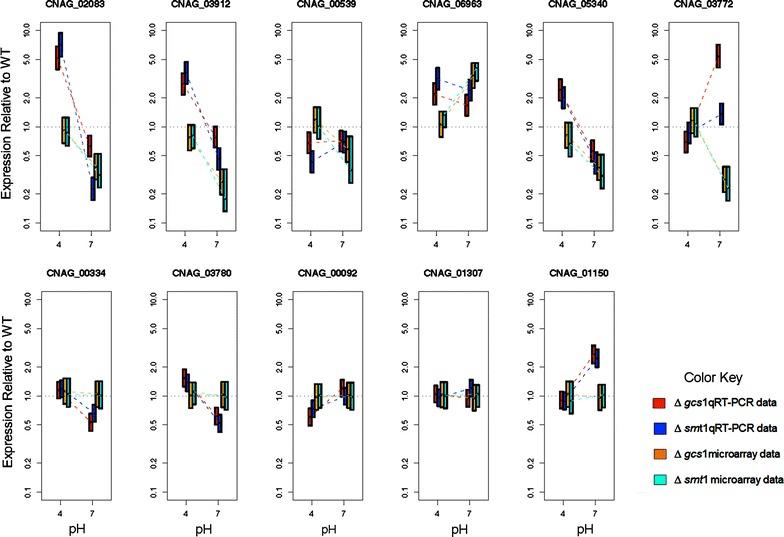
By transcriptional analysis of gene expression, we identified six genes whose expression was changed from their wild-type counterpart grown in the same conditions, i.e. they became either down regulated or up regulated in these two mutants. The microarray data was validated by real-time PCR, which confirmed their fold change in gene expression. All the six genes we identified, viz siderochrome-iron transporter (CNAG_02083), monosaccharide transporter (CNAG_05340), glucose transporter (CNAG_03772), membrane protein (CNAG_03912), membrane transport protein (CNAG_00539), and sugar transporter (CNAG_06963), are membrane-localized and have significantly altered gene expression levels. Therefore, we hypothesize that these genes function either independently or in tandem with a structurally modified cell wall/plasma membrane resulting from the modifications of the GlcCer pathway and thus possibly disrupt transmembrane signaling complex, which in turn contributes to cryptococcal osmotic, pH, ion homeostasis and its pathobiology.
CONCLUSION
Six genes identified from gene expression microarrays by gene set enrichment analysis and validated by RT-PCR, are membrane located and associated with the growth defect at neutral-alkaline pH due to the absence and or presence of a structurally modified GlcCer. They may be involved in the transmembrane signaling network in Cryptococcus neoformans, and therefore the pathobiology of the fungus in these conditions.
背景
鞘脂类葡萄糖神经酰胺(GlcCer)以及真菌GlcCer途径中涉及的因子,此前已被证明是真菌毒力不可或缺的一部分,尤其是在37°C、中性/碱性pH值和5%二氧化碳环境(如肺泡腔)中的真菌复制过程中。该途径中的两个突变体,即缺乏催化从C9 - 甲基神经酰胺形成鞘脂类GlcCer的葡萄糖神经酰胺合酶1基因(GCS1)的∆gcs1,以及缺乏向神经酰胺鞘氨醇主链第9位添加甲基的鞘脂类C9甲基转移酶基因(SMT1)的∆smt1,其毒力减弱,并且在上述条件下存在生长缺陷。这些细胞膜上要么没有GlcCer要么具有结构修饰的GlcCer的突变体,其膜刚性降低,这不仅可能改变了膜蛋白的物理位置,还可能改变了它们的表达,作为病原体适应变化需求的方式。重要的是,已知病原体通过改变其基因表达模式来适应不断变化的宿主环境。
结果
通过对基因表达的转录分析,我们鉴定出六个基因,其表达与在相同条件下生长的野生型对应基因有所不同,即在这两个突变体中它们要么下调要么上调。微阵列数据通过实时PCR得到验证,实时PCR证实了它们在基因表达上的倍数变化。我们鉴定出的所有六个基因,即铁载体 - 铁转运蛋白(CNAG_02083)、单糖转运蛋白(CNAG_05340)、葡萄糖转运蛋白(CNAG_03772)、膜蛋白(CNAG_03912)、膜转运蛋白(CNAG_00539)和糖转运蛋白(CNAG_06963),都定位于细胞膜,并且基因表达水平有显著改变。因此,我们推测这些基因要么独立发挥作用,要么与由于GlcCer途径修饰导致的结构修饰的细胞壁/质膜协同作用,从而可能破坏跨膜信号复合体,进而影响新型隐球菌的渗透压、pH值、离子稳态及其病理生物学。
结论
通过基因集富集分析从基因表达微阵列中鉴定并经RT - PCR验证的六个基因,定位于细胞膜,并且与由于缺乏和/或存在结构修饰的GlcCer而在中性 - 碱性pH值下的生长缺陷相关。它们可能参与新型隐球菌的跨膜信号网络,因此也参与了真菌在这些条件下的病理生物学过程。
 Zotero 插件