
在动脉粥样硬化动物模型中,低壁面切应力诱导内膜增厚,而大的壁面切应力变化和炎症诱导中膜变薄。
Low WSS Induces Intimal Thickening, while Large WSS Variation and Inflammation Induce Medial Thinning, in an Animal Model of Atherosclerosis.
作者信息
Millon Antoine, Sigovan Monica, Boussel Loic, Mathevet Jean-Louis, Louzier Vanessa, Paquet Christian, Geloen Alain, Provost Nicolas, Majd Zouher, Patsouris David, Serusclat Andre, Canet-Soulas Emmanuelle
机构信息
Lyon-1 University, CREATIS Laboratory, Lyon, France.
Hospices Civils de Lyon, Lyon, France.
出版信息
PLoS One. 2015 Nov 17;10(11):e0141880. doi: 10.1371/journal.pone.0141880. eCollection 2015.
OBJECTIVE
Atherosclerotic plaque development in the arterial wall is the result of complex interaction between the wall's endothelial layer and blood hemodynamics. However, the interaction between hemodynamic parameters and inflammation in plaque evolution is not yet fully understood. The aim of the present study was to investigate the relation between wall shear stress (WSS) and vessel wall inflammation during atherosclerotic plaque development in a minipig model of carotid stenosis.
METHODS
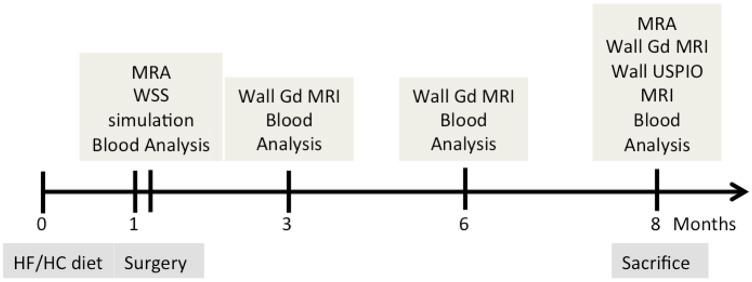
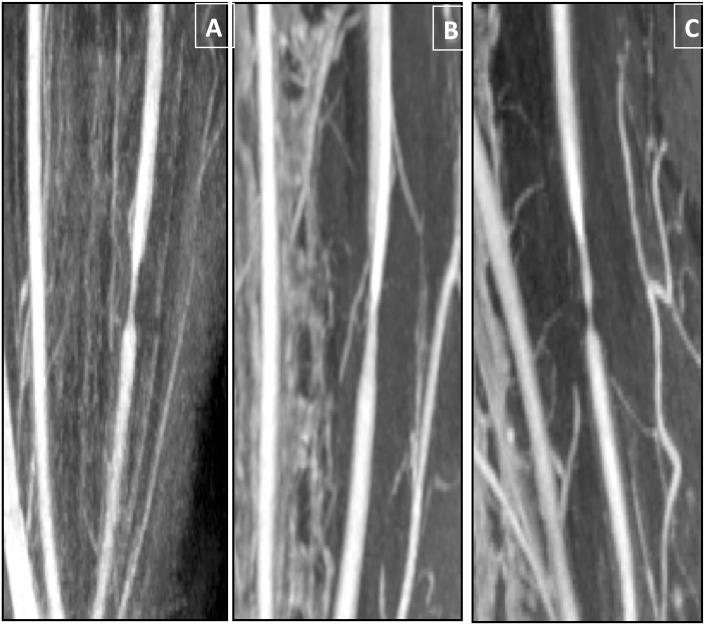
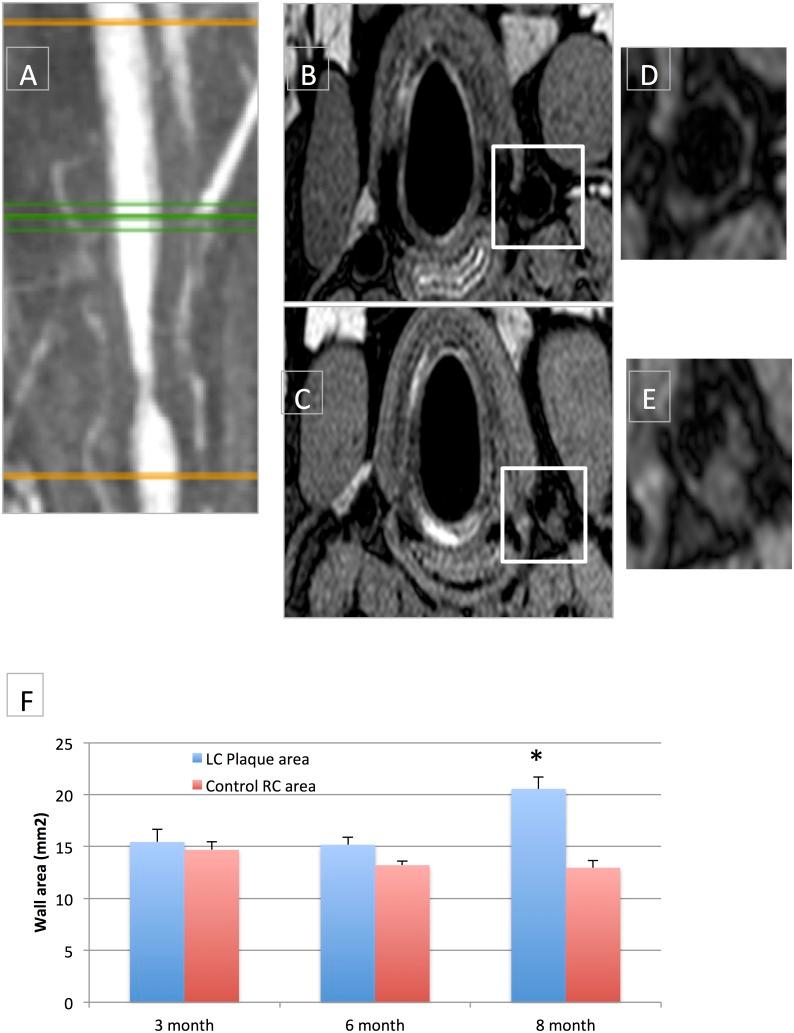
A surgical procedure was performed to create left common carotid artery stenosis by placement of a perivascular cuff in minipigs under atherogenic diet. Animals were followed up on 3T MRI, 1 week after surgery and 3, 6, and 8 months after initiation of the diet. Computational fluid dynamics simulation estimated WSS distribution for the first imaging point. Vascular geometries were co-registered for direct comparison of plaque development and features (Gadolinium- and USPIO-Contrast Enhanced MRI, for permeability and inflammation respectively) with the initial WSS. Histological analysis was performed and sections were matched to MR images, based on spatial landmarks.
RESULTS
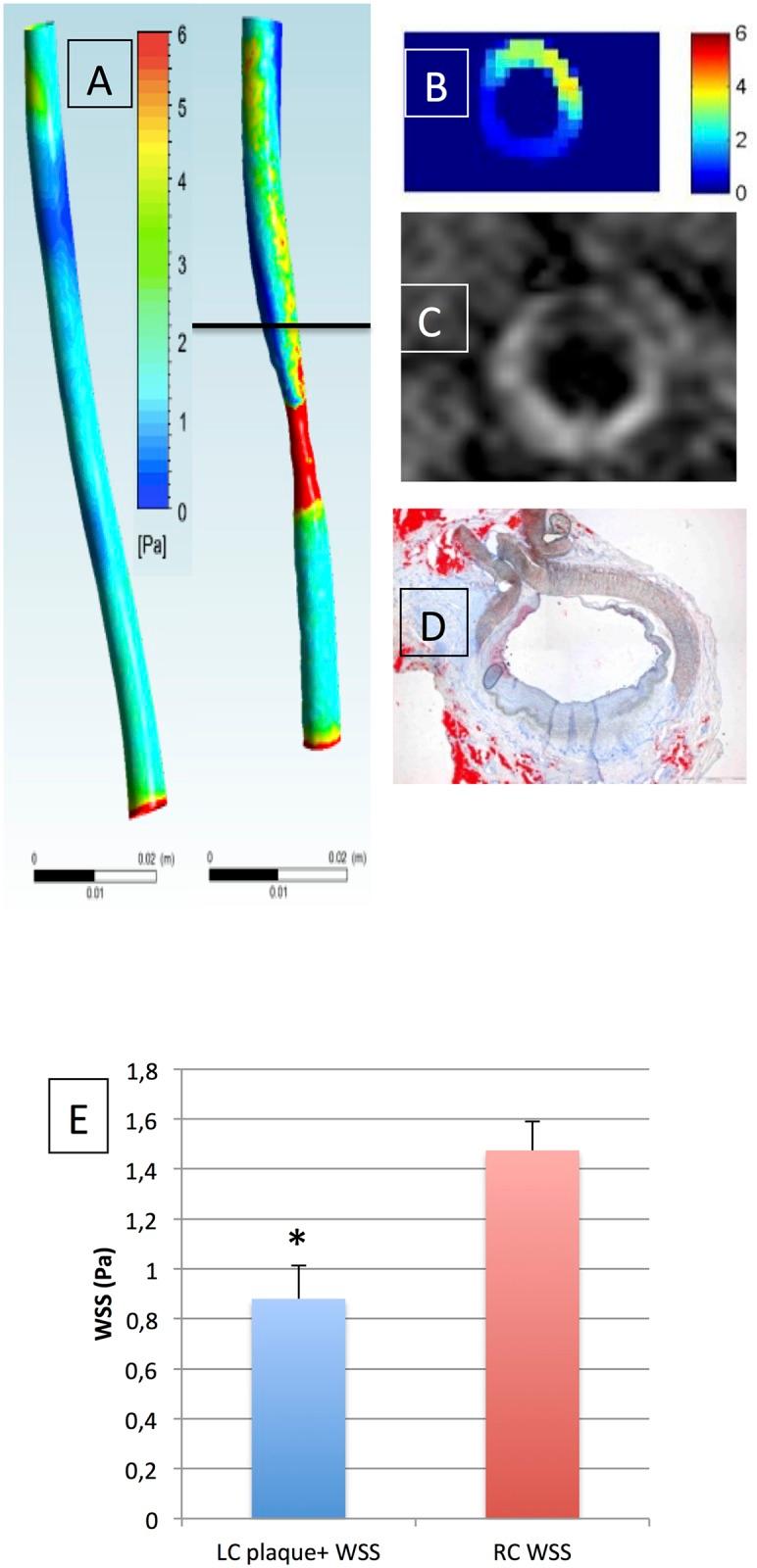
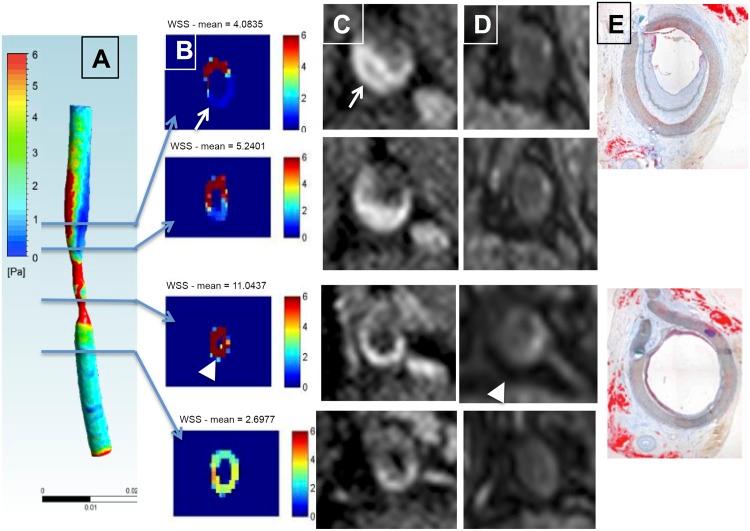
Vessel wall thickening, permeability and inflammation were observed distally from the stenosis. They were eccentric and facing regions of normal wall thickness. Histological analysis confirmed eccentric plaque formation with lipid infiltration, intimal thickening and medial degradation. High phagocytic activity in the stenosis region was co-localized with high WSS, corresponding to intense medial degradation observed on histology samples.
CONCLUSION
Lower WSS promotes atherosclerotic plaque development distal to an induced stenosis. Vascular and perivascular inflammation locations were predominant in the high WSS stenosis segment, where medial thinning was the major consequence.
目的
动脉壁内动脉粥样硬化斑块的形成是血管壁内皮细胞层与血液动力学之间复杂相互作用的结果。然而,血液动力学参数与斑块演变过程中炎症之间的相互作用尚未完全明确。本研究的目的是在小型猪颈动脉狭窄模型中,研究动脉粥样硬化斑块形成过程中壁面剪应力(WSS)与血管壁炎症之间的关系。
方法
通过在接受致动脉粥样硬化饮食的小型猪身上放置血管外袖套,进行手术以造成左颈总动脉狭窄。术后1周以及开始饮食后的3、6和8个月,对动物进行3T MRI随访。通过计算流体动力学模拟估算首个成像点的WSS分布。对血管几何结构进行配准,以便将斑块发展和特征(分别采用钆和超顺磁性氧化铁对比增强MRI评估通透性和炎症)与初始WSS进行直接比较。进行组织学分析,并根据空间标记将切片与MR图像匹配。
结果
在狭窄远端观察到血管壁增厚、通透性增加和炎症。这些变化呈偏心性,且位于正常壁厚区域。组织学分析证实形成了偏心性斑块,伴有脂质浸润、内膜增厚和中膜退变。狭窄区域的高吞噬活性与高WSS共定位,这与组织学样本上观察到的强烈中膜退变相对应。
结论
较低的WSS促进了诱导性狭窄远端动脉粥样硬化斑块的形成。血管和血管周围炎症主要发生在高WSS狭窄段,该段中膜变薄是主要后果。

 Zotero 插件