
印度尼西亚成年人的多重疾病患病率及模式:一项利用全国调查数据的探索性研究。
Multimorbidity prevalence and pattern in Indonesian adults: an exploratory study using national survey data.
作者信息
Hussain Mohammad Akhtar, Huxley Rachel R, Al Mamun Abdullah
机构信息
Division of Epidemiology and Biostatistics, School of Public Health, The University of Queensland, Brisbane, Queensland, Australia.
School of Public Health, Curtin University, Perth, Western Australia, Australia.
出版信息
BMJ Open. 2015 Dec 9;5(12):e009810. doi: 10.1136/bmjopen-2015-009810.
OBJECTIVES
To estimate the prevalence and pattern of multimorbidity in the Indonesian adult population.
DESIGN
Cross-sectional study.
SETTING
Community-based survey. The sampling frame was based on households in 13 of the 27 Indonesian provinces, representing about 83% of the Indonesian population.
PARTICIPANTS
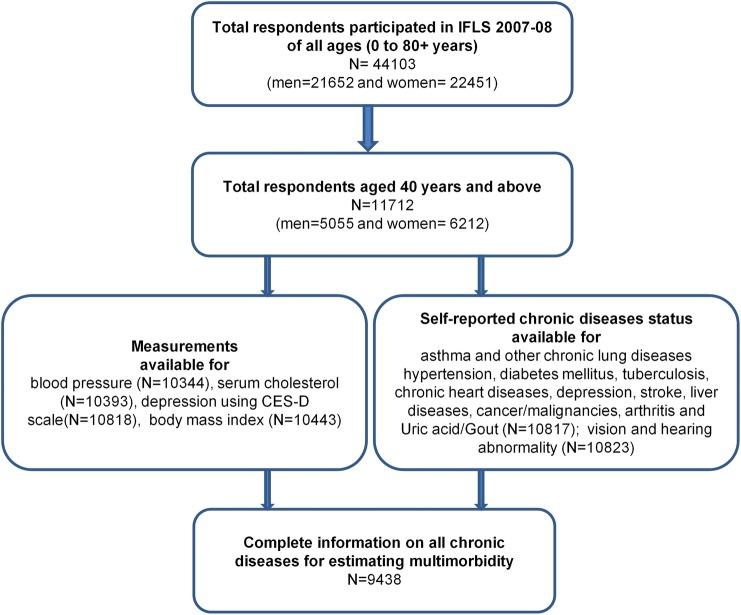
9438 Indonesian adults aged 40 years and above.
MAIN OUTCOME MEASURES
Prevalence and pattern of multimorbidity by age, gender and socioeconomic status.
RESULTS
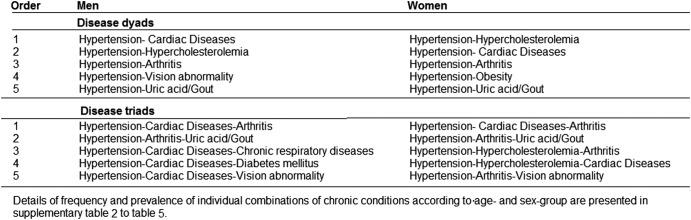
The mean number of morbidities in the sample was 1.27 (SE ± 0.01). The overall age and sex standardised prevalence of multimorbidity was 35.7% (34.8% to 36.7%), with women having significantly higher prevalence of multimorbidity than men (41.5% vs 29.5%; p<0.001). Of those with multimorbidity, 64.6% (62.8% to 66.3%) were aged less than 60 years. Prevalence of multimorbidity was positively associated with age (p for trend <0.001) and affluence (p for trend <0.001) and significantly greater in women at all ages compared with men. For each 5-year increment in age there was an approximate 20% greater risk of multimorbidity in both sexes (18% in women 95% CI 1.14 to 1.22 and 22% in men 95% CI 1.18 to 1.26). Increasing age, female gender, non-Javanese ethnicity, and high per-capital expenditure were all significantly associated with higher odds of multimorbidity. The combination of hypertension with cardiac diseases, hypercholesterolemia, arthritis, and uric acid/gout were the most commonly occurring disease pairs in both sexes.
CONCLUSIONS
More than one-third of the Indonesian adult population are living with multimorbidity with women and the more wealthy being particularly affected. Of especial concern was the high prevalence of multimorbidity among younger individuals. Hypertension was the most frequently occurring condition common to most individuals with multimorbidity.
目的
评估印度尼西亚成年人群中多病共存的患病率及模式。
设计
横断面研究。
背景
基于社区的调查。抽样框架基于印度尼西亚27个省份中13个省份的家庭,代表约83%的印度尼西亚人口。
参与者
9438名40岁及以上的印度尼西亚成年人。
主要观察指标
按年龄、性别和社会经济状况划分的多病共存患病率及模式。
结果
样本中疾病的平均数量为1.27(标准误±0.01)。多病共存的总体年龄和性别标准化患病率为35.7%(34.8%至36.7%),女性多病共存的患病率显著高于男性(41.5%对29.5%;p<0.001)。在患有多病共存的人群中,64.6%(62.8%至66.3%)年龄小于60岁。多病共存的患病率与年龄(趋势p<0.001)和富裕程度(趋势p<0.001)呈正相关,且在各年龄段女性的患病率均显著高于男性。年龄每增加5岁,两性患多病共存的风险约增加20%(女性为18%,95%置信区间为1.14至1.22;男性为22%,95%置信区间为1.18至1.26)。年龄增长、女性、非爪哇族裔和高人均支出均与患多病共存的较高几率显著相关。高血压与心脏病、高胆固醇血症、关节炎以及尿酸/痛风的组合是两性中最常见的疾病配对。
结论
超过三分之一的印度尼西亚成年人群患有多病共存,女性和较富裕人群受影响尤为明显。特别令人担忧的是年轻个体中多病共存的高患病率。高血压是大多数患有多病共存个体中最常见的疾病。


 Zotero 插件