
白藜芦醇通过在体外和体内激活miR-34c-KITLG发挥抗结直肠癌作用。
Resveratrol elicits anti-colorectal cancer effect by activating miR-34c-KITLG in vitro and in vivo.
作者信息
Yang Shu, Li Wenshuai, Sun Haimei, Wu Bo, Ji Fengqing, Sun Tingyi, Chang Huanhuan, Shen Ping, Wang Yaxi, Zhou Deshan
机构信息
Department of Histology and Embryology, School of Basic Medical Sciences, Capital Medical University, Beijing, 100069, P. R. China.
Beijing Key Laboratory of Cancer Invasion and Metastasis Research, Beijing, 100069, P. R. China.
出版信息
BMC Cancer. 2015 Dec 16;15:969. doi: 10.1186/s12885-015-1958-6.
BACKGROUND
Silence of the tumor suppressor miR-34c is implicated in the development of colorectal cancer (CRC). For the past few years, Resveratrol (Res) has been introduced to oncotherapies alone or with traditional chemotherapeutic drugs. However, the study of molecular mechanism involved in the anti-CRC effect of Res is still ongoing.
METHODS
The anti-CRC effect of Res alone or with Oxaliplatin (Oxa) was determined by cell viability assay, soft agar colony formation assay, flow cytometry and real-time cellular analyzer in HT-29 (p53+) and HCT-116 (p53-) CRC cell lines. Expressions of miR-34c and its targets were detected by qPCR and/or western blot. To evaluate the role of miR-34c in anti-CRC effect by Res alone or with Oxa, miR-34c was up or down-regulated by lentiviral mediation or specific inhibitor, respectively. To investigate how miR-34c was increased by Res, the methylation status of miR-34c promoter was detected by MSP. The tumor bearing mouse model was established by subcutaneous injection of HCT-116 cells to assess anti-CRC effect of Res alone or with Oxa in vivo. IL-6 and TNF-α in xenografts were detected by ELISA.
RESULTS
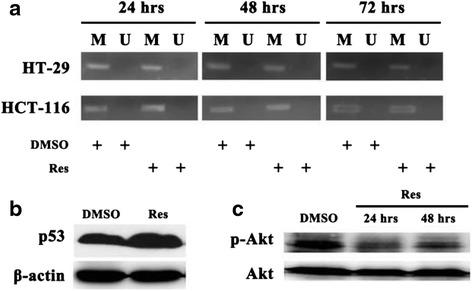
Res inhibited cell viability, proliferation, migration and invasion as well as promoted apoptosis both in HT-29 and HCT-116 CRC cells. The anti-CRC effect of Res was partially but specifically through up-regulating miR-34c which further knocked down its target KITLG; and the effect was enhanced in the presence of p53 probably through inactivating PI3K/Akt pathway. Besides, Res sensitized CRC cells to Oxa in a miR-34c dependent manner. The xenograft experiments showed that exposure to Res or Oxa suppressed tumor growth; and the efficacy was evidently augmented by the co-treatment of Res and Oxa. Likewise, miR-34c level was elevated in xenografts of Res-treated mice while the KITLG was decreased. Finally, Res clearly reduced IL-6 in xenografts.
CONCLUSION
Res suppressed CRC by specifically activating miR-34c-KITLG in vitro and in vivo; and the effect was strengthened in the presence of p53. Besides, Res exerted a synergistic effect with Oxa in a miR-34c dependent manner. We also suggested that Res-increased miR-34c could interfere IL-6-triggered CRC progression.
背景
肿瘤抑制因子miR - 34c的沉默与结直肠癌(CRC)的发生发展有关。在过去几年中,白藜芦醇(Res)已被单独或与传统化疗药物一起引入肿瘤治疗。然而,关于Res抗CRC作用的分子机制研究仍在进行中。
方法
通过细胞活力测定、软琼脂集落形成试验、流式细胞术和实时细胞分析仪,在HT - 29(p53 +)和HCT - 116(p53 -)CRC细胞系中确定Res单独或与奥沙利铂(Oxa)联合使用的抗CRC作用。通过qPCR和/或蛋白质免疫印迹法检测miR - 34c及其靶标的表达。为了评估miR - 34c在Res单独或与Oxa联合使用的抗CRC作用中的作用,分别通过慢病毒介导或特异性抑制剂上调或下调miR - 34c。为了研究Res如何增加miR - 34c,通过甲基化特异性PCR(MSP)检测miR - 34c启动子的甲基化状态。通过皮下注射HCT - 116细胞建立荷瘤小鼠模型,以评估Res单独或与Oxa联合使用在体内的抗CRC作用。通过酶联免疫吸附测定(ELISA)检测异种移植瘤中的白细胞介素 - 6(IL - 6)和肿瘤坏死因子 - α(TNF - α)。
结果
Res在HT - 29和HCT - 116 CRC细胞中均抑制细胞活力、增殖、迁移和侵袭,并促进细胞凋亡。Res的抗CRC作用部分但特异性地通过上调miR - 34c来实现,miR - 34c进一步下调其靶标KITLG;在p53存在的情况下,这种作用可能通过使磷脂酰肌醇 - 3激酶/蛋白激酶B(PI3K/Akt)信号通路失活而增强。此外,Res以miR - 34c依赖的方式使CRC细胞对Oxa敏感。异种移植实验表明,Res或Oxa处理均可抑制肿瘤生长;Res和Oxa联合治疗明显增强了疗效。同样,在Res处理的小鼠异种移植瘤中,miR - 34c水平升高而KITLG降低。最后,Res明显降低了异种移植瘤中的IL - 6。
结论
Res在体外和体内通过特异性激活miR - 34c - KITLG抑制CRC;在p53存在的情况下,这种作用增强。此外,Res以miR - 34c依赖的方式与Oxa发挥协同作用。我们还表明,Res增加的miR - 34c可能干扰IL - 6引发的CRC进展。



 Zotero 插件