
在大流行后流感的头三个季节,即2010/11年至2012/13年期间,德国儿科重症监护病房收治的甲型H1N1pdm09严重流感患儿的发病率持续居高不下。
Continued high incidence of children with severe influenza A(H1N1)pdm09 admitted to paediatric intensive care units in Germany during the first three post-pandemic influenza seasons, 2010/11-2012/13.
作者信息
Streng Andrea, Prifert Christiane, Weissbrich Benedikt, Liese Johannes G
机构信息
Department of Paediatrics, University of Würzburg, Josef-Schneider-Str. 2, 97080, Würzburg, Germany.
Institute of Virology and Immunobiology, University of Würzburg, Würzburg, Germany.
出版信息
BMC Infect Dis. 2015 Dec 18;15:573. doi: 10.1186/s12879-015-1293-1.
BACKGROUND
Previous influenza surveillance at paediatric intensive care units (PICUs) in Germany indicated increased incidence of PICU admissions for the pandemic influenza subtype A(H1N1)pdm09. We investigated incidence and clinical characteristics of influenza in children admitted to PICUs during the first three post-pandemic influenza seasons, using active screening.
METHODS
We conducted a prospective surveillance study in 24 PICUs in Bavaria (Germany) from October 2010 to September 2013. Influenza cases among children between 1 month and 16 years of age admitted to these PICUs with acute respiratory infection were confirmed by PCR analysis of respiratory secretions.
RESULTS
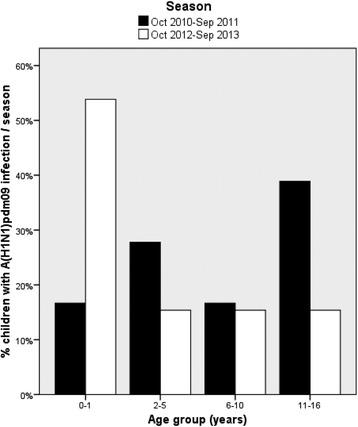
A total of 24/7/20 influenza-associated PICU admissions were recorded in the post-pandemic seasons 1/2/3; incidence estimates per 100,000 children were 1.72/0.76/1.80, respectively. Of all 51 patients, 80% had influenza A, including 65% with A(H1N1)pdm09. Influenza A(H1N1)pdm09 was almost absent in season 2 (incidence 0.11), but dominated PICU admissions in seasons 1 (incidence 1.35) and 3 (incidence 1.17). Clinical data was available for 47 influenza patients; median age was 4.8 years (IQR 1.6-11.0). The most frequent diagnoses were influenza-associated pneumonia (62%), bronchitis/bronchiolitis (32%), secondary bacterial pneumonia (26 %), and ARDS (21%). Thirty-six patients (77 %) had underlying medical conditions. Median duration of PICU stay was 3 days (IQR 1-11). Forty-seven per cent of patients received mechanical ventilation, and one patient (2%) extracorporeal membrane oxygenation; 19% were treated with oseltamivir. Five children (11%) had pulmonary sequelae. Five children (11%) died; all had underlying chronic conditions and were infected with A(H1N1)pdm09. In season 3, patients with A(H1N1)pdm09 were younger than in season 1 (p = 0.020), were diagnosed more often with bronchitis/bronchiolitis (p = 0.004), and were admitted to a PICU later after the onset of influenza symptoms (p = 0.041).
CONCLUSIONS
Active screening showed a continued high incidence of A(H1N1)pdm09-associated PICU admissions in the post-pandemic seasons 1 and 3, and indicated possible underestimation of incidence in previous German studies. The age shift of severe A(H1N1)pdm09 towards younger children may be explained by increasing immunity in the older paediatric population. The high proportion of patients with underlying chronic conditions indicates the importance of consistent implementation of the current influenza vaccination recommendations for risk groups in Germany.
背景
德国先前针对儿科重症监护病房(PICUs)开展的流感监测表明,甲型H1N1流感大流行毒株(A(H1N1)pdm09)导致入住PICUs的发病率有所增加。我们采用主动筛查的方法,调查了大流行后流感流行的前三个季节入住PICUs的儿童流感发病率及临床特征。
方法
2010年10月至2013年9月期间,我们在德国巴伐利亚州的24个PICUs开展了一项前瞻性监测研究。对因急性呼吸道感染入住这些PICUs的1个月至16岁儿童,通过呼吸道分泌物的PCR分析确诊流感病例。
结果
在大流行后第1/2/3个季节,分别记录到24/7/20例与流感相关的PICUs入院病例;每10万名儿童的发病率估计分别为1.72/0.76/1.80。在全部51例患者中,80%感染甲型流感,其中65%感染A(H1N1)pdm09。第2季几乎没有A(H1N1)pdm09(发病率0.11),但在第1季(发病率1.35)和第3季(发病率1.17),A(H1N1)pdm09导致的PICUs入院病例占主导。47例流感患者有临床数据;中位年龄为4.8岁(四分位间距1.6 - 11.0)。最常见的诊断为流感相关肺炎(62%)、支气管炎/细支气管炎(32%)、继发性细菌性肺炎(26%)和急性呼吸窘迫综合征(21%)。36例患者(77%)有基础疾病。PICUs住院时间的中位数为3天(四分位间距1 - 11)。47%的患者接受了机械通气,1例患者(2%)接受了体外膜肺氧合治疗;19%的患者接受了奥司他韦治疗。5名儿童(11%)有肺部后遗症。5名儿童(11%)死亡;均有基础慢性病且感染了A(H1N1)pdm09。在第3季,感染A(H1N1)pdm09的患者比第1季的患者年龄更小(p = 0.020),更常被诊断为支气管炎/细支气管炎(p = 0.004),且在出现流感症状后更晚入住PICUs(p = 0.041)。
结论
主动筛查显示,在大流行后第1季和第3季,A(H1N1)pdm09相关的PICUs入院病例持续高发,这表明德国先前的研究可能低估了发病率。严重A(H1N1)pdm09病例向年幼儿童转移的现象,可能是由于大龄儿童群体免疫力增强所致。基础慢性病患者比例高,表明德国持续实施针对风险群体的现行流感疫苗接种建议十分重要。
 Zotero 插件