
间歇性气动压迫对接受动脉血运重建术患者术后下肢水肿减轻及足部微循环血流正常化的影响。
Effects of Intermittent Pneumatic Compression on Reduction of Postoperative Lower Extremity Edema and Normalization of Foot Microcirculation Flow in Patients Undergoing Arterial Revascularization.
作者信息
Pawlaczyk Katarzyna, Gabriel Marcin, Urbanek Tomasz, Dzieciuchowicz Łukasz, Krasiński Zbigniew, Gabriel Zofia, Olejniczak-Nowakowska Małgorzata, Stanisić Michał
机构信息
Department of Hypertensiology, Angiology and Internal Diseases, Medical University, Poznań, Poland.
Department of General and Vascular Surgery, Medical University, Poznań, Poland.
出版信息
Med Sci Monit. 2015 Dec 21;21:3986-92. doi: 10.12659/msm.895229.
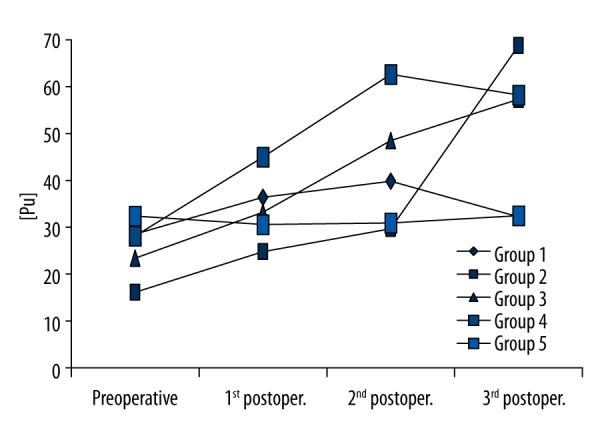
BACKGROUND In patients with chronic leg ischemia, the beneficial effect of arterial revascularization can be significantly decreased due to postoperative leg swelling. The aim of this study was to assess the effects of intermittent pneumatic compression (IPC) on skin flow normalization in patients undergoing revascularization procedures due to chronic leg ischemia. MATERIAL AND METHODS We evaluated 116 patients with chronic leg ischemia. The patients were divided into groups according to the performed treatment (endovascular or surgical) and implementation of IPC postoperatively. The leg edema assessment and microcirculation flow assessment were performed pre- and postoperatively, using percutaneous O2 pressure (TcpO2), cutaneous blood perfusion (CBP) measurements, and skin flow motion assessment. RESULTS In patients who did not receive IPC, a decrease in CBP value was observed in the 1st postoperative assessment. Among patients receiving IPC, the CBD value increased at the 1st and 2nd postoperative measurements, especially in the surgical group. The lowest TcpO2 values were observed in by-pass surgery group without IPC postoperatively. CONCLUSIONS The benefits of the by-pass procedure in patients with leg ischemia can be significantly reduced by postoperative edema. Among patients with postoperative leg edema, local tissue blood perfusion can be improved by the use of IPC, which can result in decreased local leg swelling, as well as improved skin blood perfusion and TcpO2.
背景 在慢性下肢缺血患者中,术后下肢肿胀可显著降低动脉血运重建的有益效果。本研究的目的是评估间歇性气动压迫(IPC)对因慢性下肢缺血接受血运重建手术患者皮肤血流恢复正常的影响。材料与方法 我们评估了116例慢性下肢缺血患者。根据所实施的治疗(血管内或手术)以及术后是否实施IPC将患者分组。术前和术后使用经皮氧分压(TcpO2)、皮肤血流灌注(CBP)测量以及皮肤血流运动评估进行下肢水肿评估和微循环血流评估。结果 在未接受IPC的患者中,术后第一次评估时观察到CBP值下降。在接受IPC的患者中,术后第一次和第二次测量时CBD值升高,尤其是在手术组。术后未接受IPC的旁路手术组观察到最低的TcpO2值。结论 下肢缺血患者旁路手术的益处可因术后水肿而显著降低。在术后下肢水肿患者中,使用IPC可改善局部组织血流灌注,这可导致局部下肢肿胀减轻,以及皮肤血流灌注和TcpO2改善。

 Zotero 插件