
磁遗传学:利用磁受体对神经元活动进行远程非侵入性磁激活。
Magnetogenetics: remote non-invasive magnetic activation of neuronal activity with a magnetoreceptor.
作者信息
Long Xiaoyang, Ye Jing, Zhao Di, Zhang Sheng-Jia
机构信息
School of Life Sciences, Tsinghua University, Beijing, 100084 China.
School of Medicine, Tsinghua University, Beijing, 100084 China.
出版信息
Sci Bull (Beijing). 2015;60:2107-2119. doi: 10.1007/s11434-015-0902-0. Epub 2015 Sep 14.
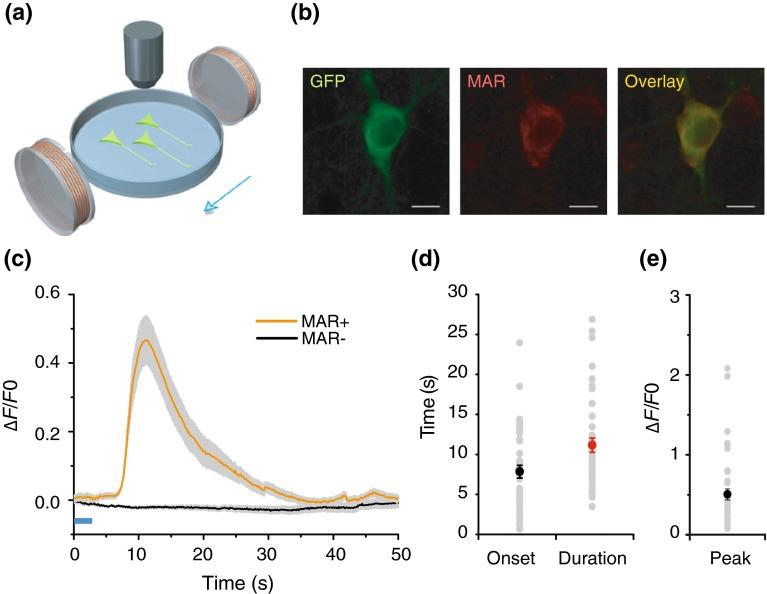
Current neuromodulation techniques such as optogenetics and deep-brain stimulation are transforming basic and translational neuroscience. These two neuromodulation approaches are, however, invasive since surgical implantation of an optical fiber or wire electrode is required. Here, we have invented a non-invasive magnetogenetics that combines the genetic targeting of a magnetoreceptor with remote magnetic stimulation. The non-invasive activation of neurons was achieved by neuronal expression of an exogenous magnetoreceptor, an iron-sulfur cluster assembly protein 1 (Isca1). In HEK-293 cells and cultured hippocampal neurons expressing this magnetoreceptor, application of an external magnetic field resulted in membrane depolarization and calcium influx in a reproducible and reversible manner, as indicated by the ultrasensitive fluorescent calcium indicator GCaMP6s. Moreover, the magnetogenetic control of neuronal activity might be dependent on the direction of the magnetic field and exhibits on-response and off-response patterns for the external magnetic field applied. The activation of this magnetoreceptor can depolarize neurons and elicit trains of action potentials, which can be triggered repetitively with a remote magnetic field in whole-cell patch-clamp recording. In transgenic expressing this magnetoreceptor in --specific muscle cells or --specific neurons, application of the external magnetic field triggered muscle contraction and withdrawal behavior of the worms, indicative of magnet-dependent activation of muscle cells and touch receptor neurons, respectively. The advantages of magnetogenetics over optogenetics are its exclusive non-invasive, deep penetration, long-term continuous dosing, unlimited accessibility, spatial uniformity and relative safety. Like optogenetics that has gone through decade-long improvements, magnetogenetics, with continuous modification and maturation, will reshape the current landscape of neuromodulation toolboxes and will have a broad range of applications to basic and translational neuroscience as well as other biological sciences. We envision a new age of magnetogenetics is coming.
当前的神经调节技术,如光遗传学和深部脑刺激,正在改变基础神经科学和转化神经科学。然而,这两种神经调节方法都是侵入性的,因为需要通过手术植入光纤或线电极。在此,我们发明了一种非侵入性磁遗传学,它将磁感受器的基因靶向与远程磁刺激相结合。通过外源性磁感受器——铁硫簇组装蛋白1(Isca1)的神经元表达实现了神经元的非侵入性激活。在表达这种磁感受器的HEK-293细胞和培养的海马神经元中,应用外部磁场会导致膜去极化和钙内流,且具有可重复性和可逆性,超灵敏荧光钙指示剂GCaMP6s显示了这一点。此外,神经元活动的磁遗传控制可能取决于磁场方向,并表现出对施加的外部磁场的开启反应和关闭反应模式。这种磁感受器的激活可使神经元去极化并引发动作电位序列,在全细胞膜片钳记录中可被远程磁场重复触发。在转基因动物中,在特定肌肉细胞或特定神经元中表达这种磁感受器,施加外部磁场分别触发了蠕虫的肌肉收缩和退缩行为,这表明肌肉细胞和触觉感受器神经元的磁依赖性激活。磁遗传学相对于光遗传学的优势在于其完全非侵入性、深度穿透、长期持续给药、无限可及性、空间均匀性和相对安全性。就像经过长达十年改进的光遗传学一样,磁遗传学随着不断的改进和成熟,将重塑当前神经调节工具箱的格局,并将在基础神经科学和转化神经科学以及其他生物科学领域有广泛应用。我们设想磁遗传学的新时代即将到来。




 Zotero 插件