
导管周围胶原微结构的增加可能导致乳腺钼靶密度升高。
Increased peri-ductal collagen micro-organization may contribute to raised mammographic density.
作者信息
McConnell James C, O'Connell Oliver V, Brennan Keith, Weiping Lisa, Howe Miles, Joseph Leena, Knight David, O'Cualain Ronan, Lim Yit, Leek Angela, Waddington Rachael, Rogan Jane, Astley Susan M, Gandhi Ashu, Kirwan Cliona C, Sherratt Michael J, Streuli Charles H
机构信息
Centre for Tissue Injury & Repair, Faculty of Medical and Human Sciences, University of Manchester, Manchester, UK.
Wellcome Trust Centre for Cell-Matrix Research and Manchester Breast Centre, Faculty of Life Sciences, University of Manchester, Manchester, UK.
出版信息
Breast Cancer Res. 2016 Jan 8;18(1):5. doi: 10.1186/s13058-015-0664-2.
BACKGROUND
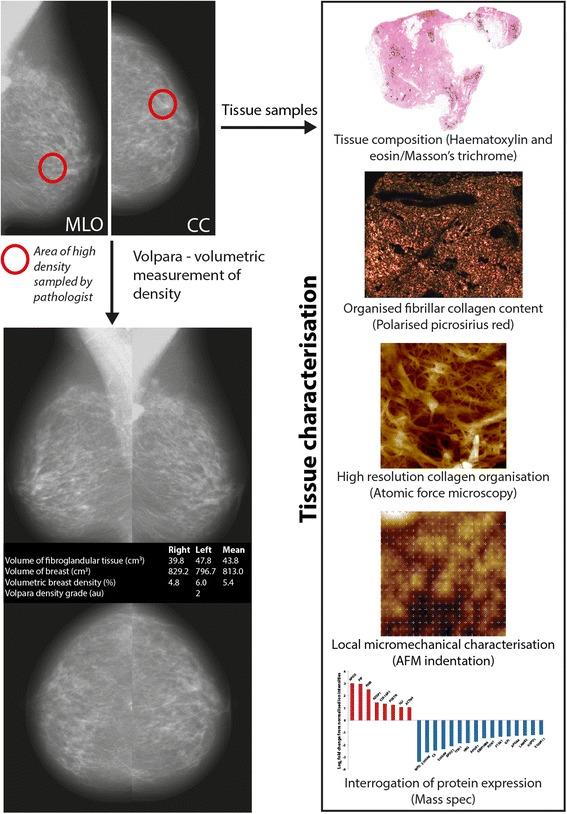
High mammographic density is a therapeutically modifiable risk factor for breast cancer. Although mammographic density is correlated with the relative abundance of collagen-rich fibroglandular tissue, the causative mechanisms, associated structural remodelling and mechanical consequences remain poorly defined. In this study we have developed a new collaborative bedside-to-bench workflow to determine the relationship between mammographic density, collagen abundance and alignment, tissue stiffness and the expression of extracellular matrix organising proteins.
METHODS
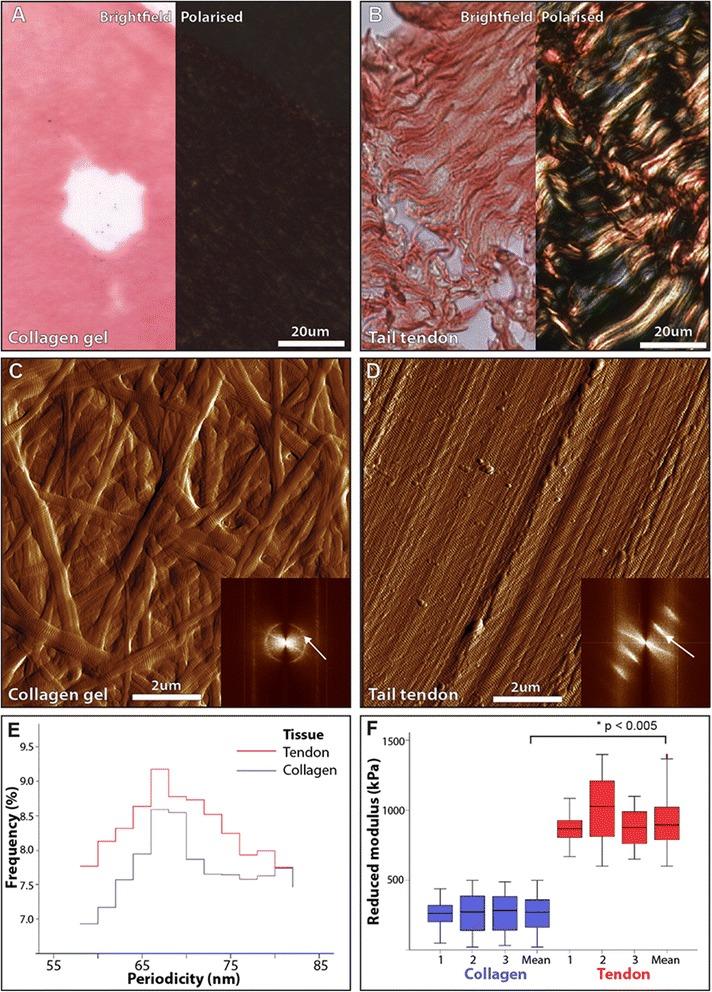
Mammographic density was assessed in 22 post-menopausal women (aged 54-66 y). A radiologist and a pathologist identified and excised regions of elevated non-cancerous X-ray density prior to laboratory characterization. Collagen abundance was determined by both Masson's trichrome and Picrosirius red staining (which enhances collagen birefringence when viewed under polarised light). The structural specificity of these collagen visualisation methods was determined by comparing the relative birefringence and ultrastructure (visualised by atomic force microscopy) of unaligned collagen I fibrils in reconstituted gels with the highly aligned collagen fibrils in rat tail tendon. Localised collagen fibril organisation and stiffness was also evaluated in tissue sections by atomic force microscopy/spectroscopy and the abundance of key extracellular proteins was assessed using mass spectrometry.
RESULTS
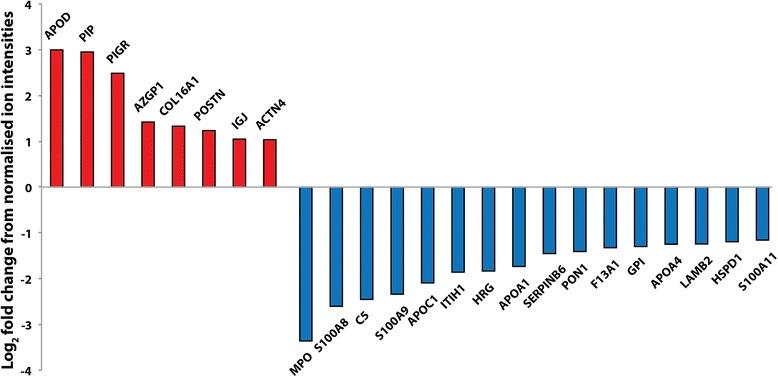
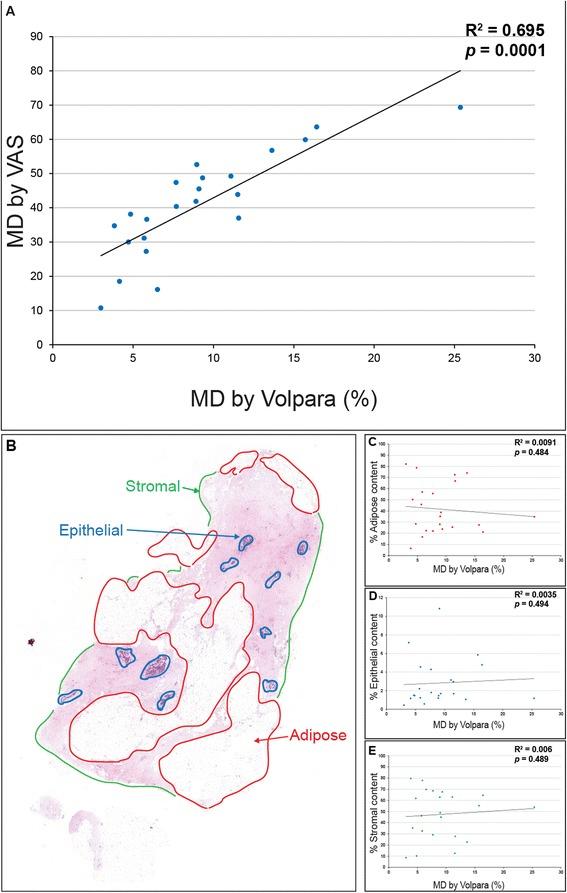
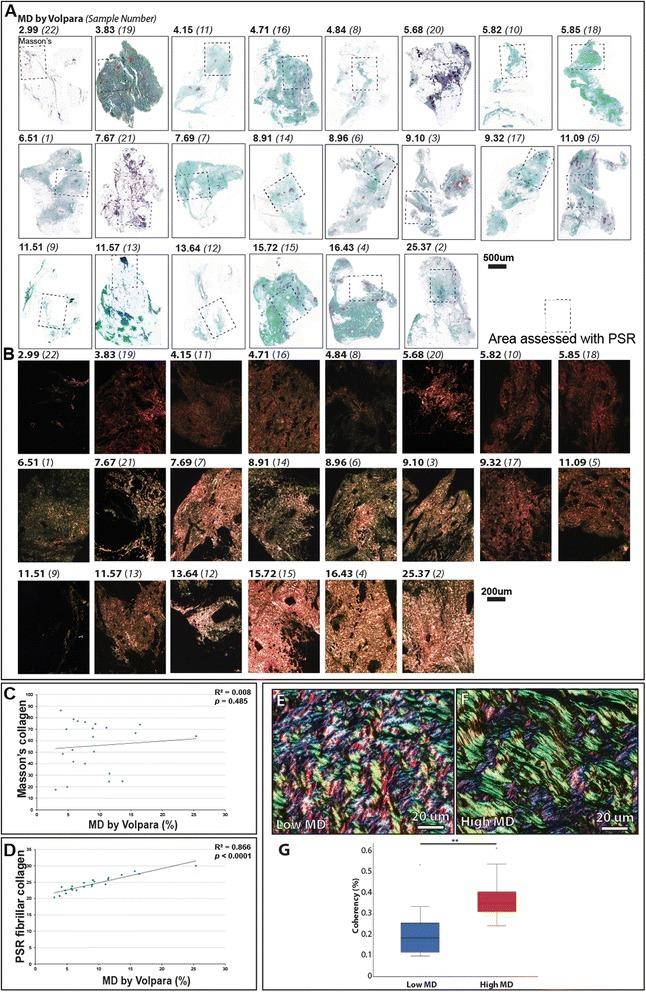
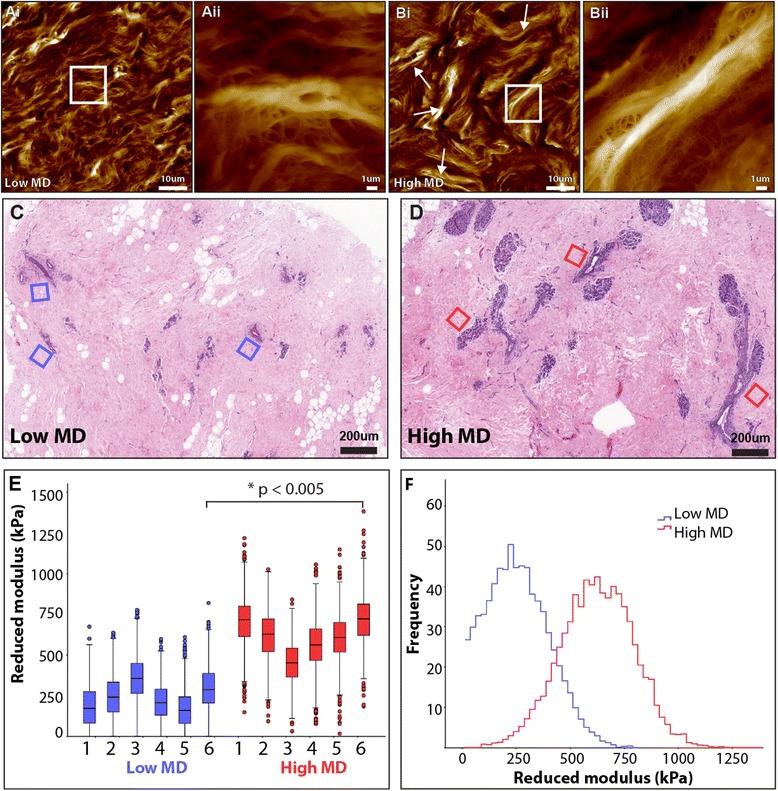
Mammographic density was positively correlated with the abundance of aligned periductal fibrils rather than with the abundance of amorphous collagen. Compared with matched tissue resected from the breasts of low mammographic density patients, the highly birefringent tissue in mammographically dense breasts was both significantly stiffer and characterised by large (>80 μm long) fibrillar collagen bundles. Subsequent proteomic analyses not only confirmed the absence of collagen fibrosis in high mammographic density tissue, but additionally identified the up-regulation of periostin and collagen XVI (regulators of collagen fibril structure and architecture) as potential mediators of localised mechanical stiffness.
CONCLUSIONS
These preliminary data suggest that remodelling, and hence stiffening, of the existing stromal collagen microarchitecture promotes high mammographic density within the breast. In turn, this aberrant mechanical environment may trigger neoplasia-associated mechanotransduction pathways within the epithelial cell population.
背景
乳腺钼靶高密度是乳腺癌一种可通过治疗改变的风险因素。尽管乳腺钼靶密度与富含胶原蛋白的纤维腺组织的相对丰度相关,但其致病机制、相关的结构重塑和力学后果仍不清楚。在本研究中,我们开发了一种新的从床边到实验台的协作工作流程,以确定乳腺钼靶密度、胶原蛋白丰度和排列、组织硬度以及细胞外基质组织蛋白表达之间的关系。
方法
对22名绝经后女性(年龄54 - 66岁)的乳腺钼靶密度进行评估。在实验室表征之前,由一名放射科医生和一名病理科医生识别并切除非癌性X线密度升高的区域。通过Masson三色染色和苦味酸天狼星红染色(在偏振光下观察时可增强胶原蛋白双折射)确定胶原蛋白丰度。通过比较重组凝胶中未排列的I型胶原纤维与大鼠尾腱中高度排列的胶原纤维的相对双折射和超微结构(通过原子力显微镜观察),确定这些胶原蛋白可视化方法的结构特异性。还通过原子力显微镜/光谱法在组织切片中评估局部胶原纤维组织和硬度,并使用质谱法评估关键细胞外蛋白的丰度。
结果
乳腺钼靶密度与排列的导管周围纤维的丰度呈正相关,而与无定形胶原蛋白的丰度无关。与从乳腺钼靶低密度患者乳房切除的匹配组织相比,乳腺钼靶高密度乳房中高双折射组织不仅明显更硬,而且其特征是存在大的(>80μm长)纤维状胶原束。随后的蛋白质组学分析不仅证实了乳腺钼靶高密度组织中不存在胶原纤维化,而且还鉴定出骨膜蛋白和胶原蛋白XVI(胶原纤维结构和结构的调节剂)的上调是局部机械硬度的潜在介质。
结论
这些初步数据表明,现有基质胶原微结构的重塑以及由此导致的硬化促进了乳腺内的高乳腺钼靶密度。反过来,这种异常的力学环境可能会触发上皮细胞群体内与肿瘤形成相关的机械转导途径。
 Zotero 插件