
青年期和中年期的生活方式改变与心血管疾病风险及全因死亡率:多廷赫姆队列研究
Lifestyle Changes in Young Adulthood and Middle Age and Risk of Cardiovascular Disease and All-Cause Mortality: The Doetinchem Cohort Study.
作者信息
Hulsegge Gerben, Looman Moniek, Smit Henriëtte A, Daviglus Martha L, van der Schouw Yvonne T, Verschuren W M Monique
机构信息
Center for Nutrition, Prevention and Health Services, National Institute for Public Health and the Environment, Bilthoven, The Netherlands (G.H., M.L., M.V.) Julius Center for Health Sciences and Primary Care, University Medical Center Utrecht, Utrecht, The Netherlands (G.H., H.S., Y.T.S., M.V.).
Center for Nutrition, Prevention and Health Services, National Institute for Public Health and the Environment, Bilthoven, The Netherlands (G.H., M.L., M.V.).
出版信息
J Am Heart Assoc. 2016 Jan 13;5(1):e002432. doi: 10.1161/JAHA.115.002432.
BACKGROUND
The associations between overall lifestyle profile and cardiovascular disease (CVD) and death have been mainly investigated in cross-sectional studies. The full benefits of a healthy lifestyle may therefore be underestimated, and the magnitude of benefits associated with changes in lifestyle remains unclear. We quantified the association of changes in lifestyle profiles over 5 years with risk of CVD and all-cause mortality.
METHODS AND RESULTS
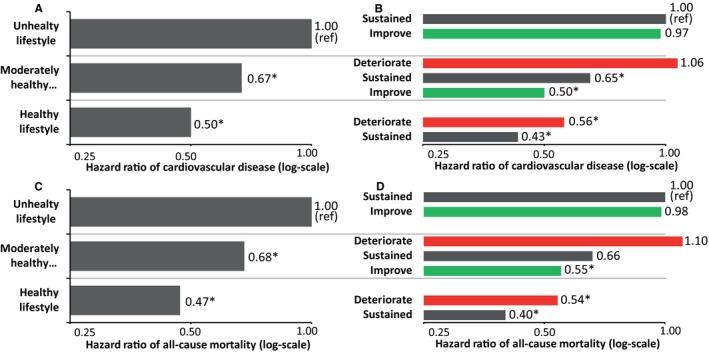
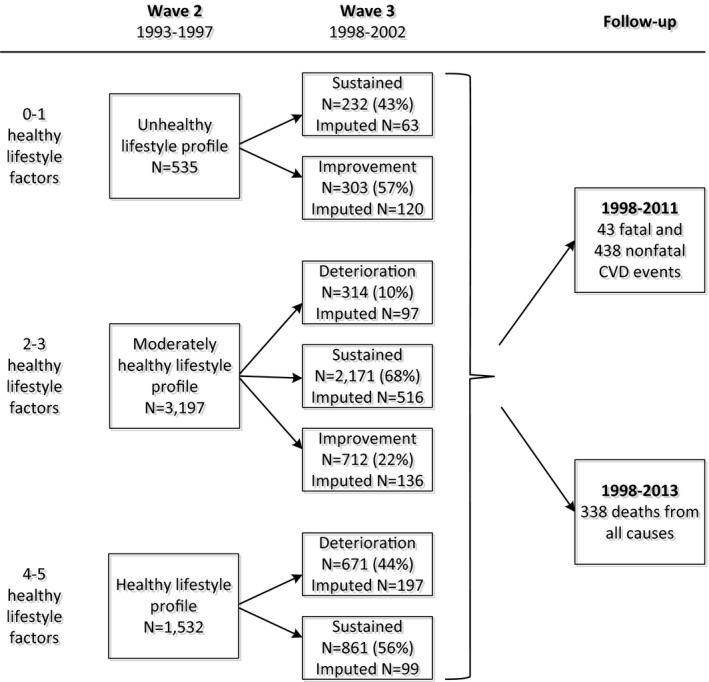
Lifestyle factors (ie, diet, physical activity, smoking, alcohol consumption) and body mass index were assessed and dichotomized as healthy/unhealthy among 5263 adults ages 26 to 66 in 1993-1997 and 5 years later (1998-2002). Multivariable-adjusted hazard ratios (HRs) and corresponding 95% confidence intervals (CIs) were estimated to quantify associations of change in lifestyle with fatal/nonfatal CVD and all-cause mortality that occurred 8 to 15 years after 1998-2002. Independent of baseline lifestyles, each decrement in number of healthy lifestyle factors was, on average, associated with 35% higher risk of CVD (HR, 1.35; 95% CI, 1.12-1.63) and 37% higher risk of all-cause mortality (HR, 1.37; 95% CI, 1.10-1.70); no association was noted with increase in the number of healthy lifestyle factors (P>0.5). Individuals who maintained 4 to 5 healthy lifestyle factors had 2.5 times lower risk of CVD (HR, 0.43; 95% CI, 0.25-0.63) and all-cause mortality (HR, 0.40; 95% CI, 0.22-0.73) than those who maintained only 0 to 1 healthy lifestyle factor.
CONCLUSIONS
Our findings suggest that the benefits of healthy lifestyles may be easier lost than gained over a 5-year period. This underscores the need for efforts to promote maintenance of healthy lifestyles throughout the life course.
背景
总体生活方式概况与心血管疾病(CVD)及死亡之间的关联主要在横断面研究中进行了调查。因此,健康生活方式的全部益处可能被低估,且与生活方式改变相关的益处程度仍不明确。我们对5年内生活方式概况的变化与CVD风险及全因死亡率之间的关联进行了量化。
方法与结果
在1993 - 1997年对5263名年龄在26至66岁的成年人进行了生活方式因素(即饮食、体育活动、吸烟、饮酒)和体重指数的评估,并将其分为健康/不健康两类,5年后(1998 - 2002年)再次评估。估计多变量调整后的风险比(HRs)及相应的95%置信区间(CIs),以量化生活方式变化与1998 - 2002年后8至15年发生的致命/非致命CVD及全因死亡率之间的关联。独立于基线生活方式,健康生活方式因素数量的每一项减少,平均而言,与CVD风险升高35%(HR,1.35;95% CI,1.12 - 1.63)及全因死亡率升高37%(HR,1.37;95% CI,1.10 - 1.70)相关;未观察到与健康生活方式因素数量增加有关联(P>0.5)。维持4至5个健康生活方式因素的个体发生CVD(HR,0.43;95% CI,0.25 - 0.63)及全因死亡率(HR,0.40;95% CI,0.22 - 0.73)的风险比仅维持0至1个健康生活方式因素的个体低2.5倍。
结论
我们的研究结果表明,在5年期间,健康生活方式的益处可能失之易而得之难。这突出了在整个生命过程中努力促进维持健康生活方式的必要性。
 Zotero 插件