
甲酰甲硫氨酸作为细菌蛋白质N端的降解信号。
Formyl-methionine as a degradation signal at the N-termini of bacterial proteins.
作者信息
Piatkov Konstantin I, Vu Tri T M, Hwang Cheol-Sang, Varshavsky Alexander
机构信息
Division of Biology, California Institute of Technology, Pasadena, CA 91125, USA; Center for Biotechnology and Biomedicine, Skolkovo Institute of Science and Technology, Moscow, 143026, Russia.
Division of Biology, California Institute of Technology, Pasadena, CA 91125, USA.
出版信息
Microb Cell. 2015;2(10):376-393. doi: 10.15698/mic2015.10.231.
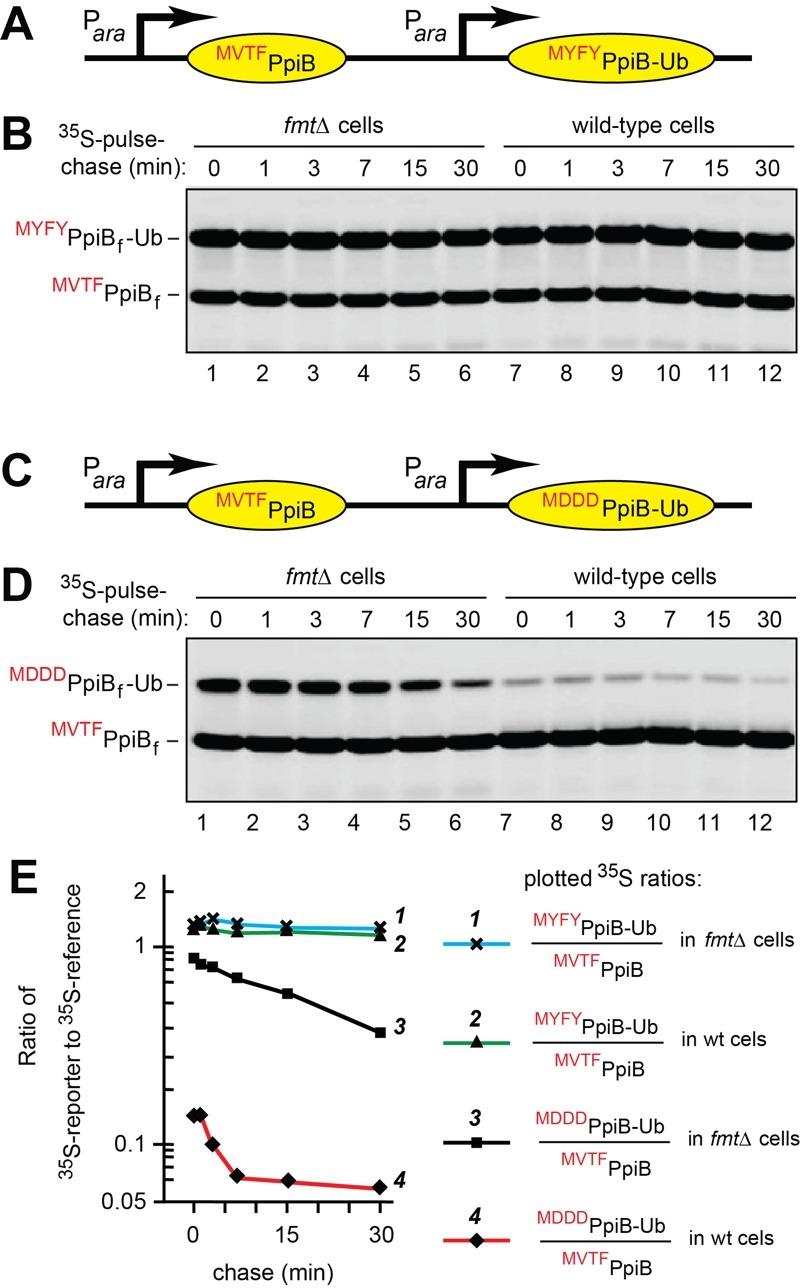
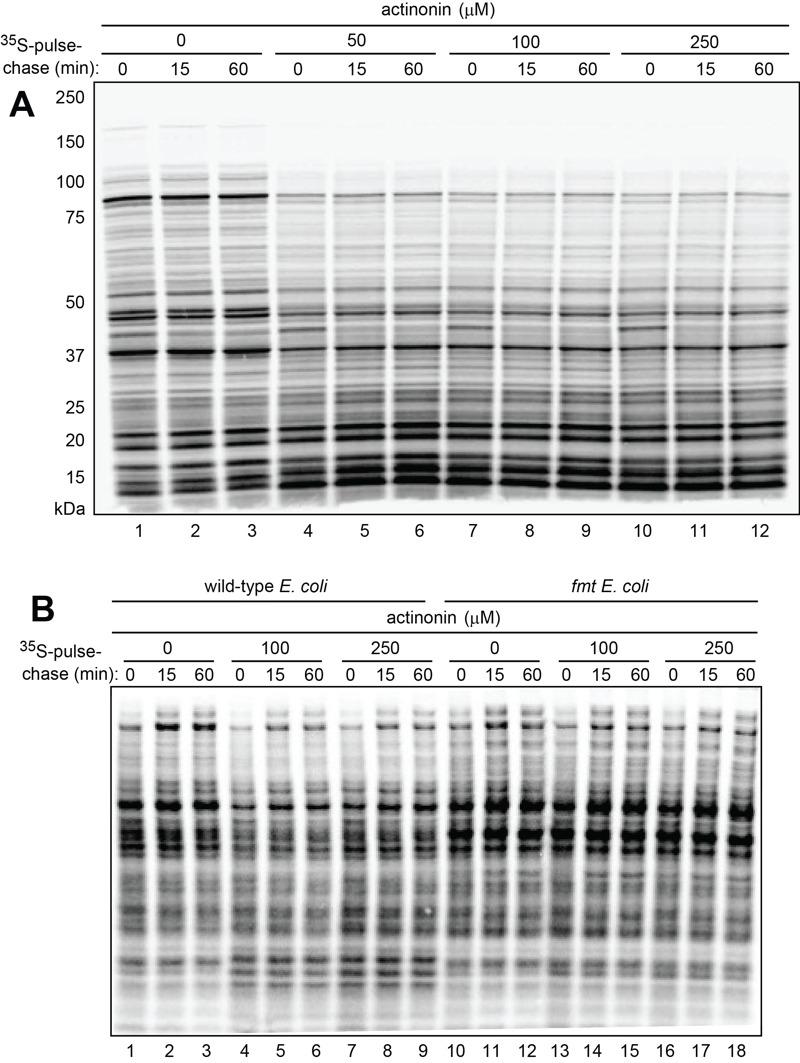
In bacteria, all nascent proteins bear the pretranslationally formed N-terminal formyl-methionine (fMet) residue. The fMet residue is cotranslationally deformylated by a ribosome-associated deformylase. The formylation of N-terminal Met in bacterial proteins is not strictly essential for either translation or cell viability. Moreover, protein synthesis by the cytosolic ribosomes of eukaryotes does not involve the formylation of N-terminal Met. What, then, is the main biological function of this metabolically costly, transient, and not strictly essential modification of N-terminal Met, and why has Met formylation not been eliminated during bacterial evolution? One possibility is that the similarity of the formyl and acetyl groups, their identical locations in N-terminally formylated (Nt-formylated) and Nt-acetylated proteins, and the recently discovered proteolytic function of Nt-acetylation in eukaryotes might also signify a proteolytic role of Nt-formylation in bacteria. We addressed this hypothesis about fMet-based degradation signals, termed fMet/N-degrons, using specific mutants, pulse-chase degradation assays, and protein reporters whose deformylation was altered, through site-directed mutagenesis, to be either rapid or relatively slow. Our findings strongly suggest that the formylated N-terminal fMet can act as a degradation signal, largely a cotranslational one. One likely function of fMet/N-degrons is the control of protein quality. In bacteria, the rate of polypeptide chain elongation is nearly an order of magnitude higher than in eukaryotes. We suggest that the faster emergence of nascent proteins from bacterial ribosomes is one mechanistic and evolutionary reason for the pretranslational design of bacterial fMet/N-degrons, in contrast to the cotranslational design of analogous Ac/N-degrons in eukaryotes.
在细菌中,所有新生蛋白质都带有翻译前形成的N端甲酰甲硫氨酸(fMet)残基。fMet残基在翻译过程中被核糖体相关的去甲酰化酶去甲酰化。细菌蛋白质中N端甲硫氨酸的甲酰化对于翻译或细胞活力并非严格必需。此外,真核生物胞质核糖体的蛋白质合成不涉及N端甲硫氨酸的甲酰化。那么,这种代谢成本高昂、短暂且并非严格必需的N端甲硫氨酸修饰的主要生物学功能是什么,以及为什么在细菌进化过程中甲硫氨酸甲酰化没有被消除呢?一种可能性是,甲酰基和乙酰基的相似性、它们在N端甲酰化(Nt-甲酰化)和Nt-乙酰化蛋白质中的相同位置,以及最近在真核生物中发现的Nt-乙酰化的蛋白水解功能,可能也意味着Nt-甲酰化在细菌中具有蛋白水解作用。我们使用特定突变体、脉冲追踪降解试验以及通过定点诱变改变去甲酰化速度使其快速或相对缓慢的蛋白质报告基因,探讨了关于基于fMet的降解信号(称为fMet/N-降解子)的这一假设。我们的研究结果强烈表明,甲酰化的N端fMet可以作为一种降解信号,主要是翻译共有的信号。fMet/N-降解子的一个可能功能是控制蛋白质质量。在细菌中,多肽链延伸的速度比真核生物快近一个数量级。我们认为,与真核生物中类似的Ac/N-降解子的翻译共有的设计相反,细菌核糖体中新生蛋白质更快出现是细菌fMet/N-降解子翻译前设计的一个机制和进化原因。


 Zotero 插件