
病毒诱导的哮喘加重小鼠模型中上游TH2细胞因子表达增加。
Increased expression of upstream TH2-cytokines in a mouse model of viral-induced asthma exacerbation.
作者信息
Mahmutovic Persson Irma, Akbarshahi Hamid, Menzel Mandy, Brandelius Angelica, Uller Lena
机构信息
Department Experimental Medical Science, Unit of Respiratory Immunopharmacology, Lund University, BMC D12, 221 84, Lund, Sweden.
出版信息
J Transl Med. 2016 Feb 16;14:52. doi: 10.1186/s12967-016-0808-x.
BACKGROUND
Exacerbations of asthma caused by respiratory viral infections are serious conditions in need of novel treatment. To this end animal models of asthma exacerbations are warranted. We have shown that dsRNA challenges or rhinoviral infection produce exacerbation effects in mice with ovalbumin (OVA)-induced allergic asthma. However, house dust mite (HDM) is a more human asthma-relevant allergen than OVA. We thus hypothesised that dsRNA challenges in mice with HDM-induced experimental asthma would produce important translational features of asthma exacerbations.
METHOD
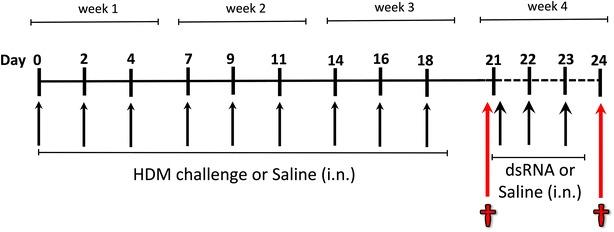
Mouse airways were challenged locally with HDM or saline three times a week for three weeks to establish experimental asthma. Then daily local dsRNA challenges were given for three consecutive days to induce exacerbation. Bronchoalveolar lavage fluid (BALF) was analysed for inflammatory cells, total protein, the necrosis marker LDH and the alarmin ATP. Lung homogenates were analysed for mRNA expression (RT-qPCR) of TNF-α, CCL2, CCL5, IL-1β, IL-33, thymic stromal lymphopoietin (TSLP), and IL-25 as well as pattern recognition receptors (PRRs) RIG-I, MDA5 and TLR3. Lung tissue IL-33 was analysed with ELISA and PRRs were quantified by western blot. Immunohistochemistry indicated lung distribution of IL-33.
RESULTS
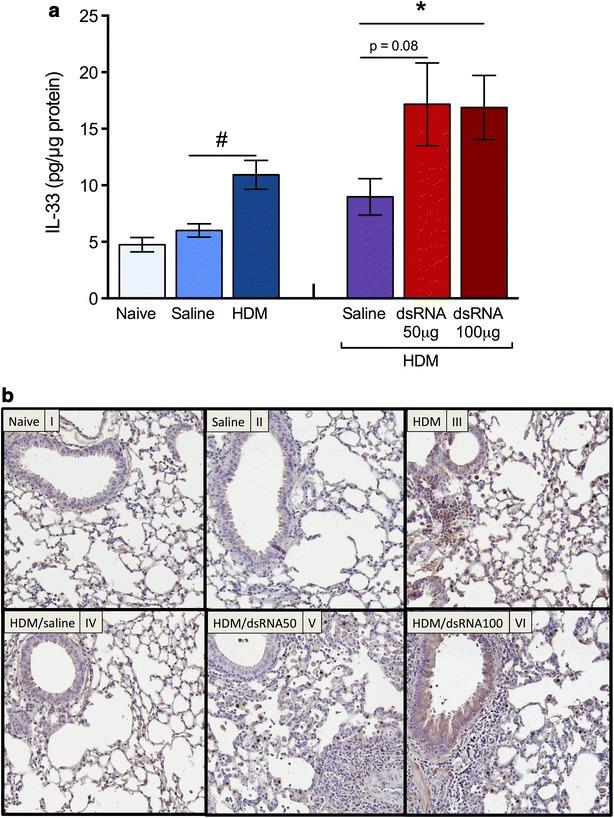
HDM challenge alone caused sustained increase in BALF total protein, eosinophils, lymphocytes and neutrophils, and transient increase in lung tissue expression of TSLP, IL-33 and TNF-α. dsRNA-induced exacerbation markedly and dose-dependently exaggerated these effects. Further, BALF levels of LDH and ATP, and lung tissue expression of CCL2, CCL5, IL-1β, IL-25 and PRRs were increased exclusively at the exacerbations. Lung protein levels of IL-33 were transiently increased by HDM and further increased at exacerbation.
CONCLUSION
We demonstrate several novel aspects of HDM-induced experimental asthma and added exacerbation effects of dsRNA. General inflammatory parameters in BALF such as exuded proteins, mixed granulocytes, LDH and ATP were increased at the present exacerbations as they are in human asthma exacerbations. We suggest that this model of asthma exacerbation involving dsRNA challenges given to mice with established HDM-induced asthma has translational value and suggest that it may be particularly suited for in vivo studies involving pharmacological effects on exacerbation-induced expression of major upstream TH2-cytokines; IL-33, TSLP and IL-25, as well as PRRs.
背景
呼吸道病毒感染引起的哮喘急性加重是需要新治疗方法的严重病症。为此,哮喘急性加重的动物模型很有必要。我们已经表明,双链RNA(dsRNA)刺激或鼻病毒感染会在卵清蛋白(OVA)诱导的过敏性哮喘小鼠中产生加重效应。然而,屋尘螨(HDM)是比OVA更与人类哮喘相关的过敏原。因此,我们假设在HDM诱导的实验性哮喘小鼠中进行dsRNA刺激会产生哮喘急性加重的重要转化特征。
方法
每周对小鼠气道进行三次局部HDM或生理盐水刺激,持续三周以建立实验性哮喘。然后连续三天每天进行局部dsRNA刺激以诱导急性加重。分析支气管肺泡灌洗液(BALF)中的炎性细胞、总蛋白、坏死标志物乳酸脱氢酶(LDH)和警报素ATP。分析肺匀浆中肿瘤坏死因子-α(TNF-α)、趋化因子配体2(CCL2)、趋化因子配体5(CCL5)、白细胞介素-1β(IL-1β)、白细胞介素-33(IL-33)、胸腺基质淋巴细胞生成素(TSLP)和白细胞介素-25(IL-25)的mRNA表达(逆转录定量聚合酶链反应,RT-qPCR)以及模式识别受体(PRR)视黄酸诱导基因I(RIG-I)、黑色素瘤分化相关基因5(MDA5)和Toll样受体3(TLR3)。用酶联免疫吸附测定(ELISA)分析肺组织IL-33,并通过蛋白质免疫印迹法定量PRR。免疫组织化学显示IL-33在肺中的分布。
结果
单独的HDM刺激导致BALF总蛋白、嗜酸性粒细胞、淋巴细胞和中性粒细胞持续增加,以及肺组织中TSLP、IL-33和TNF-α的表达短暂增加。dsRNA诱导的急性加重显著且剂量依赖性地放大了这些效应。此外,LDH和ATP的BALF水平以及CCL2、CCL5、IL-1β、IL-25和PRR的肺组织表达仅在急性加重时增加。HDM使肺组织中IL-33蛋白水平短暂升高,并在急性加重时进一步升高。
结论
我们证明了HDM诱导的实验性哮喘的几个新方面以及dsRNA的附加加重效应。BALF中的一般炎症参数,如渗出蛋白、混合粒细胞、LDH和ATP,在当前的急性加重中增加,就像在人类哮喘急性加重中一样。我们认为,这种涉及对已建立HDM诱导哮喘的小鼠进行dsRNA刺激的哮喘急性加重模型具有转化价值,并表明它可能特别适合用于涉及对急性加重诱导的主要上游辅助性T细胞2(TH2)细胞因子;IL-33、TSLP和IL-25以及PRR的药理作用的体内研究。



 Zotero 插件