
聚糖在经历上皮-间质转化的癌细胞中的作用。
Role of Glycans in Cancer Cells Undergoing Epithelial-Mesenchymal Transition.
作者信息
Li Xiang, Wang Xin, Tan Zengqi, Chen Si, Guan Feng
机构信息
Wuxi Medical School, Jiangnan University , Wuxi , China.
The Key Laboratory of Carbohydrate Chemistry and Biotechnology, Ministry of Education, School of Biotechnology, Jiangnan University , Wuxi , China.
出版信息
Front Oncol. 2016 Feb 17;6:33. doi: 10.3389/fonc.2016.00033. eCollection 2016.
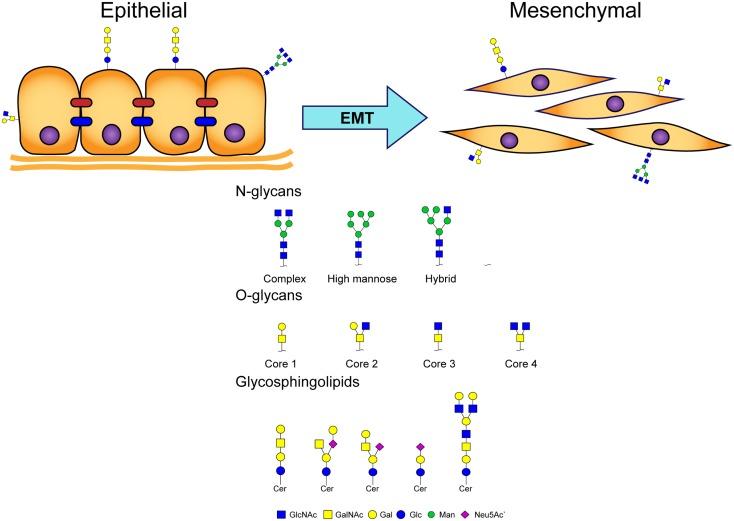
The term "cancer" refers to a group of diseases involving abnormal cell growth with the potential to invade or spread to other parts of the body. Epithelial-mesenchymal transition (EMT), a process whereby epithelial cells lose their cell polarity and cell-cell adhesion ability, and acquire migratory and invasive properties to gain mesenchymal phenotype, is an important step leading to tumor metastasis. Glycans, such as N-glycans, O-glycans, and glycosphingolipids, are involved in numerous biological processes, including inflammation, virus/bacteria-host interactions, cell-cell interactions, morphogenesis, and cancer development and progression. Aberrant expression of glycans has been observed in several EMT models, and the functional roles of such glycans in cancer development and progression has been investigated. We summarize here recent research progress regarding the functions of glycans in cancer cells undergoing EMT. Better understanding of the mechanisms underlying aberrant glycan patterns in EMT and cancer will facilitate the development of such glycans as cancer biomarkers or as targets in design and synthesis of anti-tumor drugs.
“癌症”一词指的是一组涉及异常细胞生长的疾病,这些细胞有侵入或扩散到身体其他部位的可能性。上皮-间质转化(EMT)是上皮细胞失去其细胞极性和细胞间黏附能力,并获得迁移和侵袭特性以获得间质表型的过程,是导致肿瘤转移的重要步骤。聚糖,如N-聚糖、O-聚糖和糖鞘脂,参与了众多生物学过程,包括炎症、病毒/细菌与宿主的相互作用、细胞间相互作用、形态发生以及癌症的发生和发展。在几种EMT模型中已观察到聚糖的异常表达,并且已经对这些聚糖在癌症发生和发展中的功能作用进行了研究。我们在此总结了关于聚糖在经历EMT的癌细胞中的功能的近期研究进展。更好地理解EMT和癌症中聚糖异常模式的潜在机制将有助于开发此类聚糖作为癌症生物标志物或作为抗肿瘤药物设计和合成的靶点。
 Zotero 插件