
O-糖基化:葡萄糖与细胞分化之间的桥梁。
O-GlcNAcylation: a bridge between glucose and cell differentiation.
机构信息
Department of Orthopedics, Xinqiao Hospital, Third Military Medical University, Chongqing, China.
Center for Evidence-based and Translational Medicine, Zhongnan Hospital, Wuhan University, Wuhan, China.
出版信息
J Cell Mol Med. 2016 May;20(5):769-81. doi: 10.1111/jcmm.12807. Epub 2016 Mar 1.
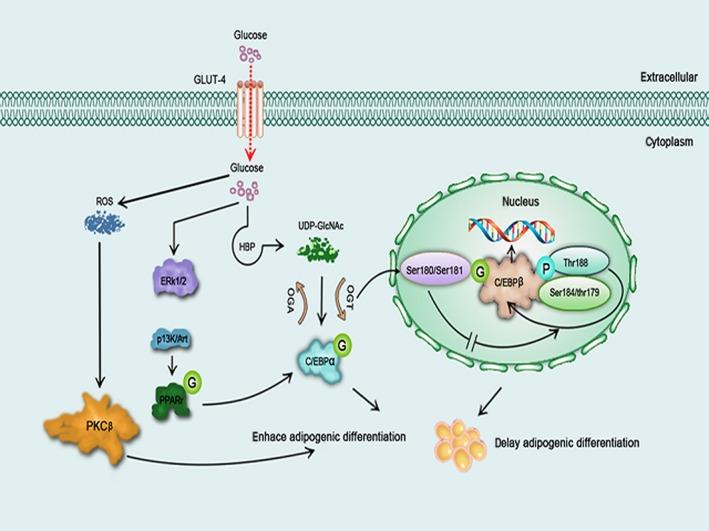
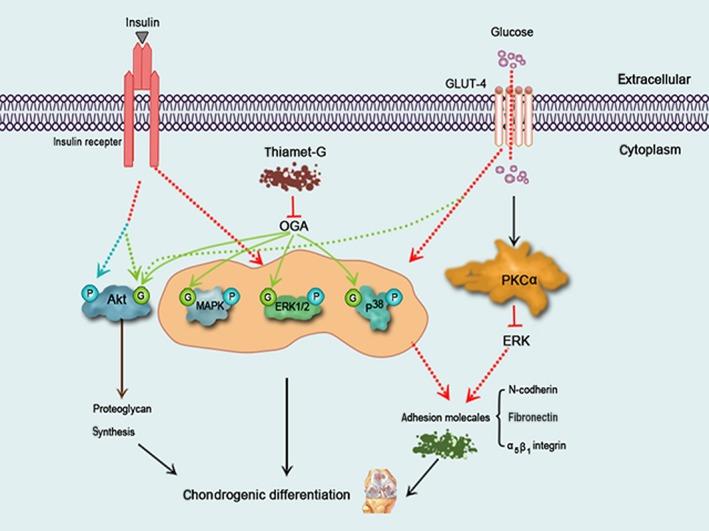
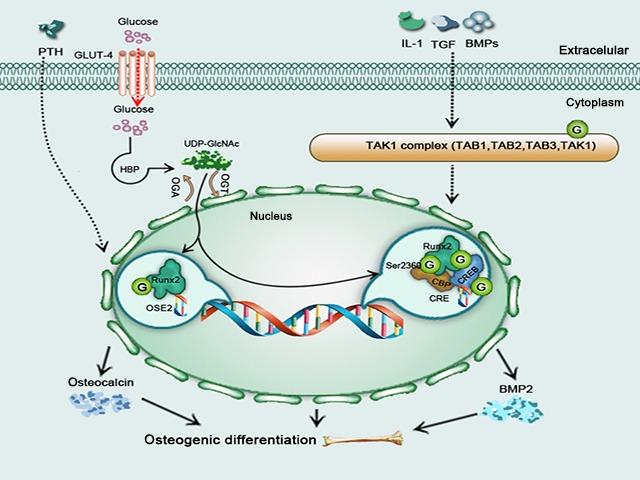
Glucose is the major energy supply and a critical metabolite for most cells and is especially important when cell is differentiating. High or low concentrations of glucose enhances or inhibits the osteogenic, chondrogenic and adipogenic differentiation of cell via the insulin, transforming growth factor-β and peroxisome proliferator-activated receptor γ pathways, among others. New evidence implicates the hexosamine biosynthetic pathway as a mediator of crosstalk between glucose flux, cellular signalling and epigenetic regulation of cell differentiation. Extracellular glucose flux alters intracellular O-GlcNAcylation levels through the hexosamine biosynthetic pathway. Signalling molecules that are important for cell differentiation, including protein kinase C, extracellular signal-regulated kinase, Runx2, CCAAT/enhancer-binding proteins, are modified by O-GlcNAcylation. Thus, O-GlcNAcylation markedly alters cell fate during differentiation via the post-transcriptional modification of proteins. Furthermore, O-GlcNAcylation and phosphorylation show complex interactions during cell differentiation: they can either non-competitively occupy different sites on a substrate or competitively occupy a single site or proximal sites. Therefore, the influence of glucose on cell differentiation via O-GlcNAcylation offers a potential target for controlling tissue homoeostasis and regeneration in ageing and disease. Here, we review recent progress establishing an emerging relationship among glucose concentration, O-GlcNAcylation levels and cell differentiation.
葡萄糖是大多数细胞的主要能量供应物和关键代谢物,在细胞分化时尤为重要。高浓度或低浓度的葡萄糖通过胰岛素、转化生长因子-β和过氧化物酶体增殖物激活受体 γ 等途径增强或抑制细胞的成骨、成软骨和成脂分化。新的证据表明,己糖胺生物合成途径是葡萄糖通量、细胞信号转导和细胞分化的表观遗传调控之间串扰的介质。细胞外葡萄糖通量通过己糖胺生物合成途径改变细胞内 O-GlcNAc 化水平。对于细胞分化很重要的信号分子,包括蛋白激酶 C、细胞外信号调节激酶、Runx2、CCAAT/增强子结合蛋白,都被 O-GlcNAc 化修饰。因此,O-GlcNAc 化通过蛋白质的转录后修饰显著改变分化过程中的细胞命运。此外,O-GlcNAc 化和磷酸化在细胞分化过程中表现出复杂的相互作用:它们可以非竞争性地占据底物上的不同位点,或者竞争性地占据单个位点或临近位点。因此,葡萄糖通过 O-GlcNAc 化对细胞分化的影响为控制衰老和疾病中组织内稳态和再生提供了一个潜在的靶点。在这里,我们综述了最近在建立葡萄糖浓度、O-GlcNAc 化水平和细胞分化之间新兴关系方面的进展。

 Zotero 插件