
出生体重与前列腺癌的总体风险以及侵袭性/致死性前列腺癌风险相关吗?一项系统综述和荟萃分析。
Is birthweight associated with total and aggressive/lethal prostate cancer risks? A systematic review and meta-analysis.
作者信息
Zhou Cindy Ke, Sutcliffe Siobhan, Welsh Judith, Mackinnon Karen, Kuh Diana, Hardy Rebecca, Cook Michael B
机构信息
Division of Cancer Epidemiology and Genetics, National Cancer Institute, National Institutes of Health, NIH, DHHS, 9609 Medical Center Drive, MSC 9774, Bethesda, MD 20892-9774, USA.
Division of Public Health Sciences and the Siteman Cancer Center, Department of Surgery, Washington University School of Medicine, St Louis, MO, USA.
出版信息
Br J Cancer. 2016 Mar 29;114(7):839-48. doi: 10.1038/bjc.2016.38. Epub 2016 Mar 1.
BACKGROUND
It has been hypothesised that intrauterine exposures are important for subsequent prostate cancer risk. Prior epidemiological studies have used birthweight as a proxy of cumulative intrauterine exposures to test this hypothesis, but results have been inconsistent partly because of limited statistical power.
METHODS
We investigated birthweight in relation to prostate cancer in the Medical Research Council (MRC) National Survey of Health and Development (NSHD) using Cox proportional hazards models. We then conducted a meta-analysis of birthweight in relation to total and aggressive/lethal prostate cancer risks, combining results from the NSHD analysis with 13 additional studies on this relationship identified from a systematic search in four major scientific literature databases through January 2015.
RESULTS
Random-effects models found that per kg increase in birthweight was positively associated with total (OR=1.02, 95% confidence interval (95% CI)=1.00, 1.05; I(2)=13%) and aggressive/lethal prostate cancer (OR=1.08, 95% CI=0.99, 1.19; I(2)=40%). Sensitivity analyses restricted to studies with birthweight extracted from medical records demonstrated stronger positive associations with total (OR=1.11, 95% CI=1.03, 1.19; I(2)=0%) and aggressive/lethal (OR=1.37, 95% CI=1.09, 1.74; I(2)=0%) prostate cancer. These studies heavily overlapped with those based in Nordic countries.
CONCLUSIONS
This study provides evidence that heavier birthweight may be associated with modest increased risks of total and aggressive/lethal prostate cancer, which supports the hypothesis that intrauterine exposures may be related to subsequent prostate cancer risks.
背景
有假设认为,子宫内暴露对后续前列腺癌风险具有重要影响。既往流行病学研究使用出生体重作为子宫内累积暴露的替代指标来检验这一假设,但结果并不一致,部分原因是统计效力有限。
方法
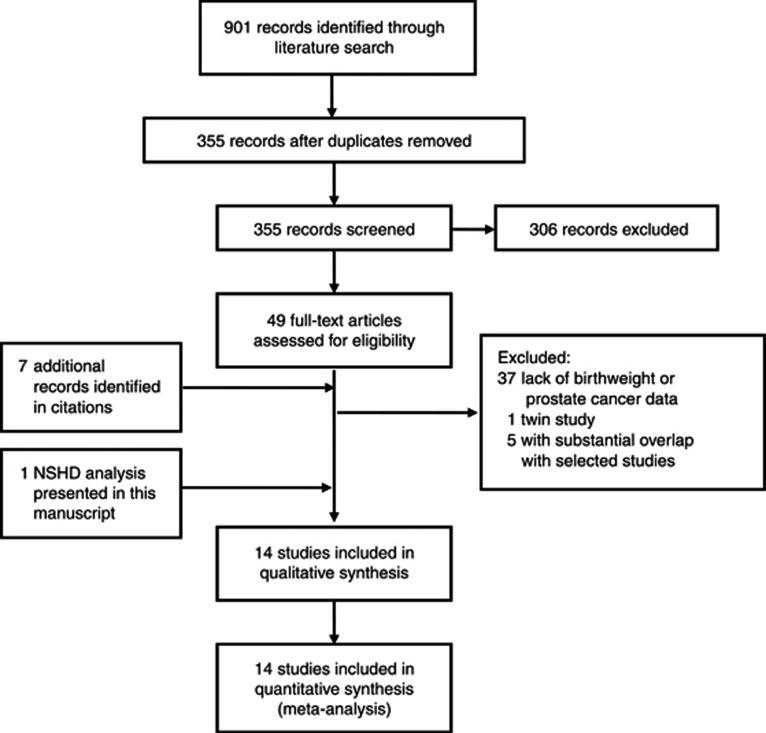
我们在医学研究理事会(MRC)全国健康与发展调查(NSHD)中,使用Cox比例风险模型研究出生体重与前列腺癌的关系。然后,我们对出生体重与总体及侵袭性/致死性前列腺癌风险的关系进行了荟萃分析,将NSHD分析结果与通过对四个主要科学文献数据库进行系统检索,截至2015年1月确定的另外13项关于此关系的研究结果相结合。
结果
随机效应模型发现,出生体重每增加1千克,与总体前列腺癌(比值比[OR]=1.02,95%置信区间[CI]=1.00, 1.05;I²=13%)及侵袭性/致死性前列腺癌(OR=1.08,95%CI=0.99, 1.19;I²=40%)呈正相关。仅限于从医疗记录中提取出生体重的研究的敏感性分析显示,与总体前列腺癌(OR=1.11,95%CI=1.03, 1.19;I²=0%)及侵袭性/致死性前列腺癌(OR=1.37,95%CI=1.09, 1.74;I²=0%)的正相关更强。这些研究与北欧国家的研究有很大重叠。
结论
本研究提供了证据,表明出生体重较重可能与总体及侵袭性/致死性前列腺癌风险适度增加有关,这支持了子宫内暴露可能与后续前列腺癌风险相关的假设。


 Zotero 插件