
使用PTC-209靶向BMI-1显示出强大的抗骨髓瘤活性并损害肿瘤微环境。
Targeting of BMI-1 with PTC-209 shows potent anti-myeloma activity and impairs the tumour microenvironment.
作者信息
Bolomsky Arnold, Schlangen Karin, Schreiner Wolfgang, Zojer Niklas, Ludwig Heinz
机构信息
Wilhelminen Cancer Research Institute, Department of Medicine I, Wilhelminenspital, Montleartstraße 37, 1160, Vienna, Austria.
Center for Medical Statistics, Informatics and Intelligent Systems, Medical University of Vienna, Vienna, Austria.
出版信息
J Hematol Oncol. 2016 Mar 2;9:17. doi: 10.1186/s13045-016-0247-4.
BACKGROUND
The polycomb complex protein BMI-1 (BMI-1) is a putative oncogene reported to be overexpressed in multiple myeloma (MM). Silencing of BMI-1 was shown to impair the growth and survival of MM cells. However, therapeutic agents specifically targeting BMI-1 were not available so far. Here, we investigated PTC-209, a novel small molecule inhibitor of BMI-1, for its activity in MM.
METHODS
BMI-1 expression was analysed in human MM cell lines and primary MM cells by using publically available gene expression profiling (GEP) data. The anti-MM activity of PTC-209 was investigated by viability testing, cell cycle analysis, annexin V and 7-AAD staining, quantification of cleaved poly(ADP-ribose) polymerase (PARP), JC-1 as well as colony formation assays. Deregulation of central myeloma growth and survival genes was studied by quantitative PCR and flow cytometry, respectively. In addition, the impact of PTC-209 on in vitro osteoclast, osteoblast and tube formation was analysed.
RESULTS
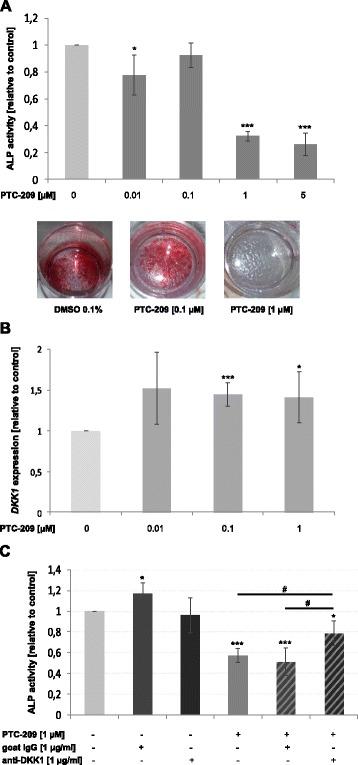
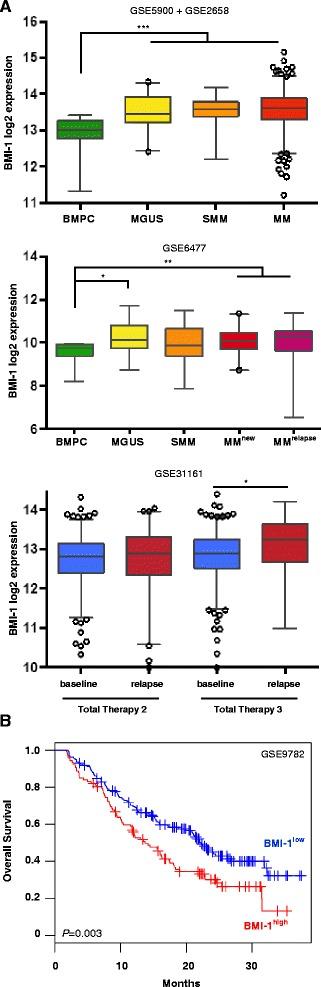
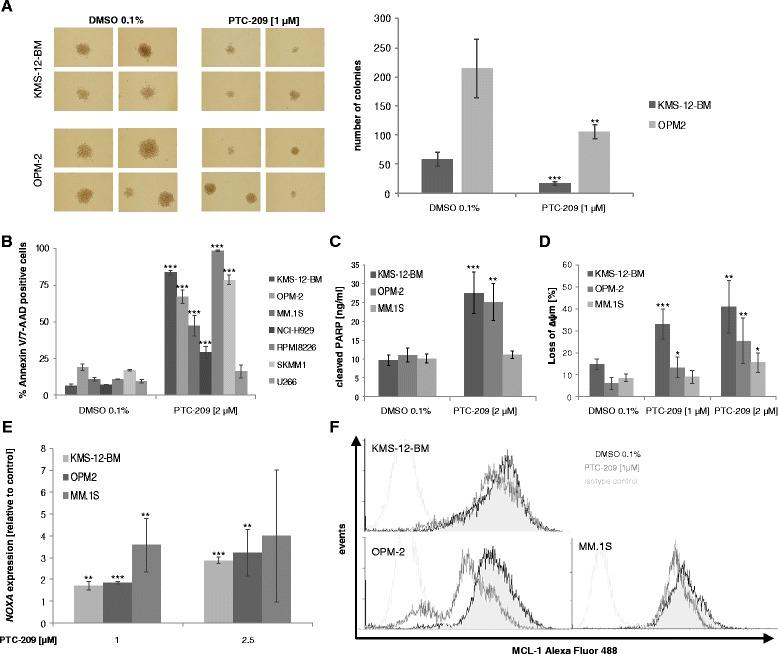
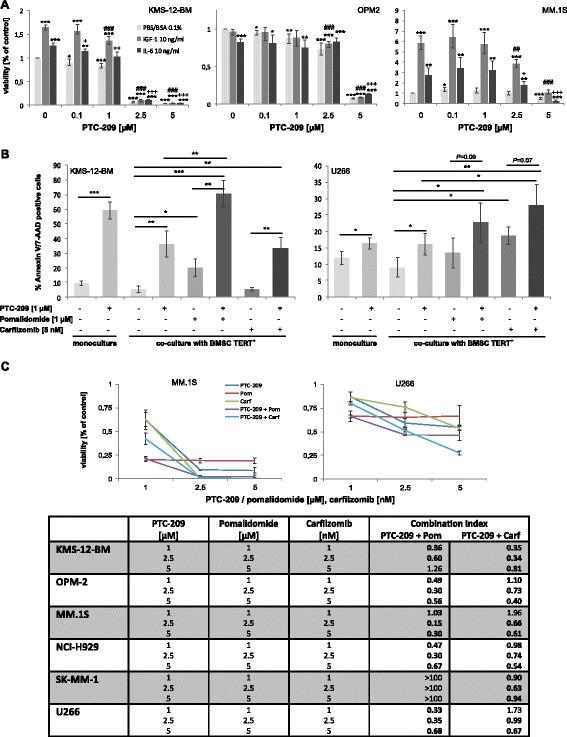
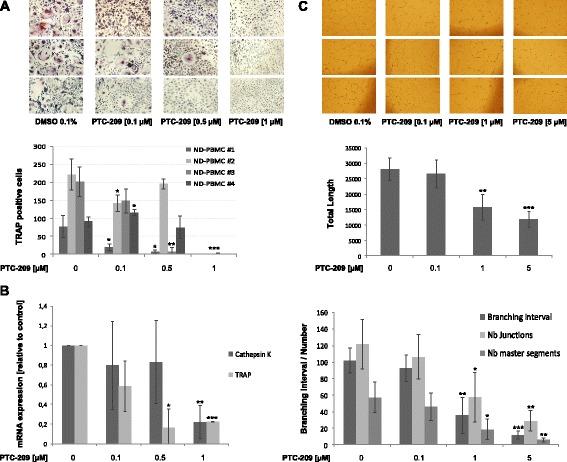
We confirmed overexpression of BMI-1 in MM patients by using publically available GEP datasets. Of note, BMI-1 expression was further increased at relapse which translated into significantly shorter overall survival in relapsed/refractory patients treated with bortezomib or dexamethasone. Treatment with PTC-209 significantly decreased viable cell numbers in human MM cell lines, induced a G1 cell cycle arrest, promoted apoptosis and demonstrated synergistic activity with pomalidomide and carfilzomib. The anti-MM activity of PTC-209 was accompanied by a significant decrease of cyclin D1 (CCND1) and v-myc avian myelocytomatosis viral oncogene homolog (MYC) expression as well as upregulation of cyclin-dependent kinase inhibitor 1A (CDKN1A) and cyclin-dependent kinase inhibitor 1B (CDKN1B). We also observed upregulation of NOXA (up to 3.6 ± 1.2-fold induction, P = 0.009) and subsequent downregulation of myeloid cell leukemia 1 (MCL-1) protein levels, which likely mediates the apoptotic effects of PTC-209. Importantly, the anti-MM activity was upheld in the presence of stromal support or myeloma growth factors insulin-like growth factor 1 (IGF-1) and interleukin 6 (IL-6). In the MM microenvironment, PTC-209 impaired tube formation, impaired osteoclast development and decreased osteoblast formation in a dose-dependent manner (P < 0.01 at 1 μM, respectively). The latter might be attributed to an induction of DKK1 and was reversed by concurrent anti-DKK1 antibody treatment.
CONCLUSIONS
We confirmed overexpression of BMI-1 in MM highlighting its role as an attractive drug target and reveal therapeutic targeting of BMI-1 by PTC-209 as a promising novel therapeutic intervention for MM.
背景
多梳蛋白复合体蛋白BMI-1是一种公认的致癌基因,据报道在多发性骨髓瘤(MM)中过表达。研究表明,沉默BMI-1会损害MM细胞的生长和存活。然而,目前尚无特异性靶向BMI-1的治疗药物。在此,我们研究了新型小分子BMI-1抑制剂PTC-209在MM中的活性。
方法
利用公开的基因表达谱(GEP)数据,分析人MM细胞系和原代MM细胞中BMI-1的表达。通过活力测试、细胞周期分析、膜联蛋白V和7-氨基放线菌素D染色、裂解的聚(ADP-核糖)聚合酶(PARP)定量、JC-1以及集落形成试验,研究PTC-209的抗MM活性。分别通过定量PCR和流式细胞术研究骨髓瘤核心生长和存活基因的失调情况。此外,分析PTC-209对体外破骨细胞、成骨细胞和血管生成的影响。
结果
我们利用公开的GEP数据集证实了MM患者中BMI-1的过表达。值得注意的是,复发时BMI-1表达进一步升高,这导致接受硼替佐米或地塞米松治疗的复发/难治性患者的总生存期显著缩短。用PTC-209治疗可显著降低人MM细胞系中的活细胞数量,诱导G1期细胞周期停滞,促进细胞凋亡,并与泊马度胺和卡非佐米表现出协同活性。PTC-209的抗MM活性伴随着细胞周期蛋白D1(CCND1)和v-myc禽骨髓细胞瘤病毒癌基因同源物(MYC)表达的显著降低以及细胞周期蛋白依赖性激酶抑制剂1A(CDKN1A)和细胞周期蛋白依赖性激酶抑制剂1B(CDKN1B)的上调。我们还观察到NOXA上调(高达3.6±1.2倍诱导率,P = 0.009),随后髓样细胞白血病1(MCL-1)蛋白水平下调,这可能介导了PTC-209的凋亡作用。重要的是在存在基质支持或骨髓瘤生长因子胰岛素样生长因子1(IGF-1)和白细胞介素6(IL-6)时抗MM活性得以维持。在MM微环境中,PTC-209以剂量依赖性方式损害血管生成、破骨细胞发育并减少成骨细胞形成(分别在1μM时P < 0.01)。后者可能归因于DKK1的诱导,并且通过同时使用抗DKK1抗体治疗得以逆转。
结论
我们证实了BMI-1在MM中的过表达,突出了其作为有吸引力的药物靶点的作用,并揭示PTC-209对BMI-1的治疗性靶向作用是MM一种有前景的新型治疗干预措施。

 Zotero 插件