
将艾滋病护理纳入社区儿童急性营养不良管理可取得良好效果:对卢萨卡一项为期三年项目的回顾性分析
Integration of HIV Care into Community Management of Acute Childhood Malnutrition Permits Good Outcomes: Retrospective Analysis of Three Years of a Programme in Lusaka.
作者信息
Amadi Beatrice, Imikendu Mercy, Sakala Milika, Banda Rosemary, Kelly Paul
机构信息
Department of Paediatrics, University Teaching Hospital, Nationalist Road, Lusaka, Zambia.
Tropical Gastroenterology & Nutrition group, University of Zambia School of Medicine, Nationalist Road, Lusaka, Zambia.
出版信息
PLoS One. 2016 Mar 4;11(3):e0149218. doi: 10.1371/journal.pone.0149218. eCollection 2016.
BACKGROUND
While HIV has had a major impact on health care in southern Africa, there are few data on its impact on acute malnutrition in children in the community. We report an analysis of outcomes in a large programme of community management of acute malnutrition in the south of Lusaka.
PROGRAMME ACTIVITIES AND ANALYSIS
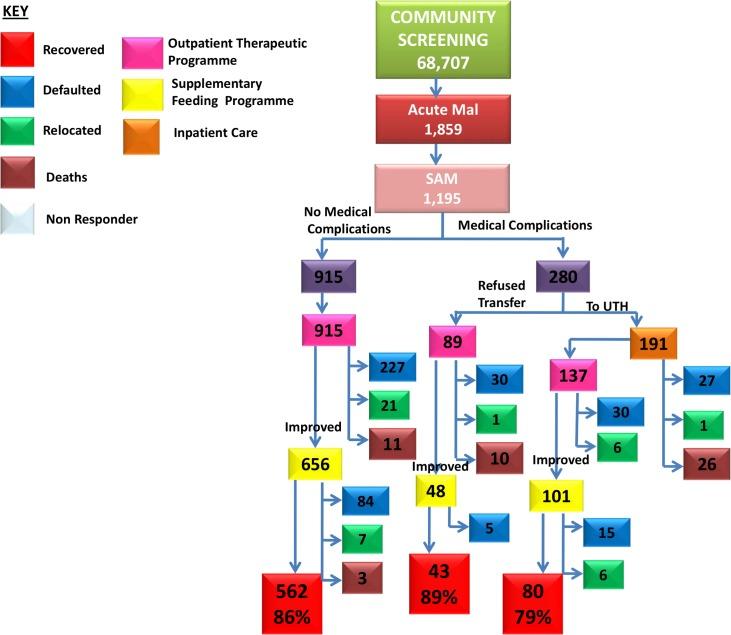
Over 3 years, 68,707 assessments for undernutrition were conducted house-to-house, and children with severe acute malnutrition (SAM) or moderate acute malnutrition (MAM) were enrolled into either Outpatient Therapeutic Programme (OTP) or Supplementary Feeding Programme (SFP) respectively. Case records were analysed using tabulation and unconditional logistic regression.
FINDINGS
1,859 children (889 boys, 970 girls; median age 16 months) with MAM (n = 664) or SAM (n = 1,195) were identified. Of 1,796 children whose parents consented to testing, 185 (10.3%) were HIV positive. Altogether 1,163 (62.6%) were discharged as recovered from acute malnutrition. Case fatality while in the programme was 4.2% in children with SAM and 0.5% in those with MAM (RR of SAM 10.9; 95%CI 3.4,34.8; P<0.0001), and higher in children with HIV infection (RR 5.2, 95%CI 2.9, 9.0; P<0.0001). In multivariate analysis, HIV (OR 5.2; 95%CI 2.6, 10.1; P<0.0001), MUAC <11.5 cm (OR 4.1; 95%CI 2.2, 7.4; P<0.0001) and the first year of the programme (OR 1.9; 95%CI 1.0, 3.4; P = 0.04) all increased mortality. Children with HIV infection who were able to initiate antiretroviral therapy had lower mortality (RR 0.23; 95%CI 0.10, 0.57; P = 0.0008).
INTERPRETATION
Our programme suggests that a comprehensive community malnutrition programme, incorporating HIV care, can achieve low mortality even in a population heavily affected by HIV.
背景
虽然艾滋病毒对南部非洲的医疗保健产生了重大影响,但关于其对社区儿童急性营养不良影响的数据却很少。我们报告了对卢萨卡南部一个大型社区急性营养不良管理项目结果的分析。
项目活动与分析
在3年多的时间里,逐户进行了68707次营养不良评估,患有严重急性营养不良(SAM)或中度急性营养不良(MAM)的儿童分别被纳入门诊治疗项目(OTP)或补充喂养项目(SFP)。使用列表法和无条件逻辑回归对病例记录进行分析。
研究结果
确定了1859名患有MAM(n = 664)或SAM(n = 1195)的儿童(889名男孩,970名女孩;中位年龄16个月)。在1796名父母同意检测的儿童中,185名(10.3%)艾滋病毒呈阳性。共有1163名(62.6%)儿童从急性营养不良中康复出院。在项目实施期间,SAM儿童的病死率为4.2%,MAM儿童为0.5%(SAM的相对危险度为10.9;95%置信区间3.4,34.8;P<0.0001),艾滋病毒感染儿童的病死率更高(相对危险度5.2,95%置信区间2.9,9.0;P<0.0001)。在多变量分析中,艾滋病毒(比值比5.2;95%置信区间2.6,10.1;P<0.0001)、上臂中段周长<11.5厘米(比值比4.1;95%置信区间2.2,7.4;P<0.0001)以及项目的第一年(比值比1.9;95%置信区间1.0,3.4;P = 0.04)均增加了死亡率。能够开始抗逆转录病毒治疗的艾滋病毒感染儿童死亡率较低(相对危险度0.23;95%置信区间0.10,0.57;P = 0.0008)。
解读
我们的项目表明,一个纳入艾滋病毒护理的综合性社区营养不良项目,即使在受艾滋病毒严重影响的人群中也能实现低死亡率。

 Zotero 插件