
射频消融术与切除术治疗巴塞罗那临床肝癌极早期/早期肝细胞癌的系统评价
Radiofrequency ablation versus resection for Barcelona clinic liver cancer very early/early stage hepatocellular carcinoma: a systematic review.
作者信息
He Zhen-Xin, Xiang Pu, Gong Jian-Ping, Cheng Nan-Sheng, Zhang Wei
机构信息
Department of Hepatobiliary Surgery, the Second Affiliated Hospital, Chongqing Medical University, Chongqing, People's Republic of China.
State Key Laboratory of Biotherapy and Cancer Center, Sichuan University, Chengdu, People's Republic of China.
出版信息
Ther Clin Risk Manag. 2016 Feb 23;12:295-303. doi: 10.2147/TCRM.S96760. eCollection 2016.
AIM
To compare the long-term survival outcomes of radiofrequency ablation and liver resection for single very early/early stage hepatocellular carcinoma (HCC).
METHODS
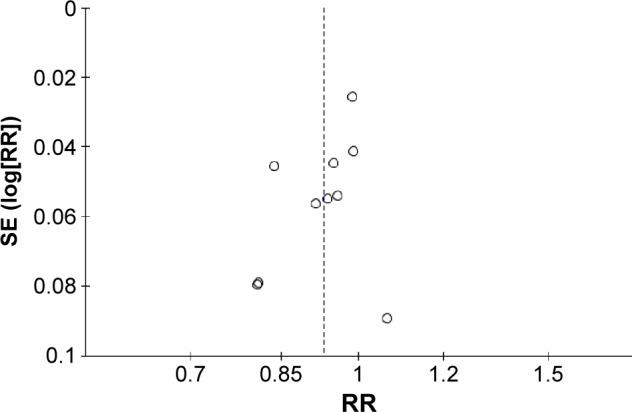
The Cochrane Library (Issue 3, 2015), Embase (1974 to March 15, 2015), PubMed (1950 to March 15, 2015), Web of Science (1900 to March 15, 2015), and Chinese Biomedical Literature Database (1978 to March 15, 2015) were searched to identify relevant trials. Only trials that compared radiofrequency ablation and liver resection for single very early stage (≤2 cm) or early stage (≤3 cm) HCC according to the Barcelona clinic liver cancer (BCLC) staging system were considered for inclusion in this review. The primary outcomes that we analyzed were the 3-year and 5-year overall survival (OS) rates, and the secondary outcomes that we analyzed were the 3-year and 5-year disease-free survival (DFS) rates. Review Manager 5.3 was used to perform a cumulative meta-analysis. Possible publication bias was examined using a funnel plot. A random-effects model was applied to summarize the various outcomes.
RESULTS
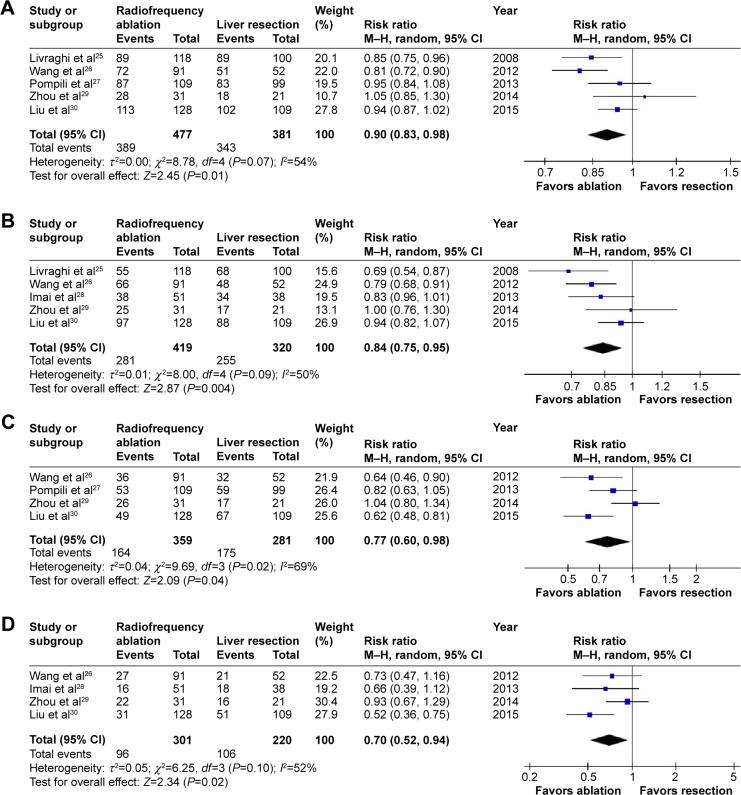
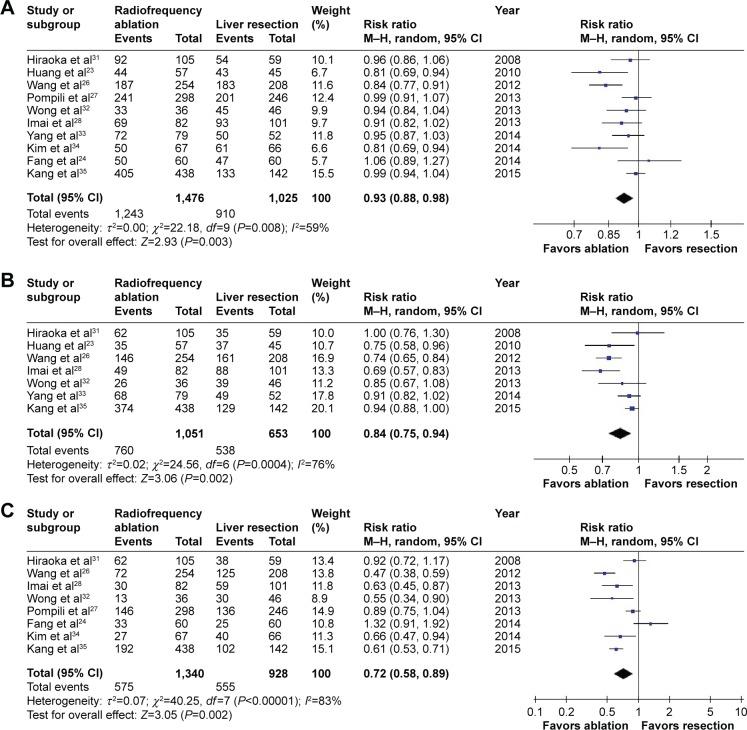
Six studies involving 947 patients were identified that compared radiofrequency ablation (n=528) to liver resection (n=419) for single BCLC very early HCC. In these six studies, the rates of 3-year OS, 5-year OS, 3-year DFS, and 5-year DFS were significantly lower in the radiofrequency ablation group than in the liver resection group (risk ratio [RR] =0.90, 95% confidence interval [CI]: 0.83-0.98, P=0.01; RR =0.84, 95% CI: 0.75-0.95, P=0.004; RR =0.77, 95% CI: 0.60-0.98, P=0.04; and RR =0.70, 95% CI: 0.52-0.94, P=0.02, respectively). Ten studies involving 2,501 patients were identified that compared radiofrequency ablation (n=1,476) to liver resection (n=1,025) for single BCLC early HCC. In these ten studies, the rates of 3-year OS, 5-year OS, 3-year DFS, and 5-year DFS were also significantly lower in the radiofrequency ablation group than in the liver resection group (RR =0.93, 95% CI: 0.88-0.98, P=0.003; RR =0.84, 95% CI: 0.75-0.94, P=0.002; RR =0.72, 95% CI: 0.58-0.89, P=0.002; and RR =0.47, 95% CI: 0.33-0.67, P<0.0001, respectively).
CONCLUSION
The long-term survival outcomes for patients with single BCLC very early/early stage HCC appear to be superior after liver resection compared to radiofrequency ablation.
目的
比较射频消融术与肝切除术治疗单个极早期/早期肝细胞癌(HCC)的长期生存结果。
方法
检索考克兰图书馆(2015年第3期)、Embase(1974年至2015年3月15日)、PubMed(1950年至2015年3月15日)、科学引文索引(1900年至2015年3月15日)及中国生物医学文献数据库(1978年至2015年3月15日)以识别相关试验。仅纳入根据巴塞罗那临床肝癌(BCLC)分期系统比较射频消融术与肝切除术治疗单个极早期(≤2 cm)或早期(≤3 cm)HCC的试验。我们分析的主要结局为3年和5年总生存率(OS),次要结局为3年和5年无病生存率(DFS)。使用Review Manager 5.3进行累积荟萃分析。采用漏斗图检查可能的发表偏倚。应用随机效应模型总结各项结局。
结果
共识别出6项研究,涉及947例患者,这些研究比较了射频消融术(n = 528)与肝切除术(n = 419)治疗单个BCLC极早期HCC的疗效。在这6项研究中,射频消融组的3年OS率、5年OS率、3年DFS率和5年DFS率均显著低于肝切除术组(风险比[RR] = 0.90,95%置信区间[CI]:0.83 - 0.98,P = 0.01;RR = 0.84,95% CI:0.75 - 0.95,P = 0.004;RR = 0.77,95% CI:0.60 - 0.98,P = 0.04;RR = 0.70,95% CI:0.52 - 0.94,P = 0.02)。共识别出10项研究,涉及2501例患者,这些研究比较了射频消融术(n = 1476)与肝切除术(n = 1025)治疗单个BCLC早期HCC的疗效。在这10项研究中,射频消融组的3年OS率、5年OS率、3年DFS率和5年DFS率也显著低于肝切除术组(RR = 0.93,95% CI:0.88 - 0.98,P = 0.003;RR = 0.84,95% CI:0.75 - 0.94,P = 0.002;RR = 0.72,95% CI:0.58 - 0.89,P = 0.002;RR = 0.47,95% CI:0.33 - 0.67,P < 0.0001)。
结论
对于单个BCLC极早期/早期HCC患者,肝切除术后的长期生存结果似乎优于射频消融术。

 Zotero 插件