
西洛多辛与坦索罗辛治疗远端输尿管结石的前瞻性随机研究。
Silodosin vs tamsulosin in the management of distal ureteric stones: A prospective randomised study.
作者信息
Elgalaly Hazem, Sakr Ahmed, Fawzi Amr, Salem Emad A, Desoky Esam, Shahin Ashraf, Kamel Mostafa
机构信息
Department of Urology, Zagazig University, Zagazig, Egypt.
出版信息
Arab J Urol. 2016 Mar;14(1):12-7. doi: 10.1016/j.aju.2015.11.004. Epub 2015 Dec 31.
OBJECTIVES
To compare the efficacy of silodosin (8 mg) vs tamsulosin (0.4 mg), as a medical expulsive therapy, in the management of distal ureteric stones (DUS) in terms of stone clearance rate and stone expulsion time.
PATIENTS AND METHODS
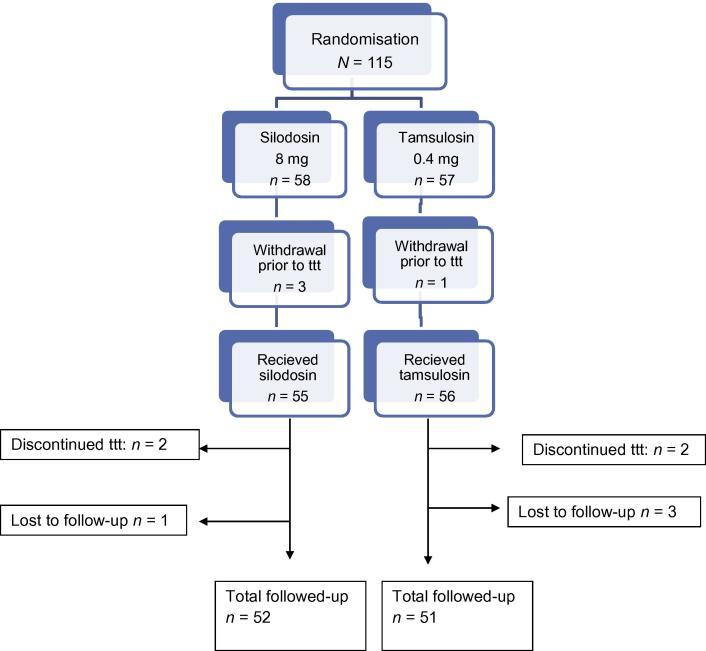
A prospective randomised study was conducted on 115 patients, aged 21-55 years, who had unilateral DUS of ⩽10 mm. Patients were divided into two groups. Group 1 received silodosin (8 mg) and Group 2 received tamsulosin (0.4 mg) daily for 1 month. The patients were followed-up by ultrasonography, plain abdominal radiograph of the kidneys, ureters and bladder, and computed tomography (in some cases).
RESULTS
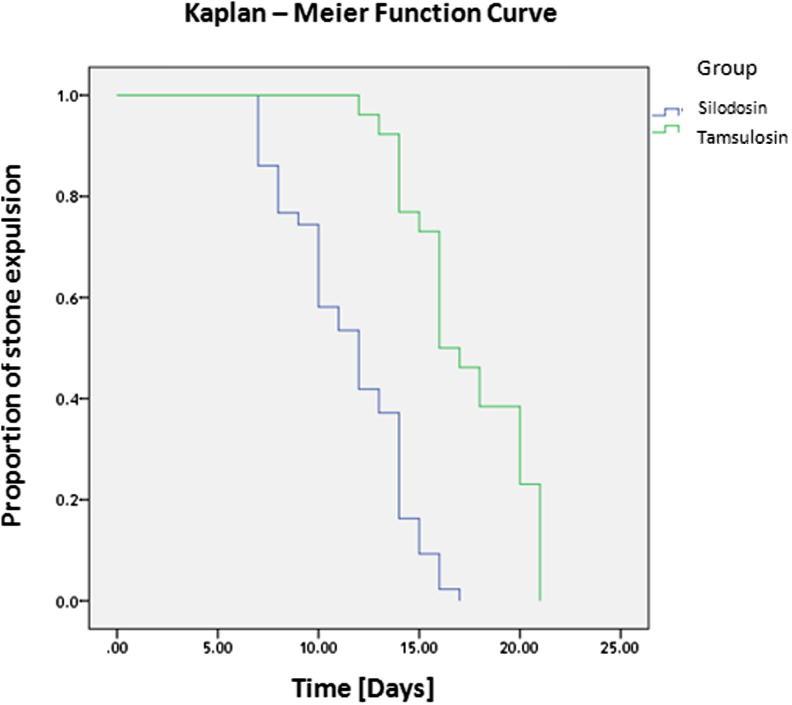
There was a significantly higher stone clearance rate of 83% in Group 1 vs 57% in Group 2 (P = 0.007). Group 1 also showed a significant advantage for stone expulsion time and analgesic use. Four patients, two in each group, discontinued the treatment in first few days due to side-effects (orthostatic hypotension). No severe complications were recorded during the treatment period. Retrograde ejaculation was recorded in nine and three patients in Groups 1 and 2, respectively.
CONCLUSION
Our data show that silodosin is more effective than tamsulosin in the management of DUS for stone clearance rates and stone expulsion times. A multicentre study on larger scale is needed to confirm the efficacy and safety of silodosin.
目的
比较西洛多辛(8毫克)与坦索罗辛(0.4毫克)作为药物排石疗法,在远端输尿管结石(DUS)治疗中结石清除率和结石排出时间方面的疗效。
患者与方法
对115例年龄在21至55岁、患有单侧直径≤10毫米DUS的患者进行了一项前瞻性随机研究。患者被分为两组。第1组每日服用西洛多辛(8毫克),第2组每日服用坦索罗辛(0.4毫克),持续1个月。通过超声检查、肾脏、输尿管和膀胱的腹部平片以及计算机断层扫描(某些情况下)对患者进行随访。
结果
第1组的结石清除率显著高于第2组,分别为83%和57%(P = 0.007)。第1组在结石排出时间和镇痛药物使用方面也显示出显著优势。四名患者(每组两名)因副作用(体位性低血压)在最初几天停止治疗。治疗期间未记录到严重并发症。第1组和第2组分别有9例和3例患者记录到逆行射精。
结论
我们的数据表明,在DUS治疗的结石清除率和结石排出时间方面,西洛多辛比坦索罗辛更有效。需要进行更大规模的多中心研究来证实西洛多辛的疗效和安全性。
 Zotero 插件