
奥地利哨点医师监测网络关于2014/15年流感病毒特征的详细报告及流感病毒疫苗效力评估
Detailed Report on 2014/15 Influenza Virus Characteristics, and Estimates on Influenza Virus Vaccine Effectiveness from Austria's Sentinel Physician Surveillance Network.
作者信息
Redlberger-Fritz Monika, Kundi Michael, Popow-Kraupp Theresia
机构信息
Department of Virology, Medical University Vienna, Vienna, Austria.
Institute of Environmental Health, Center for Public Health, Medical University Vienna, Vienna, Austria.
出版信息
PLoS One. 2016 Mar 14;11(3):e0149916. doi: 10.1371/journal.pone.0149916. eCollection 2016.
BACKGROUND
Influenza vaccine effectiveness (VE) is influenced by the antigenic similarity between vaccine- and circulating strains.
MATERIAL AND METHODS
This paper presents data obtained by the Austrian sentinel surveillance system on the evolution of influenza viruses during the season 2014/15 and its impact on influenza vaccine effectiveness in primary care in Austria as estimated by a test-negative case control design. VE estimates were performed for each influenza virus type/subtype, stratified by underlying diseases and adjusted for age, sex and calendar week of infection.
RESULTS
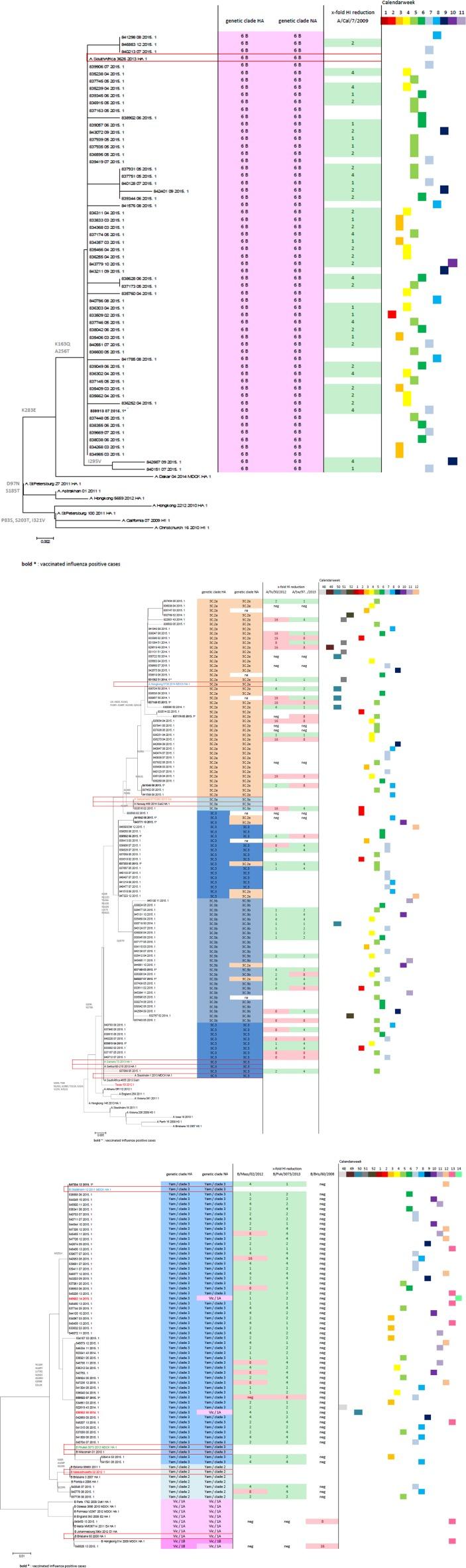
Detailed genetic and antigenic analyses showed that circulating A(H3N2) viruses were genetically distinct from the 2014/15 A(H3N2) vaccine component indicating a profound vaccine mismatch. The Influenza A(H1N1)pdm09 viruses were antigenically conserved and matched the respective vaccine component. Influenza B viruses were lineage-matched B/Yamagata viruses with a clade-level variation. Consistent with substantial vaccine mismatch for the A(H3N2) viruses a crude overall VE of only 47% was estimated, whereas the VE estimates for A(H1N1)pdm09 were 84% and for influenza B viruses 70%. Increased VE estimates were obtained after stratification by underlying diseases and adjustment for the covariates sex and age, whereby the adjustment for the calendar week of infection was the covariate exerting the highest influence on adjusted VE estimates.
CONCLUSION
In summary, VE data obtained in this study underscore the importance to perform VE estimates in the context of detailed characterization of the contributing viruses and also demonstrate that the calendar week of influenza virus infection is the most important confounder of VE estimates.
背景
流感疫苗效力(VE)受疫苗毒株与流行毒株之间抗原相似性的影响。
材料与方法
本文展示了奥地利哨点监测系统获取的数据,这些数据涉及2014/15季节流感病毒的演变情况及其对奥地利初级保健中流感疫苗效力的影响,该影响通过检测阴性病例对照设计进行估算。针对每种流感病毒型/亚型进行了疫苗效力估算,按基础疾病分层,并针对年龄、性别和感染的日历周进行了调整。
结果
详细的基因和抗原分析表明,流行的A(H3N2)病毒在基因上与2014/15 A(H3N2)疫苗组分不同,表明存在严重的疫苗错配。甲型H1N1pdm09流感病毒在抗原上保守,与相应疫苗组分匹配。乙型流感病毒是谱系匹配的B/山形病毒,存在分支水平的变异。与A(H3N2)病毒的严重疫苗错配一致,估计总体粗疫苗效力仅为47%,而甲型H1N1pdm09流感病毒的疫苗效力估计值为84%,乙型流感病毒为70%。按基础疾病分层并对协变量性别和年龄进行调整后,疫苗效力估计值有所增加,其中对感染日历周的调整是对调整后的疫苗效力估计值影响最大的协变量。
结论
总之,本研究获得的疫苗效力数据强调了在详细鉴定相关病毒的背景下进行疫苗效力估算的重要性,同时也表明流感病毒感染的日历周是疫苗效力估算中最重要的混杂因素。


 Zotero 插件