
按高或低进餐频率分层的等热量高蛋白或低蛋白饮食后,中国年轻男性心血管代谢疾病风险的餐后变化——一项随机对照交叉试验
Postprandial changes in cardiometabolic disease risk in young Chinese men following isocaloric high or low protein diets, stratified by either high or low meal frequency - a randomized controlled crossover trial.
作者信息
Mok Alexander, Haldar Sumanto, Lee Jetty Chung-Yung, Leow Melvin Khee-Shing, Henry Christiani Jeyakumar
机构信息
Clinical Nutrition Research Centre, Singapore Institute for Clinical Sciences, 14 Medical Drive, #07-02, Singapore, 117599, Singapore.
School of Biological Sciences, Kadoorie Biological Sciences Building, The University of Hong Kong, Pok Fu Lam Road, Hong Kong, SAR, China.
出版信息
Nutr J. 2016 Mar 15;15:27. doi: 10.1186/s12937-016-0141-5.
BACKGROUND
Cardio-Metabolic Disease (CMD) is the leading cause of death globally and particularly in Asia. Postprandial elevation of glycaemia, insulinaemia, triglyceridaemia are associated with an increased risk of CMD. While studies have shown that higher protein intake or increased meal frequency may benefit postprandial metabolism, their combined effect has rarely been investigated using composite mixed meals. We therefore examined the combined effects of increasing meal frequency (2-large vs 6-smaller meals), with high or low-protein (40 % vs 10 % energy from protein respectively) isocaloric mixed meals on a range of postprandial CMD risk markers.
METHODS
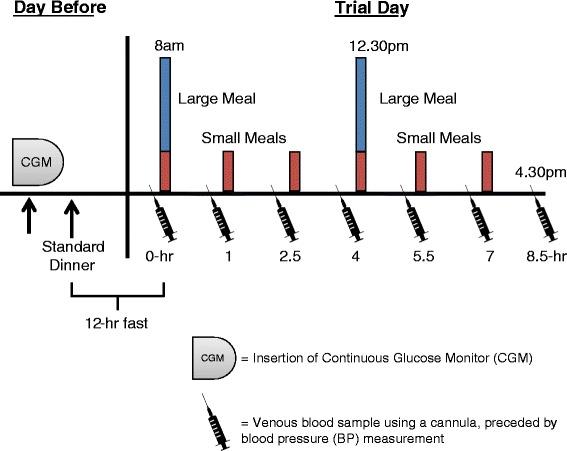
In a randomized crossover study, 10 healthy Chinese males (Age: 29 ± 7 years; BMI: 21.9 ± 1.7 kg/m(2)) underwent 4 dietary treatments: CON-2 (2 large Low-Protein meals), CON-6 (6 Small Low-Protein meals), PRO-2 (2 Large High-Protein meals) and PRO-6 (6 Small High-Protein meals). Subjects wore a continuous glucose monitor (CGM) and venous blood samples were obtained at baseline and at regular intervals for 8.5 h to monitor postprandial changes in glucose, insulin, triglycerides and high sensitivity C-reactive protein (hsCRP). Blood pressure was measured at regular intervals pre- and post- meal consumption. Urine was collected to measure excretion of creatinine and F2-isoprostanes and its metabolites over the 8.5 h postprandial period.
RESULTS
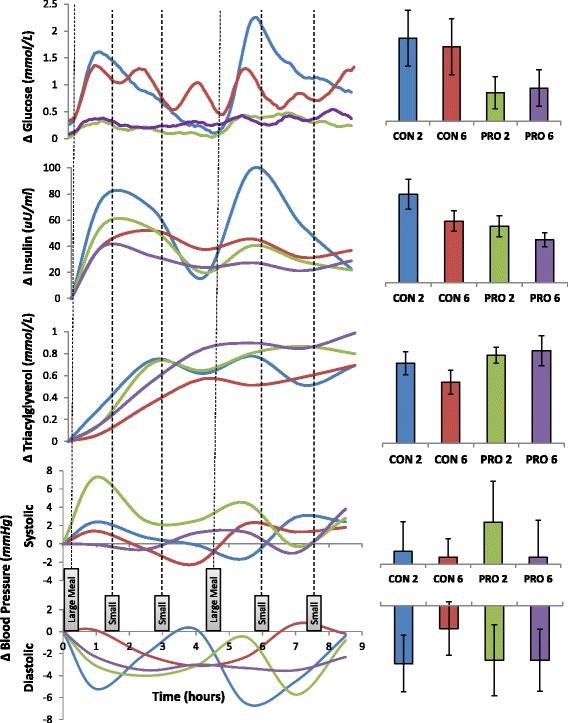
The high-protein meals, irrespective of meal frequency were beneficial for glycaemic health since glucose incremental area under the curve (iAUC) for PRO-2 (185 ± 166 mmol.min.L(-1)) and PRO-6 (214 ± 188 mmol.min.L(-1)) were 66 and 60 % lower respectively (both p < 0.05), compared with CON-2 (536 ± 290 mmol.min.L(-1)). The iAUC for insulin was the lowest for PRO-6 (13.7 ± 7.1 U.min.L(-1)) as compared with CON-2 (28.4 ± 15.6 U.min.L(-)1), p < 0.001. There were no significant differences in postprandial responses in other measurements between the dietary treatments.
CONCLUSIONS
The consumption of composite meals with higher protein content, irrespective of meal frequency appears to be beneficial for postprandial glycemic and insulinemic responses in young, healthy Chinese males. Implications of this study may be useful in the Asian context where the consumption of high glycemic index, carbohydrate meals is prevalent.
TRIAL REGISTRATION
NCT02529228 .
背景
心血管代谢疾病(CMD)是全球尤其是亚洲的主要死因。餐后血糖、胰岛素血症、甘油三酯血症升高与CMD风险增加有关。虽然研究表明,较高的蛋白质摄入量或增加进餐频率可能有益于餐后代谢,但很少使用复合混合餐来研究它们的联合作用。因此,我们研究了增加进餐频率(2顿大餐与6顿小餐),搭配高或低蛋白质(分别占能量的40%与10%)等热量混合餐对一系列餐后CMD风险标志物的联合作用。
方法
在一项随机交叉研究中,10名健康中国男性(年龄:29±7岁;体重指数:21.9±1.7kg/m²)接受了4种饮食治疗:CON-2(2顿低蛋白大餐)、CON-6(6顿低蛋白小餐)、PRO-2(2顿高蛋白大餐)和PRO-6(6顿高蛋白小餐)。受试者佩戴连续血糖监测仪(CGM),并在基线和8.5小时内定期采集静脉血样,以监测餐后血糖、胰岛素、甘油三酯和高敏C反应蛋白(hsCRP)的变化。在进餐前后定期测量血压。收集尿液以测量餐后8.5小时内肌酐、F2-异前列腺素及其代谢产物的排泄量。
结果
高蛋白餐,无论进餐频率如何,对血糖健康都有益,因为PRO-2(185±166mmol·min·L⁻¹)和PRO-6(214±188mmol·min·L⁻¹)的葡萄糖曲线下增量面积(iAUC)分别比CON-2(536±290mmol·min·L⁻¹)低66%和60%(均p<0.05)。与CON-2(28.4±15.6U·min·L⁻¹)相比,PRO-6的胰岛素iAUC最低(13.7±7.1U·min·L⁻¹),p<0.001。饮食治疗之间在其他测量的餐后反应方面没有显著差异。
结论
摄入蛋白质含量较高的复合餐,无论进餐频率如何,似乎对年轻、健康的中国男性的餐后血糖和胰岛素反应有益。这项研究的意义在高血糖指数碳水化合物餐消费普遍的亚洲背景下可能有用。
试验注册
NCT02529228 。
 Zotero 插件