
姜黄素通过PI3K/Akt信号通路保护新生大鼠心肌细胞免受高糖诱导的凋亡。
Curcumin Protects Neonatal Rat Cardiomyocytes against High Glucose-Induced Apoptosis via PI3K/Akt Signalling Pathway.
作者信息
Yu Wei, Zha Wenliang, Ke Zhiqiang, Min Qing, Li Cairong, Sun Huirong, Liu Chao
机构信息
Hubei Province Key Laboratory on Cardiovascular, Cerebrovascular, and Metabolic Disorders, Hubei University of Science and Technology, Xianning 437100, China; Department of Pharmacology, Hubei University of Science and Technology, Xianning 437100, China.
Hubei Province Key Laboratory on Cardiovascular, Cerebrovascular, and Metabolic Disorders, Hubei University of Science and Technology, Xianning 437100, China.
出版信息
J Diabetes Res. 2016;2016:4158591. doi: 10.1155/2016/4158591. Epub 2016 Feb 16.
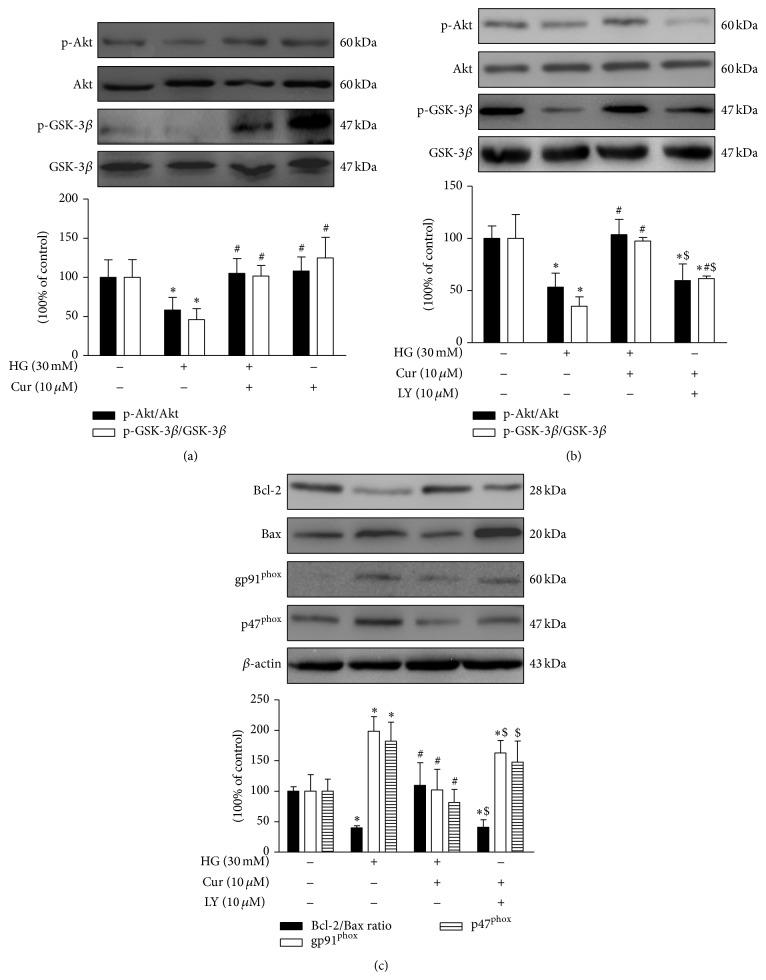
The function of curcumin on NADPH oxidase-related ROS production and cardiac apoptosis, together with the modulation of protein signalling pathways, was investigated in cardiomyocytes. Primary cultures of neonatal rat cardiomyocytes were exposed to 30 mmol/L high glucose with or without curcumin. Cell viability, apoptosis, superoxide formation, the expression of NADPH oxidase subunits, and potential regulatory molecules, Akt and GSK-3β, were assessed in cardiomyocytes. Cardiomyocytes exposure to high glucose led to an increase in both cell apoptosis and intracellular ROS levels, which were strongly prevented by curcumin treatment (10 μM). In addition, treatment with curcumin remarkably suppressed the increased activity of Rac1, as well as the enhanced expression of gp91(phox) and p47(phox) induced by high glucose. Lipid peroxidation and SOD were reversed in the presence of curcumin. Furthermore, curcumin treatment markedly inhibited the reduced Bcl-2/Bax ratio elicited by high glucose exposure. Moreover, curcumin significantly increased Akt and GSK-3β phosphorylation in cardiomyocytes treated with high glucose. In addition, LY294002 blocked the effects of curcumin on cardiomyocytes exposure to high glucose. In conclusion, these results demonstrated that curcumin attenuated high glucose-induced cardiomyocyte apoptosis by inhibiting NADPH-mediated oxidative stress and this protective effect is most likely mediated by PI3K/Akt-related signalling pathway.
在心肌细胞中研究了姜黄素对烟酰胺腺嘌呤二核苷酸磷酸(NADPH)氧化酶相关的活性氧(ROS)生成及心脏细胞凋亡的作用,以及对蛋白质信号通路的调节。将新生大鼠心肌细胞的原代培养物暴露于30 mmol/L高糖环境中,同时或不同时添加姜黄素。评估心肌细胞的细胞活力、凋亡、超氧化物形成、NADPH氧化酶亚基的表达以及潜在的调节分子Akt和糖原合成酶激酶-3β(GSK-3β)。心肌细胞暴露于高糖环境导致细胞凋亡和细胞内ROS水平均升高,而姜黄素处理(10 μM)可强烈阻止这种情况。此外,姜黄素处理显著抑制了高糖诱导的Rac1活性增加以及gp91(吞噬细胞氧化酶)和p47(吞噬细胞氧化酶)表达增强。在存在姜黄素的情况下,脂质过氧化和超氧化物歧化酶(SOD)情况得到逆转。此外,姜黄素处理显著抑制了高糖暴露引起的Bcl-2/Bax比值降低。此外,姜黄素显著增加了高糖处理的心肌细胞中Akt和GSK-3β的磷酸化。此外,LY294002阻断了姜黄素对暴露于高糖环境的心肌细胞的作用。总之,这些结果表明,姜黄素通过抑制NADPH介导的氧化应激减轻高糖诱导的心肌细胞凋亡,这种保护作用很可能由磷脂酰肌醇-3激酶(PI3K)/Akt相关信号通路介导。


 Zotero 插件