
刺鼠相关肽神经回路介导饥饿状态下的适应性行为。
Agouti-related peptide neural circuits mediate adaptive behaviors in the starved state.
作者信息
Padilla Stephanie L, Qiu Jian, Soden Marta E, Sanz Elisenda, Nestor Casey C, Barker Forrest D, Quintana Albert, Zweifel Larry S, Rønnekleiv Oline K, Kelly Martin J, Palmiter Richard D
机构信息
Howard Hughes Medical Institute, University of Washington, Seattle, Washington, USA.
Department of Physiology and Pharmacology, Oregon Health and Science University, Portland, Oregon, USA.
出版信息
Nat Neurosci. 2016 May;19(5):734-741. doi: 10.1038/nn.4274. Epub 2016 Mar 28.
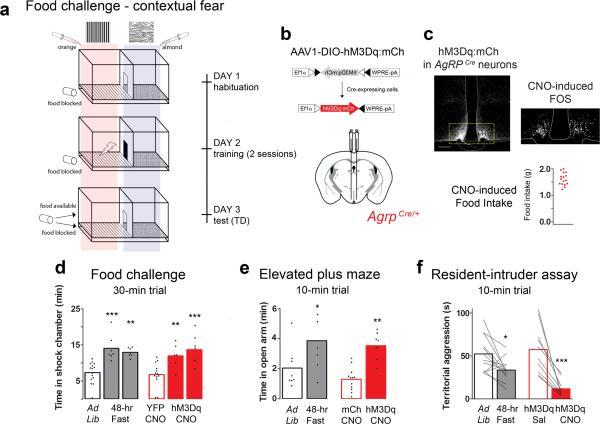
In the face of starvation, animals will engage in high-risk behaviors that would normally be considered maladaptive. Starving rodents, for example, will forage in areas that are more susceptible to predators and will also modulate aggressive behavior within a territory of limited or depleted nutrients. The neural basis of these adaptive behaviors likely involves circuits that link innate feeding, aggression and fear. Hypothalamic agouti-related peptide (AgRP)-expressing neurons are critically important for driving feeding and project axons to brain regions implicated in aggression and fear. Using circuit-mapping techniques in mice, we define a disynaptic network originating from a subset of AgRP neurons that project to the medial nucleus of the amygdala and then to the principal bed nucleus of the stria terminalis, which suppresses territorial aggression and reduces contextual fear. We propose that AgRP neurons serve as a master switch capable of coordinating behavioral decisions relative to internal state and environmental cues.
面对饥饿时,动物会采取通常被认为是适应不良的高风险行为。例如,饥饿的啮齿动物会在更容易受到捕食者攻击的区域觅食,并且还会在营养有限或枯竭的领地内调节攻击行为。这些适应性行为的神经基础可能涉及连接先天进食、攻击和恐惧的神经回路。表达下丘脑刺鼠相关肽(AgRP)的神经元对于驱动进食至关重要,其轴突投射到与攻击和恐惧相关的脑区。利用小鼠中的神经回路映射技术,我们定义了一个双突触网络,该网络起源于投射到杏仁核内侧核然后到终纹床核主核的AgRP神经元子集,它抑制领地攻击并减少情境恐惧。我们提出,AgRP神经元充当一个主开关,能够根据内部状态和环境线索协调行为决策。



 Zotero 插件