
基于短信的糖尿病自我管理支持(SMS4BG):一项随机对照试验的研究方案
Text message-based diabetes self-management support (SMS4BG): study protocol for a randomised controlled trial.
作者信息
Dobson Rosie, Whittaker Robyn, Jiang Yannan, Shepherd Matthew, Maddison Ralph, Carter Karen, Cutfield Richard, McNamara Catherine, Khanolkar Manish, Murphy Rinki
机构信息
National Institute for Health Innovation, University of Auckland, Private Bag 92019, Auckland, 1142, New Zealand.
Waitemata District Health Board, Auckland, New Zealand.
出版信息
Trials. 2016 Apr 2;17:179. doi: 10.1186/s13063-016-1305-5.
BACKGROUND
Addressing the increasing prevalence, and associated disease burden, of diabetes is a priority of health services internationally. Interventions to support patients to effectively self-manage their condition have the potential to reduce the risk of costly and debilitating complications. The utilisation of mobile phones to deliver self-management support allows for patient-centred care at the frequency and intensity that patients desire from outside the clinic environment. Self-Management Support for Blood Glucose (SMS4BG) is a novel text message-based intervention for supporting people with diabetes to improve self-management behaviours and achieve better glycaemic control and is tailored to individual patient preferences, demographics, clinical characteristics, and culture. This study aims to assess whether SMS4BG can improve glycaemic control in adults with poorly controlled diabetes. This paper outlines the rationale and methods of the trial.
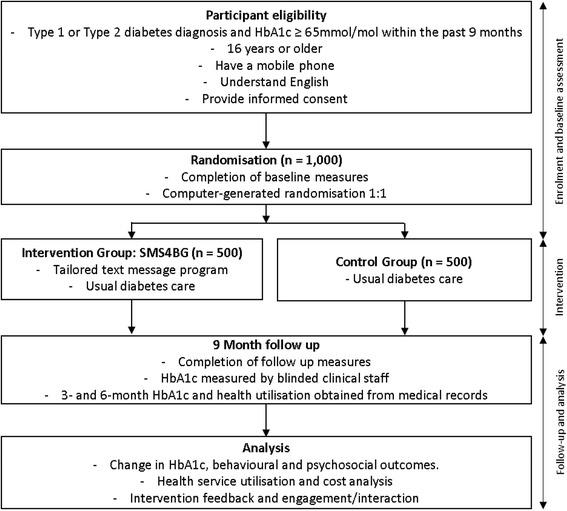
METHODS/DESIGN: A two-arm, parallel, randomised controlled trial will be conducted across New Zealand health districts. One thousand participants will be randomised at a 1:1 ratio to receive SMS4BG, a theoretically based and individually tailored automated text message-based diabetes self-management support programme (intervention) in addition to usual care, or usual care alone (control). The primary outcome is change in glycaemic control (HbA1c) at 9 months. Secondary outcomes include glycaemic control at 3 and 6 months, self-efficacy, self-care behaviours, diabetes distress, health-related quality of life, perceived social support, and illness perceptions. Cost information and healthcare utilisation will also be collected as well as intervention satisfaction and interaction.
DISCUSSION
This study will provide information on the effectiveness of a text message-based self-management support tool for people with diabetes. If found to be effective it has the potential to provide individualised support to people with diabetes across New Zealand (and internationally), thus extending care outside the clinic environment.
TRIAL REGISTRATION
Australian New Zealand Clinical Trials Registry: ACTRN12614001232628 .
背景
应对糖尿病患病率不断上升及其相关疾病负担,是国际卫生服务的一项优先事项。支持患者有效自我管理病情的干预措施,有可能降低出现代价高昂且使人衰弱的并发症的风险。利用手机提供自我管理支持,能够以患者期望的频率和强度,在诊所环境之外提供以患者为中心的护理。血糖自我管理支持(SMS4BG)是一种基于短信的新型干预措施,旨在支持糖尿病患者改善自我管理行为,实现更好的血糖控制,并根据患者的个人偏好、人口统计学特征、临床特征和文化进行量身定制。本研究旨在评估SMS4BG能否改善糖尿病控制不佳的成年人的血糖控制。本文概述了该试验的基本原理和方法。
方法/设计:将在新西兰各卫生区进行一项双臂、平行、随机对照试验。1000名参与者将按1:1的比例随机分组,一组除接受常规护理外,还将接受SMS4BG,这是一个基于理论且针对个人量身定制的基于自动短信的糖尿病自我管理支持项目(干预组),另一组仅接受常规护理(对照组)。主要结局是9个月时血糖控制(糖化血红蛋白)的变化。次要结局包括3个月和6个月时的血糖控制、自我效能感、自我护理行为、糖尿病困扰、健康相关生活质量、感知到的社会支持以及疾病认知。还将收集成本信息和医疗保健利用率,以及干预满意度和互动情况。
讨论
本研究将提供关于一种基于短信的自我管理支持工具对糖尿病患者有效性的信息。如果该工具被证明有效,它有可能为新西兰(乃至国际)的糖尿病患者提供个性化支持,从而将护理扩展到诊所环境之外。
试验注册
澳大利亚新西兰临床试验注册中心:ACTRN12614001232628 。
 Zotero 插件