
质子偶联叶酸转运体的实验优化穿膜结构
Experimentally optimized threading structures of the proton-coupled folate transporter.
作者信息
Date Swapneeta S, Chen Cheng-Yen Charles, Chen Yidong, Jansen Michaela
机构信息
Department of Cell Physiology and Molecular Biophysics School of Medicine Texas Tech University Health Sciences Center Lubbock TX USA; Center for Membrane Protein Research School of Medicine Texas Tech University Health Sciences Center Lubbock TX USA.
Center for Membrane Protein Research School of Medicine Texas Tech University Health Sciences Center Lubbock TX USA; Medical Student Summer Research Program School of Medicine Texas Tech University Health Sciences Center Lubbock TX USA.
出版信息
FEBS Open Bio. 2016 Feb 22;6(3):216-30. doi: 10.1002/2211-5463.12041. eCollection 2016 Mar.
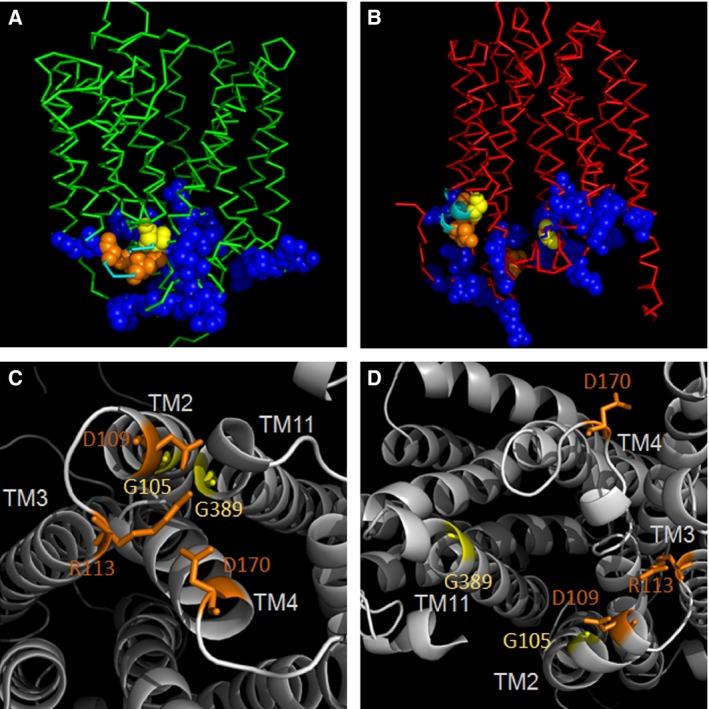
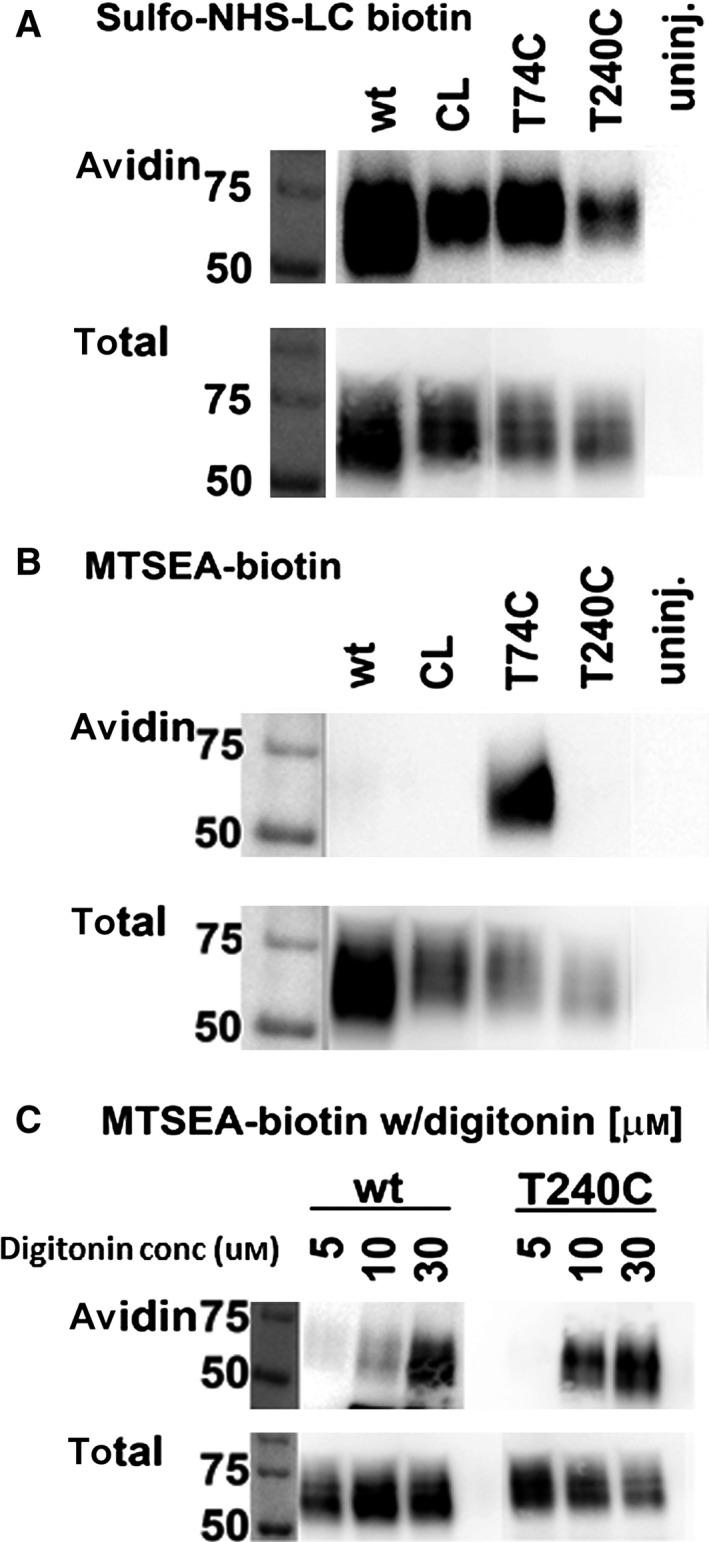
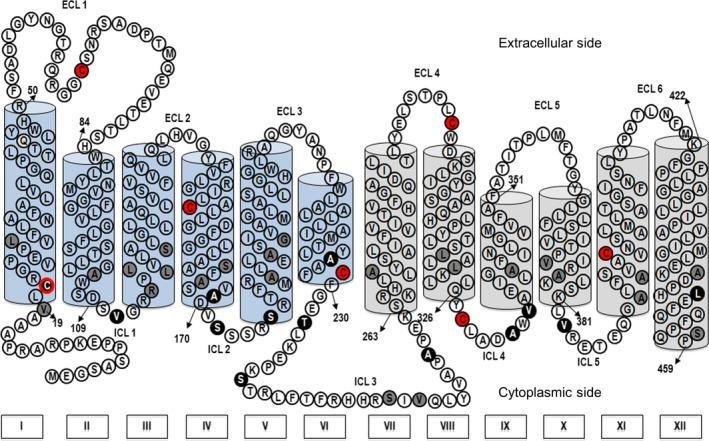
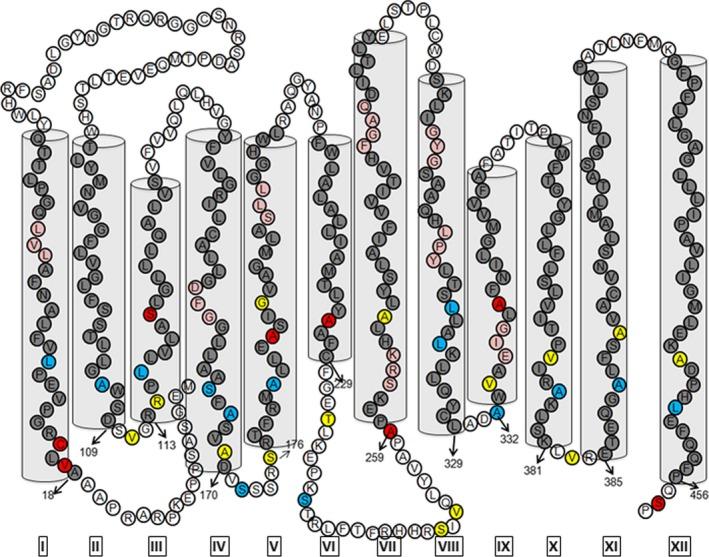
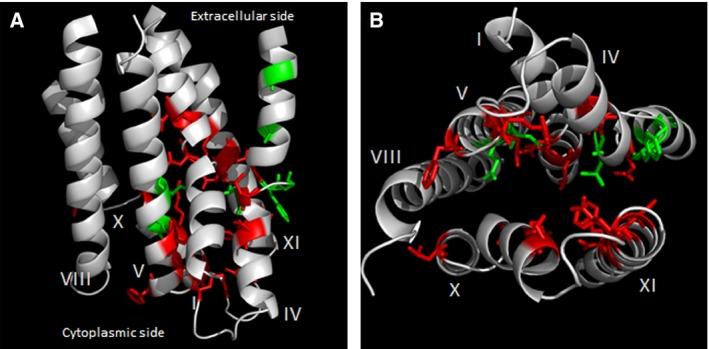
The proton-coupled folate transporter (PCFT, SLC46A1) transports folic acid across the plasma membrane, together with an excess of protons such that the net charge translocation is positive. We developed 3D structural models of PCFT threaded onto the X-ray structures of major facilitator superfamily (MFS) members that were identified as close structural homologues. The model of PCFT threaded onto the glycerol-3-phosphate transporter (GlpT) structure is consistent with detailed accessibility studies in the absence of extracellular substrate and at pH 7.4 presented here, and additionally with a multitude of other mutagenesis and functional studies. Characteristic MFS structural features are preserved in this PCFT model, such as 12 transmembrane helices divided into two pseudosymmetric bundles, and a high density of positive charges on the periphery of the cytoplasmic site that allow interactions with negatively charged lipid head-groups. Under the experimental conditions, PCFT predominantly samples the resting state, which in this case is inward-open. Several positions lining the substrate cavity have been identified. Motif A, a helix-turn-helix motif that is a hallmark of MFS transporters between transmembrane segments II and III is oriented appropriately to interact with residues from transmembrane segments IV as well as XI upon conformational transition to the outward-open state. A charge-relay system between three charged residues as well as apposing glycines in two α-helices, both contributed to by motif A, become engaged when PCFT is modeled on the outward-open state of a putative proton-driven transporter (YajR).
质子偶联叶酸转运体(PCFT,SLC46A1)可将叶酸转运穿过质膜,同时伴有过量质子,从而使净电荷转运为正。我们构建了PCFT的三维结构模型,该模型以被确定为紧密结构同源物的主要易化子超家族(MFS)成员的X射线结构为模板。以甘油-3-磷酸转运体(GlpT)结构为模板构建的PCFT模型,与本文在此呈现的在无细胞外底物且pH为7.4的情况下进行的详细可及性研究一致,此外还与大量其他诱变和功能研究一致。在此PCFT模型中保留了MFS的特征性结构特征,例如12个跨膜螺旋分为两个假对称束,以及在细胞质位点周边有高密度的正电荷,这允许与带负电荷的脂质头部基团相互作用。在实验条件下,PCFT主要处于静息状态,在这种情况下是向内开放的。已确定了底物腔内衬的几个位置。基序A是一个螺旋-转角-螺旋基序,是跨膜片段II和III之间MFS转运体的标志,在向向外开放状态的构象转变时,其取向适合与跨膜片段IV以及XI的残基相互作用。当PCFT以推定的质子驱动转运体(YajR)的向外开放状态为模型时,由基序A贡献的三个带电荷残基以及两个α-螺旋中相对的甘氨酸之间的电荷中继系统开始起作用。


 Zotero 插件