
秀丽隐杆线虫miro-1突变减少线粒体数量并延长寿命。
C. elegans miro-1 Mutation Reduces the Amount of Mitochondria and Extends Life Span.
作者信息
Shen Yanqing, Ng Li Fang, Low Natarie Pei Wen, Hagen Thilo, Gruber Jan, Inoue Takao
机构信息
Department of Biochemistry, Yong Loo Lin School of Medicine, National University of Singapore, Singapore, Singapore.
Science Division, Yale-NUS College, Singapore, Singapore.
出版信息
PLoS One. 2016 Apr 11;11(4):e0153233. doi: 10.1371/journal.pone.0153233. eCollection 2016.
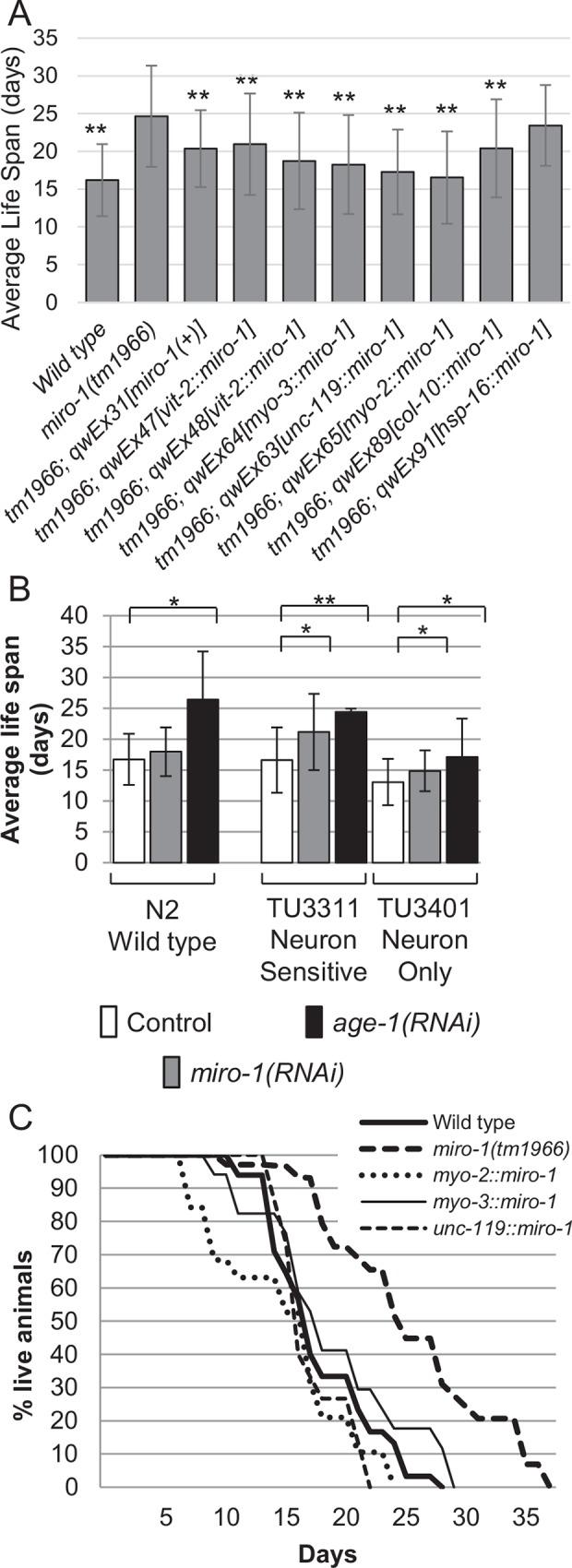
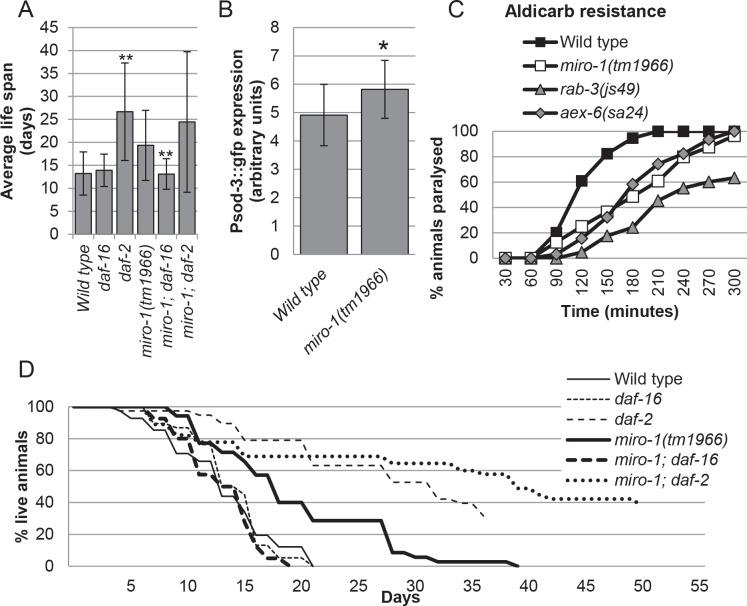
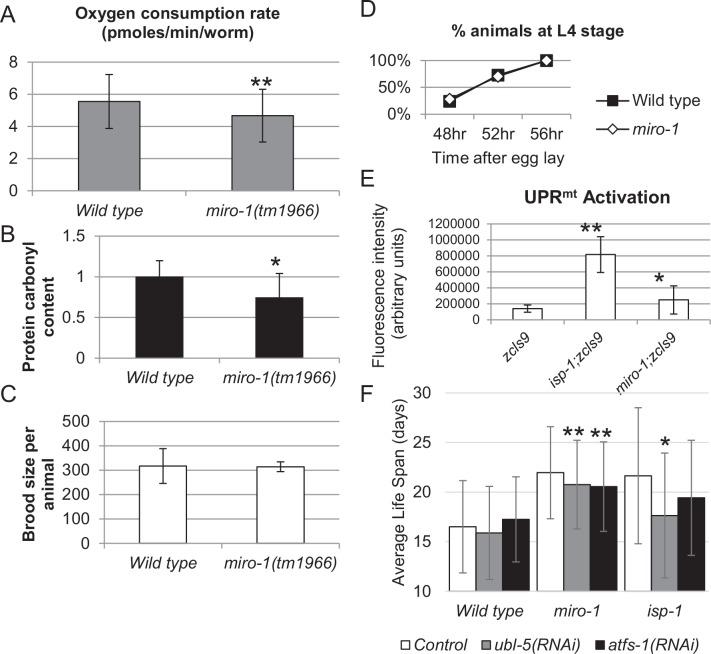
Mitochondria play a critical role in aging, however, the underlying mechanism is not well understood. We found that a mutation disrupting the C. elegans homolog of Miro GTPase (miro-1) extends life span. This phenotype requires simultaneous loss of miro-1 from multiple tissues including muscles and neurons, and is dependent on daf-16/FOXO. Notably, the amount of mitochondria in the miro-1 mutant is reduced to approximately 50% of the wild-type. Despite this reduction, oxygen consumption is only weakly reduced, suggesting that mitochondria of miro-1 mutants are more active than wild-type mitochondria. The ROS damage is slightly reduced and the mitochondrial unfolded protein response pathway is weakly activated in miro-1 mutants. Unlike previously described long-lived mitochondrial electron transport chain mutants, miro-1 mutants have normal growth rate. These results suggest that the reduction in the amount of mitochondria can affect the life span of an organism through activation of stress pathways.
线粒体在衰老过程中起着关键作用,然而,其潜在机制尚未得到充分理解。我们发现,破坏秀丽隐杆线虫Miro GTP酶(miro-1)同源物的突变可延长寿命。这种表型需要包括肌肉和神经元在内的多个组织同时缺失miro-1,并且依赖于daf-16/FOXO。值得注意的是,miro-1突变体中线粒体的数量减少到野生型的约50%。尽管数量减少,但氧气消耗仅略有降低,这表明miro-1突变体的线粒体比野生型线粒体更活跃。miro-1突变体中的活性氧损伤略有减少,线粒体未折叠蛋白反应途径被微弱激活。与先前描述的长寿线粒体电子传递链突变体不同,miro-1突变体具有正常的生长速率。这些结果表明,线粒体数量的减少可通过激活应激途径影响生物体的寿命。


 Zotero 插件