
高通量血液透析和高容量血液滤过可改善血清钙化倾向。
High-Flux Hemodialysis and High-Volume Hemodiafiltration Improve Serum Calcification Propensity.
作者信息
Dekker Marijke, Pasch Andreas, van der Sande Frank, Konings Constantijn, Bachtler Matthias, Dionisi Mauro, Meier Matthias, Kooman Jeroen, Canaud Bernard
机构信息
Department of Internal Medicine, Division of Nephrology, Maastricht University Medical Center, Maastricht, The Netherlands.
Department of Internal Medicine, Division of Nephrology, Catharina Hospital Eindhoven, Eindhoven, The Netherlands.
出版信息
PLoS One. 2016 Apr 11;11(4):e0151508. doi: 10.1371/journal.pone.0151508. eCollection 2016.
BACKGROUND
Calciprotein particles (CPPs) may play an important role in the calcification process. The calcification propensity of serum (T50) is highly predictive of all-cause mortality in chronic kidney disease patients. Whether T50 is therapeutically improvable, by high-flux hemodialysis (HD) or hemodiafiltration (HDF), has not been studied yet.
METHODS
We designed a cross-sectional single center study, and included stable prevalent in-center dialysis patients on HD or HDF. Patients were divided into two groups based on dialysis modality, were on a thrice-weekly schedule, had a dialysis vintage of > 3 months and vascular access providing a blood flow rate > 300 ml/min. Calcification propensity of serum was measured by the time of transformation from primary to secondary CPP (T50 test), by time-resolved nephelometry.
RESULTS
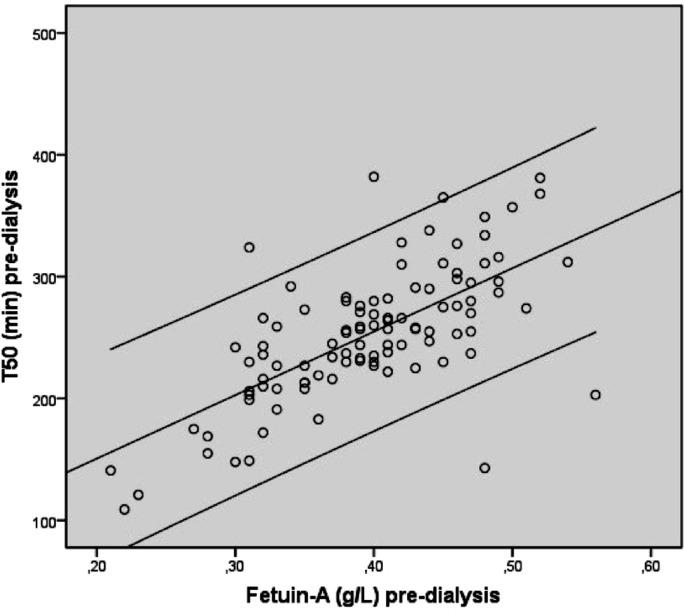
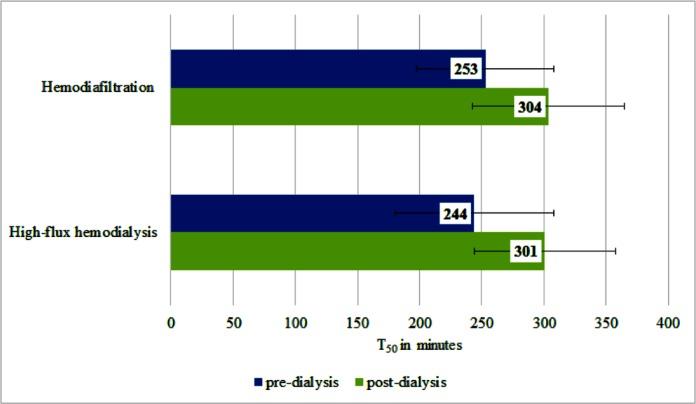
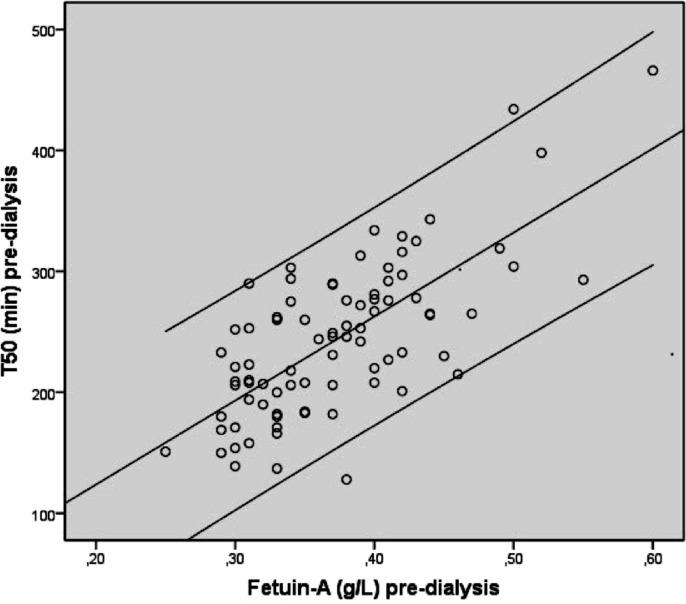
We included 64 patients, mean convective volume was 21.7L (SD 3.3L). In the pooled analysis, T50 levels increased in both the HD and HDF group with pre- and post-dialysis (mean (SD)) of 244(64) - 301(57) and 253(55) - 304(61) min respectively (P = 0.43(HD vs. HDF)). The mean increase in T50 was 26.29% for HD and 21.97% for HDF patients (P = 0.61 (HD vs. HDF)). The delta values (Δ) of calcium, phosphate and serum albumin were equal in both groups. Baseline T50 was negatively correlated with phosphate, and positively correlated with serum magnesium and fetuin-A. The ΔT50 was mostly influenced by Δ phosphate (r = -0.342; P = 0.002 HD and r = -0.396; P<0.001 HDF) in both groups.
CONCLUSIONS
HD and HDF patients present with same baseline T50 calcification propensity values pre-dialysis. Calcification propensity is significantly improved during both HD and HDF sessions without significant differences between both modalities.
背景
钙蛋白颗粒(CPPs)可能在钙化过程中起重要作用。血清钙化倾向(T50)可高度预测慢性肾病患者的全因死亡率。目前尚未研究通过高通量血液透析(HD)或血液透析滤过(HDF)能否在治疗上改善T50。
方法
我们设计了一项横断面单中心研究,纳入接受HD或HDF治疗的稳定的中心内透析患者。根据透析方式将患者分为两组,每周透析三次,透析时间超过3个月,血管通路血流量>300 ml/min。通过时间分辨比浊法,测量从初级CPP转变为次级CPP的时间(T50试验)来评估血清钙化倾向。
结果
我们纳入了64例患者,平均对流体积为21.7L(标准差3.3L)。在汇总分析中,HD组和HDF组透析前和透析后的T50水平均升高,分别为244(64)-301(57)分钟和253(55)-304(61)分钟(P = 0.43(HD与HDF))。HD患者T50的平均升高幅度为26.29%,HDF患者为21.97%(P = 0.61(HD与HDF))。两组钙、磷和血清白蛋白的变化值(Δ)相等。基线T50与磷呈负相关,与血清镁和胎球蛋白-A呈正相关。两组中,ΔT50大多受Δ磷的影响(HD组r = -0.342;P = 0.002,HDF组r = -0.396;P<0.001)。
结论
HD和HDF患者透析前的基线T50钙化倾向值相同。HD和HDF治疗期间钙化倾向均显著改善,两种方式之间无显著差异。
 Zotero 插件