
一种用于恶性疟原虫无标记基因组编辑的重新设计的CRISPR/Cas9系统。
A redesigned CRISPR/Cas9 system for marker-free genome editing in Plasmodium falciparum.
作者信息
Lu Junnan, Tong Ying, Pan Jiaqiang, Yang Yijun, Liu Quan, Tan Xuefang, Zhao Siting, Qin Li, Chen Xiaoping
机构信息
Laboratory of Pathogen Biology, State Key Laboratory of Respiratory Disease, Center for Infection and Immunity, Guangzhou Institutes of Biomedicine and Health (GIBH), Chinese Academy of Sciences, No. 190 Kaiyuan Avenue, Guangzhou Science Park, Guangzhou, 510530, Guangdong Province, China.
CAS Lamvac Biotech Co., Ltd, No. 3 Lanyue Road, Guangzhou Science Park, Guangzhou, 510530, Guangdong Province, China.
出版信息
Parasit Vectors. 2016 Apr 11;9:198. doi: 10.1186/s13071-016-1487-4.
BACKGROUND
A highly efficient CRISPR/Cas9-based marker-free genome editing system has been established in Plasmodium falciparum (Pf). However, with the current methods, two drug-selectable markers are needed for episome retention, which may present hurdles for consecutive genome manipulations due to the limited number of available selectable markers. The loading capacity of donor DNA is also unsatisfactory due to the large size of the Cas9 nuclease and sgRNA co-expression system, which limits the size of knock-in DNA fragments. Because of the inefficient end joining (EJ) DNA repair mechanism of Pf, a suicide-rescue approach could be used to address the challenges. Cas9 nuclease and sgRNA were co-expressed from a single plasmid (suicide vector) with one selectable marker, and the donor DNA was ligated into the other plasmid (rescue vector) containing only the ampicillin-resistance gene (AmpR) and a ColEl replication origin (ori). Nonetheless, whether this approach can mediate even the regular gene editing in Pf remains unknown. This study aimed to demonstrate the basic gene editing function of this Cas9-mediated suicide-rescue system.
FINDINGS
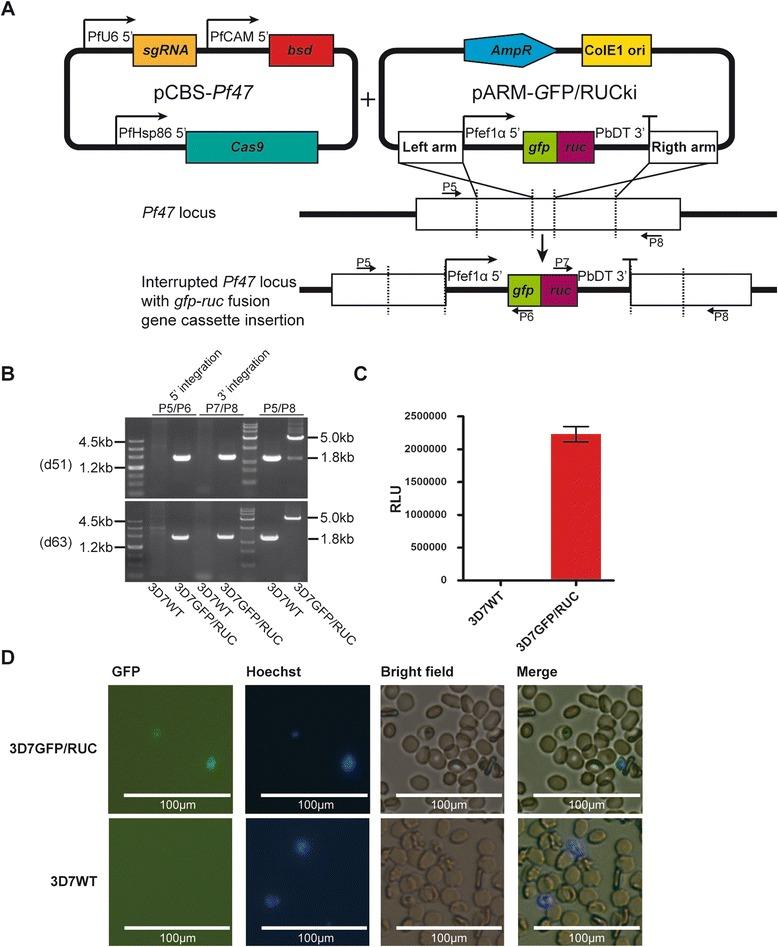
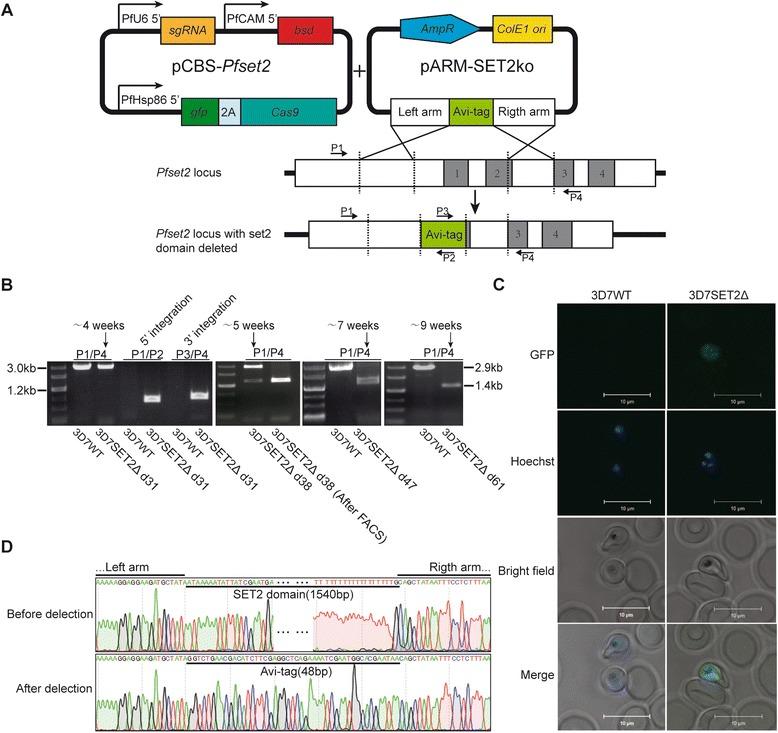
The suicide and rescue vectors were constructed and co-transfected into Pf3D7. This system worked as expected when used to disrupt the Pfset2 gene and to insert a green fluorescent protein-renilla luciferase (gfp-ruc) fusion gene cassette of 3334 base pairs (bp) into the Pf47 locus, demonstrating that the suicide vector actually induced double-strand breaks (DSBs) and that the rescue vector functioned without maintenance via drug selection.
CONCLUSIONS
The adapted marker-free CRISPR/Cas9 system with only a single episome-selectable marker performs well as the current systems for general gene editing which lays a solid foundation for further studies including consecutive gene manipulations and large gene knock-ins.
背景
已在恶性疟原虫(Pf)中建立了一种高效的基于CRISPR/Cas9的无标记基因组编辑系统。然而,使用当前方法时,需要两个药物选择标记来维持附加体,由于可用选择标记数量有限,这可能给连续的基因组操作带来障碍。由于Cas9核酸酶和sgRNA共表达系统体积较大,供体DNA的装载能力也不尽人意,这限制了敲入DNA片段的大小。由于Pf的末端连接(EJ)DNA修复机制效率低下,可以采用自杀拯救方法来应对这些挑战。Cas9核酸酶和sgRNA从带有一个选择标记的单个质粒(自杀载体)中共表达,供体DNA连接到另一个仅包含氨苄青霉素抗性基因(AmpR)和ColE1复制起点(ori)的质粒(拯救载体)中。尽管如此,这种方法是否能介导Pf中的常规基因编辑仍不清楚。本研究旨在证明这种Cas9介导的自杀拯救系统的基本基因编辑功能。
研究结果
构建了自杀载体和拯救载体,并将它们共转染到Pf3D7中。当该系统用于破坏Pfset2基因并将一个3334个碱基对(bp)的绿色荧光蛋白-海肾荧光素酶(gfp-ruc)融合基因盒插入Pf47位点时,其工作情况符合预期,这表明自杀载体实际上诱导了双链断裂(DSB),并且拯救载体无需通过药物选择来维持其功能。
结论
仅带有单个附加体选择标记的改良无标记CRISPR/Cas9系统在一般基因编辑方面与当前系统表现相当,为包括连续基因操作和大基因敲入在内的进一步研究奠定了坚实基础。
 Zotero 插件