
Tor通过具有复杂拓扑结构的N端螺旋螺线管形成二聚体。
Tor forms a dimer through an N-terminal helical solenoid with a complex topology.
作者信息
Baretić Domagoj, Berndt Alex, Ohashi Yohei, Johnson Christopher M, Williams Roger L
机构信息
MRC Laboratory of Molecular Biology, Cambridge CB2 0QH, UK.
出版信息
Nat Commun. 2016 Apr 13;7:11016. doi: 10.1038/ncomms11016.
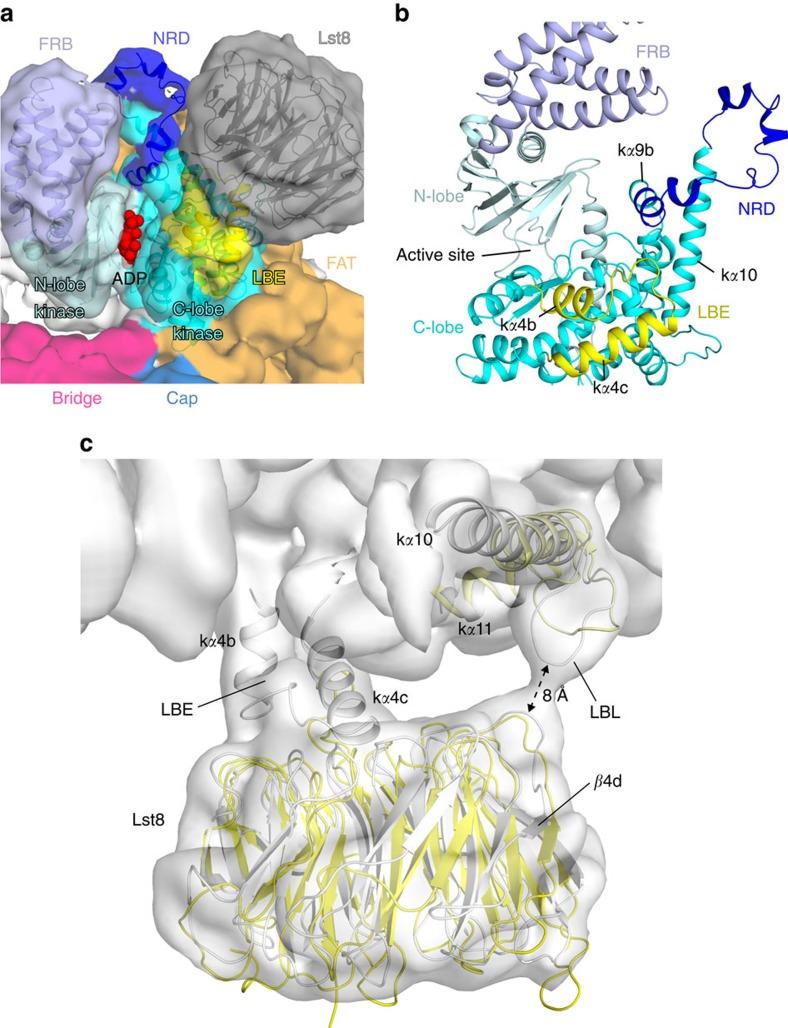
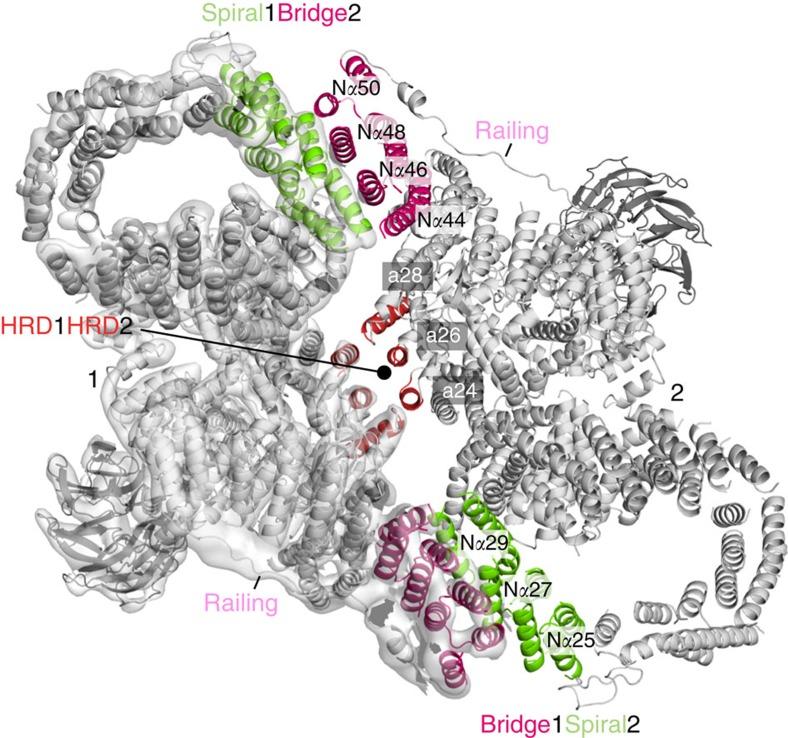
The target of rapamycin (Tor) is a Ser/Thr protein kinase that regulates a range of anabolic and catabolic processes. Tor is present in two complexes, TORC1 and TORC2, in which the Tor-Lst8 heterodimer forms a common sub-complex. We have determined the cryo-electron microscopy (EM) structure of Tor bound to Lst8. Two Tor-Lst8 heterodimers assemble further into a dyad-symmetry dimer mediated by Tor-Tor interactions. The first 1,300 residues of Tor form a HEAT repeat-containing α-solenoid with four distinct segments: a highly curved 800-residue N-terminal 'spiral', followed by a 400-residue low-curvature 'bridge' and an extended 'railing' running along the bridge leading to the 'cap' that links to FAT region. This complex topology was verified by domain insertions and offers a new interpretation of the mTORC1 structure. The spiral of one TOR interacts with the bridge of another, which together form a joint platform for the Regulatory Associated Protein of TOR (RAPTOR) regulatory subunit.
雷帕霉素靶蛋白(Tor)是一种丝氨酸/苏氨酸蛋白激酶,可调节一系列合成代谢和分解代谢过程。Tor存在于两种复合物TORC1和TORC2中,其中Tor-Lst8异二聚体形成一个共同的亚复合物。我们已经确定了与Lst8结合的Tor的冷冻电子显微镜(EM)结构。两个Tor-Lst8异二聚体通过Tor-Tor相互作用进一步组装成一个二元对称二聚体。Tor的前1300个残基形成一个包含HEAT重复序列的α-螺线管,有四个不同的部分:一个高度弯曲的800个残基的N端“螺旋”,接着是一个400个残基的低曲率“桥”,以及一个沿着桥延伸并通向与FAT区域相连的“帽”的“栏杆”。这种复杂的拓扑结构通过结构域插入得到验证,并为mTORC1结构提供了新的解释。一个TOR的螺旋与另一个的桥相互作用,共同形成TOR调节相关蛋白(RAPTOR)调节亚基的联合平台。



 Zotero 插件