
衰弱与医疗保健费用的关联——埃丝特队列研究结果
Associations of frailty with health care costs--results of the ESTHER cohort study.
作者信息
Bock Jens-Oliver, König Hans-Helmut, Brenner Hermann, Haefeli Walter E, Quinzler Renate, Matschinger Herbert, Saum Kai-Uwe, Schöttker Ben, Heider Dirk
机构信息
Department of Health Economics and Health Services Research, Hamburg Center for Health Economics, University Medical Center Hamburg-Eppendorf, Martinistrasse 52, Hamburg, 20246, Germany.
Division of Clinical Epidemiology and Aging Research, German Cancer Research Center, Im Neuenheimer Feld 581, Heidelberg, 69120, Germany.
出版信息
BMC Health Serv Res. 2016 Apr 14;16:128. doi: 10.1186/s12913-016-1360-3.
BACKGROUND
The concept of frailty is rapidly gaining attention as an independent syndrome with high prevalence in older adults. Thereby, frailty is often related to certain adverse outcomes like mortality or disability. Another adverse outcome discussed is increased health care utilization. However, only few studies examined the impact of frailty on health care utilization and corresponding costs. The aim of this study was therefore to investigate comprehensively the relationship between frailty, health care utilization and costs.
METHODS
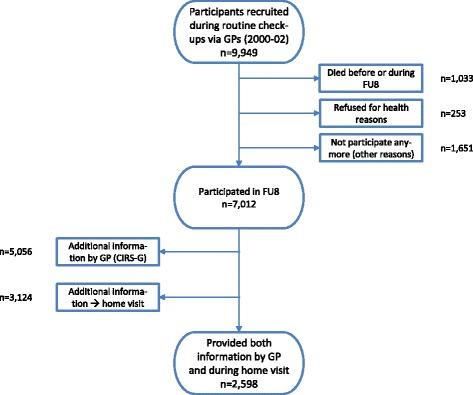
Cross sectional data from 2598 older participants (57-84 years) recruited in the Saarland, Germany, between 2008 and 2010 was used. Participants passed geriatric assessments that included Fried's five frailty criteria: weakness, slowness, exhaustion, unintentional weight loss, and physical inactivity. Health care utilization was recorded in the sectors of inpatient treatment, outpatient treatment, pharmaceuticals, and nursing care.
RESULTS
Prevalence of frailty (≥3 symptoms) was 8.0%. Mean total 3-month costs of frail participants were €3659 (4 or 5 symptoms) and €1616 (3 symptoms) as compared to €642 of nonfrail participants (no symptom). Controlling for comorbidity and general socio-demographic characteristics in multiple regression models, the difference in total costs between frail and non-frail participants still amounted to €1917; p < .05 (4 or 5 symptoms) and €680; p < .05 (3 symptoms). Among the 5 symptoms of frailty, weight loss and exhaustion were significantly associated with total costs after controlling for comorbidity.
CONCLUSIONS
The study provides evidence that frailty is associated with increased health care costs. The analyses furthermore indicate that frailty is an important factor for health care costs independent from pure age and comorbidity. Costs were rather attributable to frailty (and comorbidity) than to age. This stresses that the overlapping concepts of multimorbidity and frailty are both necessary to explain health care use and corresponding costs among older adults.
背景
衰弱这一概念作为一种在老年人中具有高患病率的独立综合征正迅速受到关注。因此,衰弱常与某些不良结局相关,如死亡率或残疾。另一个被讨论的不良结局是医疗保健利用率的增加。然而,仅有少数研究考察了衰弱对医疗保健利用率及相应成本的影响。因此,本研究的目的是全面调查衰弱、医疗保健利用率和成本之间的关系。
方法
使用了2008年至2010年间在德国萨尔州招募的2598名老年参与者(57 - 84岁)的横断面数据。参与者通过了老年评估,其中包括弗里德的五项衰弱标准:虚弱、行动迟缓、疲惫、非刻意体重减轻和身体活动不足。医疗保健利用率记录于住院治疗、门诊治疗、药品和护理服务领域。
结果
衰弱(≥3种症状)的患病率为8.0%。衰弱参与者的平均3个月总费用在有4或5种症状时为3659欧元,有3种症状时为1616欧元,而非衰弱参与者(无症状)为642欧元。在多元回归模型中控制了合并症和一般社会人口学特征后,衰弱和非衰弱参与者之间的总成本差异仍达1917欧元;p < 0.05(4或5种症状)和680欧元;p < 0.05(3种症状)。在衰弱的5种症状中,控制合并症后,体重减轻和疲惫与总成本显著相关。
结论
该研究提供了证据表明衰弱与医疗保健成本增加相关。分析还表明,衰弱是医疗保健成本的一个重要因素,独立于单纯的年龄和合并症。成本更多地归因于衰弱(和合并症)而非年龄。这强调了多重疾病和衰弱这两个重叠的概念对于解释老年人的医疗保健使用及相应成本都是必要的。
 Zotero 插件