
不良事件结果的报告:奥利司他试验的期刊发表文章与未发表临床研究报告的比较
Reporting of harms outcomes: a comparison of journal publications with unpublished clinical study reports of orlistat trials.
作者信息
Hodkinson Alex, Gamble Carrol, Smith Catrin Tudur
机构信息
Centre for Reviews and Dissemination, University of York, Heslington, York, YO10 5DD, UK.
Department of Biostatistics, MRC North West Hub for Trials Methodology Research, University of Liverpool, Liverpool, England, UK.
出版信息
Trials. 2016 Apr 22;17(1):207. doi: 10.1186/s13063-016-1327-z.
BACKGROUND
The quality of harms reporting in journal publications is often poor, which can impede the risk-benefit interpretation of a clinical trial. Clinical study reports can provide more reliable, complete, and informative data on harms compared to the corresponding journal publication. This case study compares the quality and quantity of harms data reported in journal publications and clinical study reports of orlistat trials.
METHODS
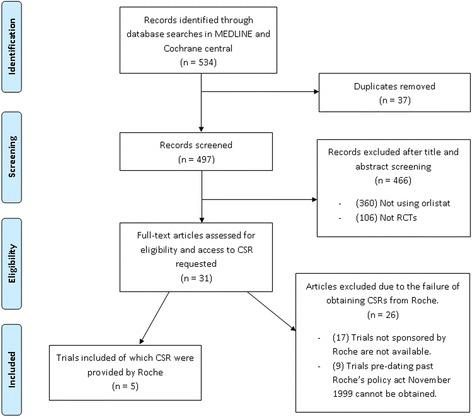
Publications related to clinical trials of orlistat were identified through comprehensive literature searches. A request was made to Roche (Genentech; South San Francisco, CA, USA) for clinical study reports related to the orlistat trials identified in our search. We compared adverse events, serious adverse events, and the reporting of 15 harms criteria in both document types and compared meta-analytic results using data from the clinical study reports against the journal publications.
RESULTS
Five journal publications with matching clinical study reports were available for five independent clinical trials. Journal publications did not always report the complete list of identified adverse events and serious adverse events. We found some differences in the magnitude of the pooled risk difference between both document types with a statistically significant risk difference for three adverse events and two serious adverse events using data reported in the clinical study reports; these events were of mild intensity and unrelated to the orlistat. The CONSORT harms reporting criteria were often satisfied in the methods section of the clinical study reports (70-90 % of the methods section criteria satisfied in the clinical study reports compared to 10-50 % in the journal publications), but both document types satisfied 80-100 % of the results section criteria, albeit with greater detail being provided in the clinical study reports.
CONCLUSIONS
In this case study, journal publications provided insufficient information on harms outcomes of clinical trials and did not specify that a subset of harms data were being presented. Clinical study reports often present data on harms, including serious adverse events, which are not reported or mentioned in the journal publications. Therefore, clinical study reports could support a more complete, accurate, and reliable investigation, and researchers undertaking evidence synthesis of harm outcomes should not rely only on incomplete published data that are presented in the journal publications.
背景
期刊发表文章中危害报告的质量通常较差,这可能会妨碍对临床试验的风险效益解读。与相应的期刊发表文章相比,临床研究报告可以提供关于危害的更可靠、完整和信息丰富的数据。本案例研究比较了奥利司他试验的期刊发表文章和临床研究报告中所报告的危害数据的质量和数量。
方法
通过全面的文献检索确定与奥利司他临床试验相关的发表文章。向罗氏公司(基因泰克;美国加利福尼亚州南旧金山)索取与我们检索中确定的奥利司他试验相关的临床研究报告。我们比较了两种文档类型中的不良事件、严重不良事件以及15项危害标准的报告情况,并使用临床研究报告中的数据与期刊发表文章比较荟萃分析结果。
结果
五项独立临床试验有五篇匹配临床研究报告的期刊发表文章。期刊发表文章并不总是报告已确定的不良事件和严重不良事件的完整列表。我们发现两种文档类型之间合并风险差异的大小存在一些差异,使用临床研究报告中报告的数据,三项不良事件和两项严重不良事件的风险差异具有统计学意义;这些事件强度较轻且与奥利司他无关。临床研究报告的方法部分通常满足CONSORT危害报告标准(临床研究报告中70 - 90%的方法部分标准得到满足,而期刊发表文章中为10 - 50%),但两种文档类型都满足80 - 100%的结果部分标准,尽管临床研究报告提供了更详细的内容。
结论
在本案例研究中,期刊发表文章提供的关于临床试验危害结果的信息不足,并且未指明所呈现的危害数据只是一部分。临床研究报告通常会呈现期刊发表文章中未报告或提及的危害数据,包括严重不良事件。因此,临床研究报告可以支持更完整、准确和可靠的调查,进行危害结果证据综合的研究人员不应仅依赖期刊发表文章中呈现的不完整已发表数据。


 Zotero 插件