
在初级宫颈癌筛查中对阴道和尿液自我采样进行高危型人乳头瘤病毒(hrHPV)检测的临床验证(来自邓弗里斯和加洛韦乳头瘤病毒研究-PaVDaG研究的横断面结果)
Clinical validation of hrHPV testing on vaginal and urine self-samples in primary cervical screening (cross-sectional results from the Papillomavirus Dumfries and Galloway-PaVDaG study).
作者信息
Stanczuk Grazyna, Baxter Gwendoline, Currie Heather, Lawrence James, Cuschieri Kate, Wilson Allan, Arbyn Marc
机构信息
Research and Development Support Unit, Dumfries and Galloway Royal Infirmary, Dumfries, UK Global Health Academy, University of Edinburgh, Edinburgh, UK.
Research and Development Support Unit, Dumfries and Galloway Royal Infirmary, Dumfries, UK.
出版信息
BMJ Open. 2016 Apr 25;6(4):e010660. doi: 10.1136/bmjopen-2015-010660.
OBJECTIVES
Papillomavirus Dumfries and Galloway (PaVDaG) assessed the performance of a high-risk human papillomavirus (hrHPV) PCR-based assay to detect high-grade cervical intraepithelial neoplasia (CIN2+) in self-collected vaginal and urine samples.
SETTING
Women attending routine cervical screening in primary care.
PARTICIPANTS
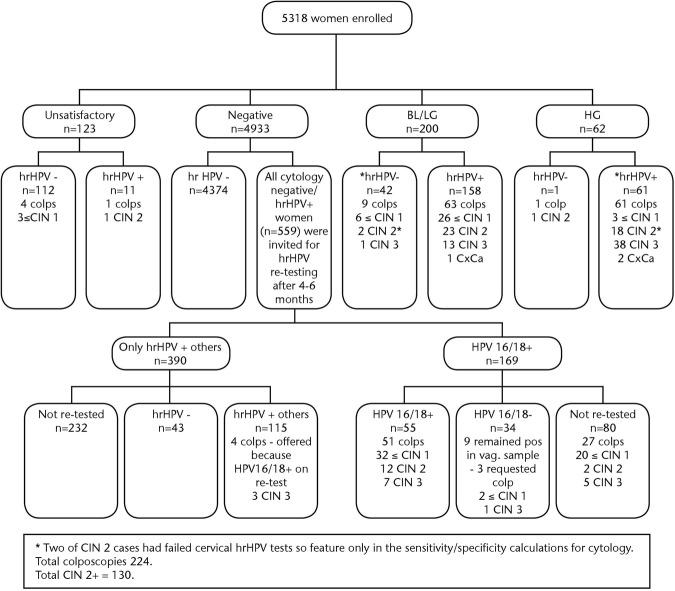
5318 women aged 20-60 years provided self-collected random urine and vaginal samples for hrHPV testing and a clinician-collected liquid-based cytology (LBC) sample for cytology and hrHPV testing.
INTERVENTIONS
HrHPV testing. All samples were tested for hrHPV using the PCR-based cobas 4800 assay. Colposcopy was offered to women with high-grade or repeated borderline/low-grade cytological abnormalities; also to those who were LBC negative but hrHPV 16/18 positive.
PRIMARY AND SECONDARY OUTCOME MEASURES
The self-tests' absolute sensitivity and specificity for CIN2+ were assessed on all biospecimens; also, their relative sensitivity and specificity compared with clinician-taken samples. Interlaboratory and intralaboratory performance of the hrHPV assay in self-collected samples was also established.
RESULTS
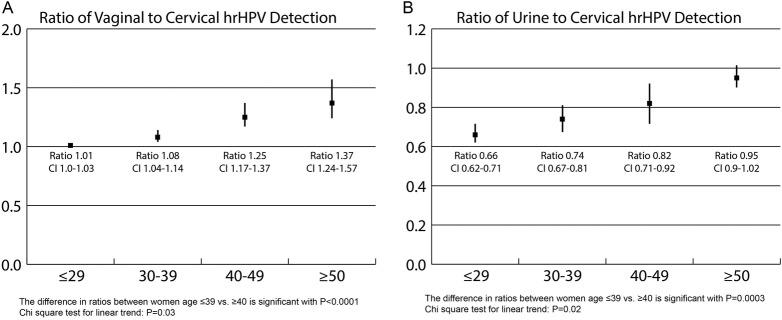
HrHPV prevalence was 14.7%, 16.6% and 11.6% in cervical, vaginal and urine samples, respectively. Sensitivity for detecting CIN2+ was 97.7% (95% to 100%), 94.6% (90.7% to 98.5%) and 63.1% (54.6% to 71.7%) for cervical, vaginal and urine hrHPV detection, respectively. The corresponding specificities were 87.3% (86.4% to 88.2%), 85.4% (84.4% to 86.3%) and 89.8% (89.0% to 90.7%). There was a 38% (24% to 57%) higher HPV detection rate in vaginal self-samples from women over 50 years compared with those ≤29 years. Relative sensitivity and specificity of hrHPV positivity for the detection of CIN2+ in vaginal versus cervical samples were 0.97 (0.94 to 1.00) and 0.98 (0.97 to 0.99); urine versus cervical comparisons were 0.53 (0.42 to 0.67) and 1.03 (1.02 to 1.04). The intralaboratory and interlaboratory agreement for hrHPV positivity in self-samples was high (κ values 0.98 (0.96 to 0.99) and 0.94 (0.92 to 0.97) for vaginal samples and 0.95 (0.93 to 0.98) and 0.90 (0.87 to 0.94) for urine samples).
CONCLUSIONS
The sensitivity of self-collected vaginal samples for the detection of CIN2+ was similar to that of cervical samples and justifies consideration of this sample for primary screening.
目的
邓弗里斯和加洛韦乳头瘤病毒(PaVDaG)评估了一种基于高危型人乳头瘤病毒(hrHPV)的聚合酶链反应(PCR)检测方法在检测自行采集的阴道和尿液样本中的高级别宫颈上皮内瘤变(CIN2+)方面的性能。
背景
在初级保健机构接受常规宫颈筛查的女性。
参与者
5318名年龄在20至60岁之间的女性提供了自行采集的随机尿液和阴道样本用于hrHPV检测,以及临床医生采集的液基细胞学(LBC)样本用于细胞学和hrHPV检测。
干预措施
hrHPV检测。所有样本均使用基于PCR的cobas 4800检测方法进行hrHPV检测。对于有高级别或反复出现的临界/低级别细胞学异常的女性,以及LBC检测为阴性但hrHPV 16/18阳性的女性,提供阴道镜检查。
主要和次要观察指标
评估所有生物样本中自行检测对CIN2+的绝对敏感性和特异性;还评估与临床医生采集的样本相比的相对敏感性和特异性。同时确定自行采集样本中hrHPV检测方法的实验室间和实验室内性能。
结果
宫颈、阴道和尿液样本中的hrHPV流行率分别为14.7%、16.6%和11.6%。宫颈、阴道和尿液hrHPV检测对CIN2+的检测敏感性分别为97.7%(95%至100%)、94.6%(90.7%至98.5%)和63.1%(54.6%至71.7%)。相应的特异性分别为87.3%(86.4%至88.2%)、85.4%(84.4%至86.3%)和89.8%(89.0%至90.7%)。50岁以上女性的阴道自行采集样本中的HPV检测率比≤29岁女性高38%(24%至57%)。阴道样本与宫颈样本中hrHPV阳性对CIN2+检测的相对敏感性和特异性分别为0.97(0.94至1.00)和0.98(0.97至0.99);尿液样本与宫颈样本的比较分别为0.53(0.42至0.67)和1.03(1.02至1.04)。自行采集样本中hrHPV阳性的实验室内和实验室间一致性较高(阴道样本的κ值为0.98(0.96至0.99)和0.94(0.92至0.97),尿液样本的κ值为0.95(0.93至0.98)和0.90(0.87至0.94))。
结论
自行采集的阴道样本对CIN2+的检测敏感性与宫颈样本相似,有理由考虑将该样本用于初筛。

 Zotero 插件