
[(68)Ga]NODAGA-RGD:来自肝细胞癌和肝硬化患者的代谢稳定性、生物分布及剂量学数据
[(68)Ga]NODAGA-RGD - Metabolic stability, biodistribution, and dosimetry data from patients with hepatocellular carcinoma and liver cirrhosis.
作者信息
Haubner Roland, Finkenstedt Armin, Stegmayr Armin, Rangger Christine, Decristoforo Clemens, Zoller Heinz, Virgolini Irene J
机构信息
Department of Nuclear Medicine, Medical University of Innsbruck, Anichstr. 35, 6020, Innsbruck, Austria.
Department of Internal Medicine II, Medical University of Innsbruck, Innsbruck, Austria.
出版信息
Eur J Nucl Med Mol Imaging. 2016 Oct;43(11):2005-13. doi: 10.1007/s00259-016-3396-3. Epub 2016 May 11.
PURPOSE
This study was designed to determine safety, tolerability, and radiation burden of a [(68)Ga]NODAGA-RGD-PET for imaging integrin αvβ3 expression in patients with hepatocellular carcinoma (HCC) and liver cirrhosis. Moreover, metabolic stability and biokinetic data were compiled.
METHODS
After injection of 154-184 MBq [(68)Ga]NODAGA-RGD three consecutive PET/CT scans were acquired starting 8.3 ± 2.1, 36.9 ± 2.8, and 75.1 ± 3.4 min after tracer injection. For metabolite analysis, blood and urine samples were analyzed by HPLC. For dosimetry studies, residence time VOIs were placed in the corresponding organs. The OLINDA/EXM program was used to estimate the absorbed radiation dose.
RESULTS
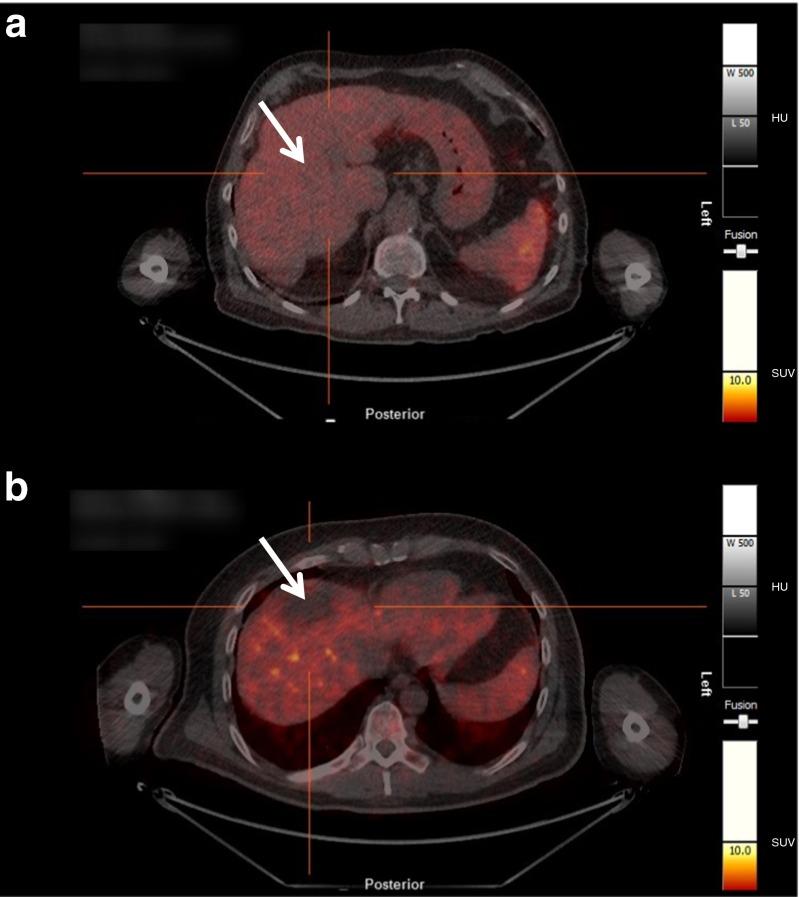
The radiopharmaceutical was well tolerated and no drug-related adverse effects were observed. No metabolites could be detected in blood (30 and 60 min p.i.) and urine (60 min p.i.). [(68)Ga]NODAGA-RGD showed rapid and predominantly renal elimination. Background radioactivity in blood, intestine, lung, and muscle tissue was low (%ID/l 60 min p.i. was 0.56 ± 0.43, 0.54 ± 0.39, 0.22 ± 0.05, and 0.16 ± 0.8, respectively). The calculated effective dose was 21.5 ± 5.4 μSv/MBq, and the highest absorbed radiation dose was found for the urinary bladder wall (0.26 ± 0.09 mSv/MBq). No increased uptake of the tracer was found in HCC compared with the background liver tissue.
CONCLUSIONS
[(68)Ga]NODAGA-RGD uptake in the HCCs lesions was not sufficient to use this tracer for imaging these tumors. [(68)Ga]NODAGA-RGD was well tolerated and metabolically stable. Due to rapid renal excretion, background radioactivity was low in most of the body, resulting in low radiation burden and indicating the potential of [(68)Ga]NODAGA-RGD PET for non-invasive determination of integrin αvβ3 expression.
目的
本研究旨在确定[(68)Ga]NODAGA-RGD-PET用于成像肝细胞癌(HCC)和肝硬化患者整合素αvβ3表达的安全性、耐受性和辐射负担。此外,还收集了代谢稳定性和生物动力学数据。
方法
注射154 - 184 MBq [(68)Ga]NODAGA-RGD后,在示踪剂注射后8.3±2.1、36.9±2.8和75.1±3.4分钟开始连续进行三次PET/CT扫描。为进行代谢物分析,通过高效液相色谱法分析血液和尿液样本。对于剂量学研究,在相应器官中放置停留时间感兴趣区(VOIs)。使用OLINDA/EXM程序估算吸收辐射剂量。
结果
该放射性药物耐受性良好,未观察到与药物相关的不良反应。在血液(注射后30和60分钟)和尿液(注射后60分钟)中未检测到代谢物。[(68)Ga]NODAGA-RGD显示出快速且主要经肾脏排泄。血液、肠道、肺部和肌肉组织中的本底放射性较低(注射后60分钟时的%ID/l分别为0.56±0.43、0.54±0.39、0.22±0.05和0.16±0.8)。计算得到的有效剂量为21.5±5.4 μSv/MBq,膀胱壁的吸收辐射剂量最高(0.26±... 0.09 mSv/MBq)。与背景肝组织相比,在HCC中未发现示踪剂摄取增加。
结论
[(68)Ga]NODAGA-RGD在HCC病变中的摄取不足以用于这些肿瘤的成像。[(68)Ga]NODAGA-RGD耐受性良好且代谢稳定。由于肾脏快速排泄,身体大部分部位的本底放射性较低,导致辐射负担较低,表明[(68)Ga]NODAGA-RGD PET在无创测定整合素αvβ3表达方面具有潜力。 (注:原文中“0.16±0.8”可能有误,推测应为“0.16±0.08”,译文按原文翻译)


 Zotero 插件