
利用单细胞数据对表型空间进行自动映射。
Automated mapping of phenotype space with single-cell data.
作者信息
Samusik Nikolay, Good Zinaida, Spitzer Matthew H, Davis Kara L, Nolan Garry P
机构信息
Department of Microbiology and Immunology, Stanford University School of Medicine, Stanford, California, USA.
Department of Pathology, Stanford University School of Medicine, Stanford, California, USA.
出版信息
Nat Methods. 2016 Jun;13(6):493-6. doi: 10.1038/nmeth.3863. Epub 2016 May 16.
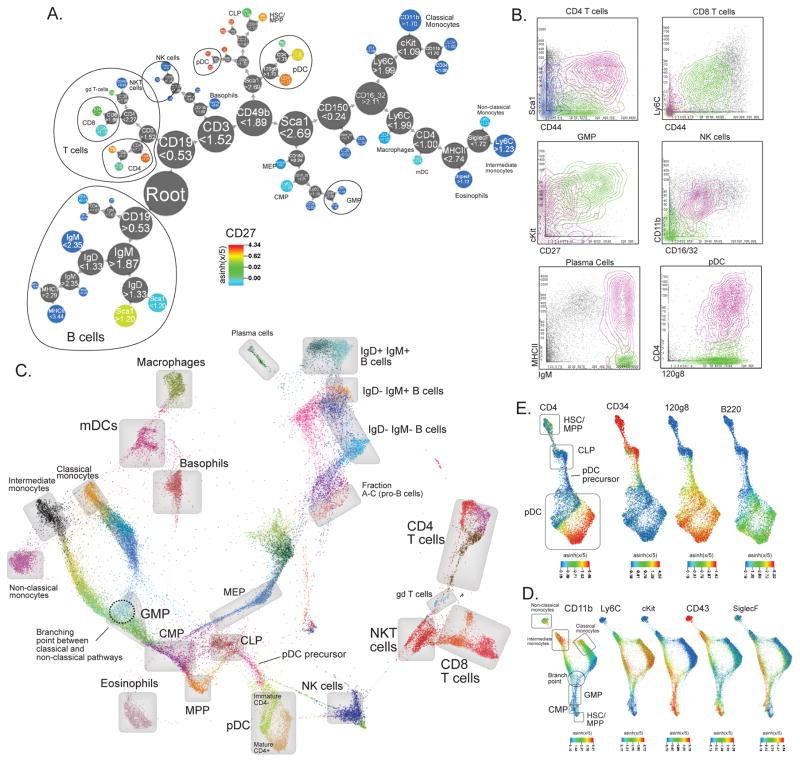
Accurate identification of cell subsets in complex populations is key to discovering novelty in multidimensional single-cell experiments. We present X-shift (http://web.stanford.edu/~samusik/vortex/), an algorithm that processes data sets using fast k-nearest-neighbor estimation of cell event density and arranges populations by marker-based classification. X-shift enables automated cell-subset clustering and access to biological insights that 'prior knowledge' might prevent the researcher from discovering.
在复杂群体中准确识别细胞亚群是在多维单细胞实验中发现新事物的关键。我们提出了X-shift(http://web.stanford.edu/~samusik/vortex/),这是一种算法,它使用细胞事件密度的快速k近邻估计来处理数据集,并通过基于标记的分类来排列群体。X-shift能够实现自动细胞亚群聚类,并获得“先验知识”可能会阻止研究人员发现的生物学见解。

 Zotero 插件