
阿尔茨海默病中的诱导多能干细胞:疾病建模与细胞替代疗法的应用
Induced pluripotent stem cells in Alzheimer's disease: applications for disease modeling and cell-replacement therapy.
作者信息
Yang Juan, Li Song, He Xi-Biao, Cheng Cheng, Le Weidong
机构信息
Key Laboratory of Stem Cell Biology, Institute of Health Sciences, Shanghai Institutes for Biological Sciences, Chinese Academy of Sciences/Shanghai Jiao Tong University School of Medicine, 200031, Shanghai, China.
Center for Translational Research on Neurological Diseases, the First Affiliated Hospital, Dalian Medical University, 116021, Dalian, China.
出版信息
Mol Neurodegener. 2016 May 17;11(1):39. doi: 10.1186/s13024-016-0106-3.
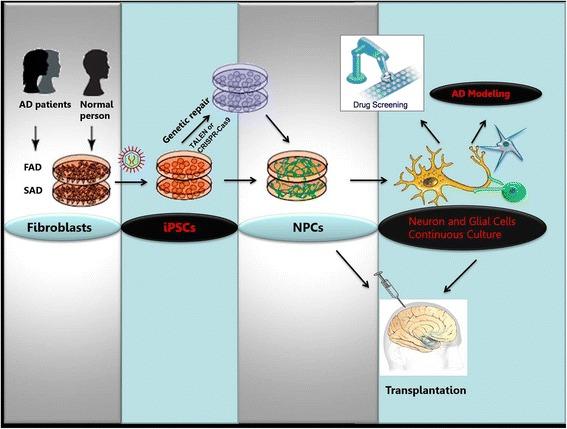
Alzheimer's disease (AD) is the most common cause of dementia in those over the age of 65. While a numerous of disease-causing genes and risk factors have been identified, the exact etiological mechanisms of AD are not yet completely understood, due to the inability to test theoretical hypotheses on non-postmortem and patient-specific research systems. The use of recently developed and optimized induced pluripotent stem cells (iPSCs) technology may provide a promising platform to create reliable models, not only for better understanding the etiopathological process of AD, but also for efficient anti-AD drugs screening. More importantly, human-sourced iPSCs may also provide a beneficial tool for cell-replacement therapy against AD. Although considerable progress has been achieved, a number of key challenges still require to be addressed in iPSCs research, including the identification of robust disease phenotypes in AD modeling and the clinical availabilities of iPSCs-based cell-replacement therapy in human. In this review, we highlight recent progresses of iPSCs research and discuss the translational challenges of AD patients-derived iPSCs in disease modeling and cell-replacement therapy.
阿尔茨海默病(AD)是65岁以上人群中痴呆症最常见的病因。虽然已经确定了许多致病基因和风险因素,但由于无法在非尸检和患者特异性研究系统上验证理论假设,AD的确切病因机制尚未完全明确。最近开发和优化的诱导多能干细胞(iPSC)技术的应用,可能为创建可靠模型提供一个有前景的平台,不仅有助于更好地理解AD的病因病理过程,还能用于高效的抗AD药物筛选。更重要的是,源自人类的iPSC也可能为针对AD的细胞替代疗法提供有益工具。尽管已取得了相当大的进展,但iPSC研究仍有一些关键挑战需要解决,包括在AD模型中识别可靠的疾病表型以及基于iPSC的细胞替代疗法在人体中的临床可用性。在本综述中,我们重点介绍了iPSC研究的最新进展,并讨论了源自AD患者的iPSC在疾病建模和细胞替代疗法中的转化挑战。
 Zotero 插件