
青蒿素联合疗法治疗单纯性恶性疟原虫疟疾后的配子体携带情况:个体患者数据的系统评价和荟萃分析
Gametocyte carriage in uncomplicated Plasmodium falciparum malaria following treatment with artemisinin combination therapy: a systematic review and meta-analysis of individual patient data.
出版信息
BMC Med. 2016 May 24;14:79. doi: 10.1186/s12916-016-0621-7.
BACKGROUND
Gametocytes are responsible for transmission of malaria from human to mosquito. Artemisinin combination therapy (ACT) reduces post-treatment gametocyte carriage, dependent upon host, parasite and pharmacodynamic factors. The gametocytocidal properties of antimalarial drugs are important for malaria elimination efforts. An individual patient clinical data meta-analysis was undertaken to identify the determinants of gametocyte carriage and the comparative effects of four ACTs: artemether-lumefantrine (AL), artesunate/amodiaquine (AS-AQ), artesunate/mefloquine (AS-MQ), and dihydroartemisinin-piperaquine (DP).
METHODS
Factors associated with gametocytaemia prior to, and following, ACT treatment were identified in multivariable logistic or Cox regression analysis with random effects. All relevant studies were identified through a systematic review of PubMed. Risk of bias was evaluated based on study design, methodology, and missing data.
RESULTS
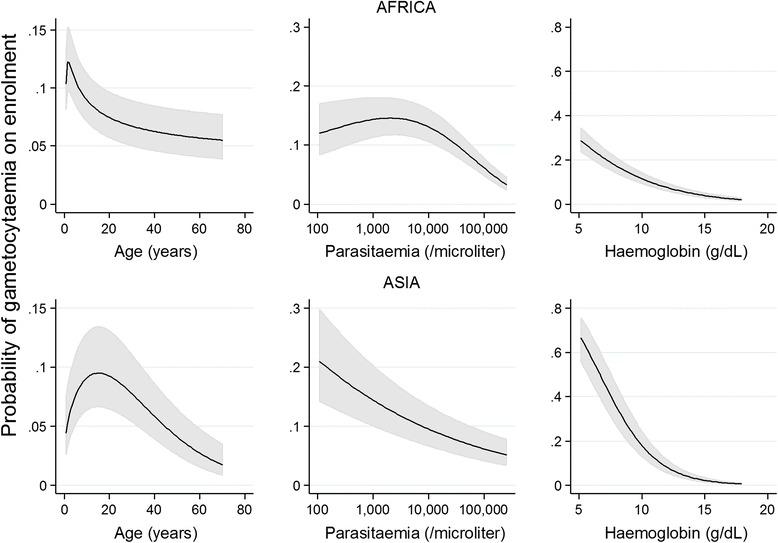
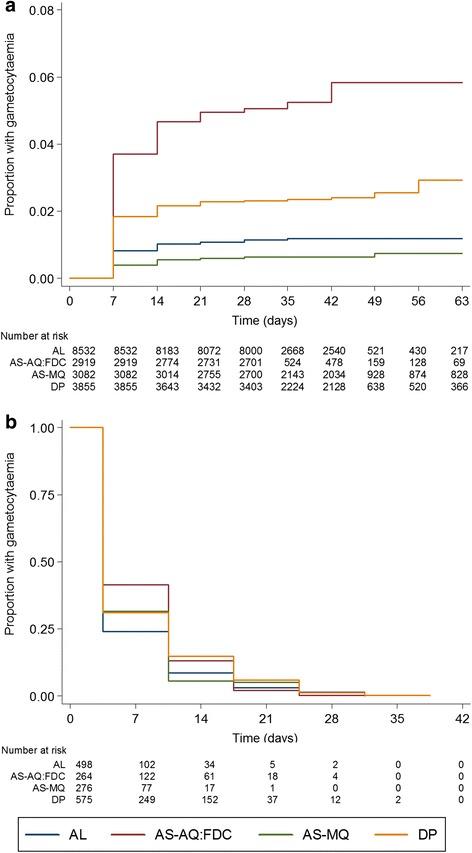
The systematic review identified 169 published and 9 unpublished studies, 126 of which were shared with the WorldWide Antimalarial Resistance Network (WWARN) and 121 trials including 48,840 patients were included in the analysis. Prevalence of gametocytaemia by microscopy at enrolment was 12.1 % (5887/48,589), and increased with decreasing age, decreasing asexual parasite density and decreasing haemoglobin concentration, and was higher in patients without fever at presentation. After ACT treatment, gametocytaemia appeared in 1.9 % (95 % CI, 1.7-2.1) of patients. The appearance of gametocytaemia was lowest after AS-MQ and AL and significantly higher after DP (adjusted hazard ratio (AHR), 2.03; 95 % CI, 1.24-3.12; P = 0.005 compared to AL) and AS-AQ fixed dose combination (FDC) (AHR, 4.01; 95 % CI, 2.40-6.72; P < 0.001 compared to AL). Among individuals who had gametocytaemia before treatment, gametocytaemia clearance was significantly faster with AS-MQ (AHR, 1.26; 95 % CI, 1.00-1.60; P = 0.054) and slower with DP (AHR, 0.74; 95 % CI, 0.63-0.88; P = 0.001) compared to AL. Both recrudescent (adjusted odds ratio (AOR), 9.05; 95 % CI, 3.74-21.90; P < 0.001) and new (AOR, 3.03; 95 % CI, 1.66-5.54; P < 0.001) infections with asexual-stage parasites were strongly associated with development of gametocytaemia after day 7.
CONCLUSIONS
AS-MQ and AL are more effective than DP and AS-AQ FDC in preventing gametocytaemia shortly after treatment, suggesting that the non-artemisinin partner drug or the timing of artemisinin dosing are important determinants of post-treatment gametocyte dynamics.
背景
配子体是疟疾从人传播至蚊子的媒介。青蒿素联合疗法(ACT)可降低治疗后配子体携带率,这取决于宿主、寄生虫和药效学因素。抗疟药物的杀配子体特性对疟疾消除工作很重要。开展了一项个体患者临床数据荟萃分析,以确定配子体携带的决定因素以及四种ACT(蒿甲醚-本芴醇(AL)、青蒿琥酯/阿莫地喹(AS-AQ)、青蒿琥酯/甲氟喹(AS-MQ)和双氢青蒿素-哌喹(DP))的比较效果。
方法
在多变量逻辑回归或随机效应Cox回归分析中确定ACT治疗前后与配子血症相关的因素。通过对PubMed的系统评价确定了所有相关研究。基于研究设计、方法和缺失数据评估偏倚风险。
结果
系统评价确定了169项已发表研究和9项未发表研究,其中126项与全球抗疟药物耐药性网络(WWARN)共享,分析纳入了121项试验,共48840例患者。入组时显微镜检查的配子血症患病率为12.1%(5887/48589),且随年龄降低、无性寄生虫密度降低和血红蛋白浓度降低而升高,在就诊时无发热的患者中更高。ACT治疗后,1.9%(95%CI,1.7-2.1)的患者出现配子血症。AS-MQ和AL治疗后配子血症的出现率最低,DP治疗后显著更高(调整后风险比(AHR),2.03;95%CI,1.24-3.12;与AL相比,P = 0.005),AS-AQ固定剂量复方(FDC)治疗后也更高(AHR,4.01;95%CI,2.40-6.72;与AL相比,P < 0.001)。在治疗前有配子血症的个体中,与AL相比,AS-MQ的配子血症清除明显更快(AHR,1.26;95%CI,1.00-1.60;P = 0.054),DP则较慢(AHR,0.74;95%CI,0.63-0.88;P = 0.001)。无性期寄生虫的复发感染(调整后比值比(AOR),9.05;95%CI,3.74-21.90;P < 0.001)和新感染(AOR,3.03;95%CI,1.66-5.54;P < 0.001)均与第7天后配子血症的发生密切相关。
结论
AS-MQ和AL在治疗后短期内预防配子血症方面比DP和AS-AQ FDC更有效,这表明非青蒿素联合药物或青蒿素给药时间是治疗后配子体动态变化的重要决定因素。


 Zotero 插件