
阻塞性睡眠呼吸暂停合并血脂异常对增加动脉粥样硬化性心血管疾病的患病率具有叠加效应。
Obstructive sleep apnea combined dyslipidemia render additive effect on increasing atherosclerotic cardiovascular diseases prevalence.
作者信息
Cao Zhiyong, Zhang Ping, He Zhiqing, Yang Jing, Liang Chun, Ren Yusheng, Wu Zonggui
机构信息
Shanghai Changzheng Hospital, Second Military Medical University, Shanghai, 200003, China.
Branch of No. 411 Hospital, PLA, Shanghai, 200003, China.
出版信息
Lipids Health Dis. 2016 May 26;15:98. doi: 10.1186/s12944-016-0267-7.
BACKGROUND
Current study was designed to investigate the effects of obstructive sleep apnea (OSA) combined dyslipidemia on the prevalence of atherosclerotic cardiovascular diseases (ASCVD).
METHODS
This was a cross-sectional study and subjects with documented dyslipidemia and without previous diagnosis of OSA were enrolled. Polysomnography was applied to evaluate apnea-hypopnea index (AHI). Based on AHI value, subjects were classified into four groups: without OSA, mild, moderate and severe OSA groups. Clinical characteristics and laboratory examination data were recorded. Relationship between AHI event and lipid profiles was analyzed, and logistic regression analysis was used to evaluate the effects of OSA combined dyslipidemia on ASCVD prevalence.
RESULTS
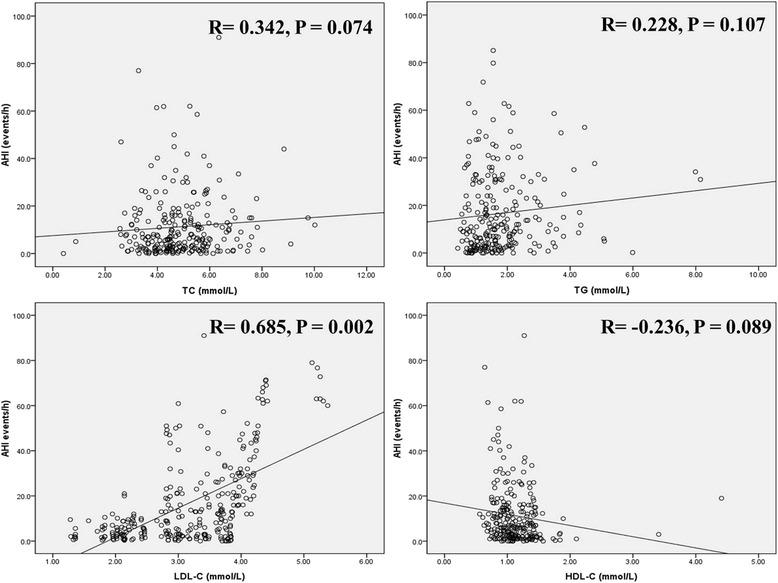
Totally 248 subjects with dyslipidemia were enrolled. Compared to the other 3 groups, subjects with severe OSA were older, male predominant and had higher smoking rate. In addition, subjects with severe OSA had higher body mass index, waist-hip ratio, blood pressure, and higher rates of overweight and obesity. Serum levels of fasting plasma glucose, glycated hemoglobin, LDL-C and CRP were all significantly higher. ASCVD prevalence was considerably higher in subjects with severe OSA. AHI event in the severe OSA group was up to 35.4 ± 5.1 events per hour which was significantly higher than the other groups (P < 0.05 for trend). Pearson correlation analysis showed that only LDL-C was positively correlated with AHI events (r = 0.685, P < 0.05). Logistic regression analysis revealed that in unadjusted model, compared to dyslipidemia plus no-OSA group (reference group), OSA enhanced ASCVD risk in subjects with dyslipidemia, regardless of OSA severity. After extensively adjusted for confounding variables, the odds of dyslipidemia plus mild-OSA was reduced to insignificance. While the effects of moderate- and severe-OSA on promoting ASCVD risk in subjects with dyslipidemia remained significant, with severe-OSA most prominent (odds ratio: 1.52, 95% confidence interval: 1.13-2.02).
CONCLUSION
OSA combined dyslipidemia conferred additive adverse effects on cardiovascular system, with severe-OSA most prominent.
背景
本研究旨在探讨阻塞性睡眠呼吸暂停(OSA)合并血脂异常对动脉粥样硬化性心血管疾病(ASCVD)患病率的影响。
方法
这是一项横断面研究,纳入有血脂异常记录且既往未诊断为OSA的受试者。应用多导睡眠图评估呼吸暂停低通气指数(AHI)。根据AHI值,将受试者分为四组:无OSA组、轻度OSA组、中度OSA组和重度OSA组。记录临床特征和实验室检查数据。分析AHI事件与血脂谱之间的关系,并采用逻辑回归分析评估OSA合并血脂异常对ASCVD患病率的影响。
结果
共纳入248例血脂异常患者。与其他三组相比,重度OSA患者年龄更大,以男性为主,吸烟率更高。此外,重度OSA患者的体重指数、腰臀比、血压更高,超重和肥胖率也更高。空腹血糖、糖化血红蛋白、低密度脂蛋白胆固醇(LDL-C)和C反应蛋白(CRP)的血清水平均显著升高。重度OSA患者的ASCVD患病率显著更高。重度OSA组的AHI事件高达每小时35.4±5.1次,显著高于其他组(趋势P<0.05)。Pearson相关分析显示,仅LDL-C与AHI事件呈正相关(r = 0.685,P<0.05)。逻辑回归分析显示,在未调整模型中,与血脂异常加无OSA组(参照组)相比,OSA增加了血脂异常患者的ASCVD风险,无论OSA严重程度如何。在对混杂变量进行广泛调整后,血脂异常加轻度OSA的比值降低至无统计学意义。而中度和重度OSA对血脂异常患者促进ASCVD风险的影响仍然显著,其中重度OSA最为突出(比值比:1.52,95%置信区间:1.13-2.02)。
结论
OSA合并血脂异常对心血管系统具有叠加的不良影响,其中重度OSA最为突出。
 Zotero 插件