
腰椎间盘突出症手术患者疼痛强度的病程:一项为期5年的纵向观察研究。
The Course of Pain Intensity in Patients Undergoing Herniated Disc Surgery: A 5-Year Longitudinal Observational Study.
作者信息
Dorow Marie, Löbner Margrit, Stein Janine, Pabst Alexander, Konnopka Alexander, Meisel Hans J, Günther Lutz, Meixensberger Jürgen, Stengler Katarina, König Hans-Helmut, Riedel-Heller Steffi G
机构信息
Institute of Social Medicine, Occupational Health and Public Health, University of Leipzig, Leipzig, Germany.
Department of Health Economics and Health Services Research, University Medical Center Hamburg-Eppendorf, Hamburg, Germany.
出版信息
PLoS One. 2016 May 31;11(5):e0156647. doi: 10.1371/journal.pone.0156647. eCollection 2016.
OBJECTIVES
The aims of this study are to answer the following questions (1) How does the pain intensity of lumbar and cervical disc surgery patients change within a postoperative time frame of 5 years? (2) Which sociodemographic, medical, work-related, and psychological factors are associated with postoperative pain in lumbar and cervical disc surgery patients?
METHODS
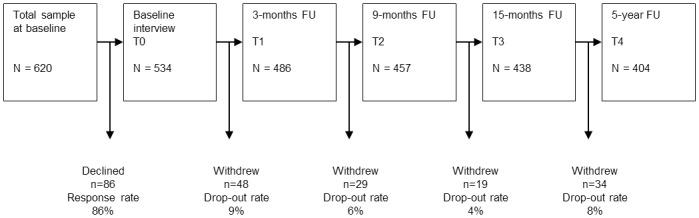
The baseline survey (T0; n = 534) was conducted 3.6 days (SD 2.48) post-surgery in the form of face-to-face interviews. The follow-up interviews were conducted 3 months (T1; n = 486 patients), 9 months (T2; n = 457), 15 months (T3; n = 438), and 5 years (T4; n = 404) post-surgery. Pain intensity was measured on a numeric rating-scale (NRS 0-100). Estimated changes to and influences on postoperative pain by random effects were accounted by regression models.
RESULTS
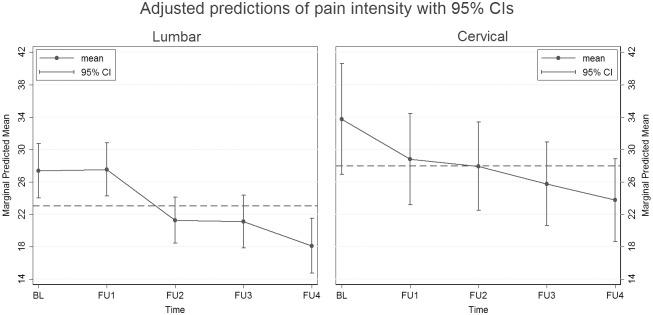
Average pain decreased continuously over time in patients with lumbar herniated disc (Wald Chi² = 25.97, p<0.001). In patients with cervical herniated disc a reduction of pain was observed, albeit not significant (Chi² = 7.02, p = 0.135). Two predictors were associated with postoperative pain in lumbar and cervical disc surgery patients: the subjective prognosis of gainful employment (p<0.001) and depression (p<0.001).
CONCLUSION
In the majority of disc surgery patients, a long-term reduction of pain was observed. Cervical surgery patients seemed to benefit less from surgery than the lumbar surgery patients. A negative subjective prognosis of gainful employment and stronger depressive symptoms were associated with postoperative pain. The findings may promote multimodal rehabilitation concepts including psychological and work-related support.
目的
本研究旨在回答以下问题:(1)腰椎和颈椎间盘手术患者的疼痛强度在术后5年的时间范围内如何变化?(2)哪些社会人口学、医学、工作相关和心理因素与腰椎和颈椎间盘手术患者的术后疼痛相关?
方法
以面对面访谈的形式在术后3.6天(标准差2.48)进行基线调查(T0;n = 534)。术后3个月(T1;n = 486例患者)、9个月(T2;n = 457)、15个月(T3;n = 438)和5年(T4;n = 404)进行随访访谈。疼痛强度采用数字评分量表(NRS 0 - 100)进行测量。通过回归模型考虑随机效应对术后疼痛的估计变化和影响。
结果
腰椎间盘突出症患者的平均疼痛随时间持续下降(Wald卡方 = 25.97,p<0.001)。颈椎间盘突出症患者的疼痛有所减轻,尽管不显著(卡方 = 7.02,p = 0.135)。有两个预测因素与腰椎和颈椎间盘手术患者的术后疼痛相关:有酬就业的主观预后(p<0.001)和抑郁(p<0.001)。
结论
在大多数椎间盘手术患者中,观察到疼痛长期减轻。颈椎手术患者似乎比腰椎手术患者从手术中获益更少。有酬就业的负面主观预后和更强的抑郁症状与术后疼痛相关。这些发现可能会促进包括心理和工作相关支持在内的多模式康复概念。
 Zotero 插件